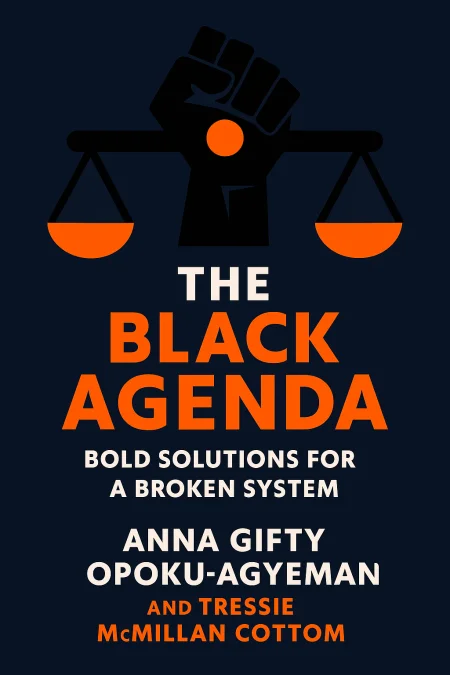
The Black Agenda
Bold Solutions for a Broken System
byTressie McMillan Cottom, Anna Gifty Opoku-Agyeman
Book Edition Details
Summary
In a powerful collection that redefines the conversation on racial justice, "The Black Agenda" orchestrates a symphony of voices from Black scholars and experts across critical fields like economics, technology, and healthcare. Edited by the visionary Anna Gifty Opoku-Agyeman, this groundbreaking anthology challenges entrenched ideas and inspires action, offering profound insights into crafting an equitable future. From the legacy of systemic racism unveiled by the pandemic to the pressing need for reparations and AI fairness, these essays provoke thought and ignite dialogue. Engage with pioneering thinkers like Dr. Sandy Darity and Janelle Jones, whose transformative perspectives promise to not just heal Black America, but foster progress nationwide.
Introduction
The persistence of racial disparities across American society reveals a fundamental flaw in how policy solutions are conceived, debated, and implemented. While mainstream discourse often approaches racial inequality as a series of isolated problems requiring technical fixes, the reality demands a more comprehensive understanding of how systemic barriers operate across multiple domains simultaneously. The expertise of Black scholars, practitioners, and advocates offers a unique lens through which to examine these interconnected challenges, drawing from both lived experience and rigorous analysis to propose transformative solutions. This collection of expert perspectives challenges the conventional wisdom that incremental reforms can address centuries of structural exclusion. Instead, it presents a framework for understanding racial inequality as a systemic phenomenon requiring bold, coordinated interventions across climate policy, healthcare, education, technology, and economic systems. The contributors demonstrate how centering Black expertise leads to more accurate diagnoses of societal problems and more effective policy prescriptions that benefit all Americans, not just marginalized communities. The analytical approach employed here moves beyond surface-level symptoms to examine root causes, revealing how seemingly race-neutral policies often perpetuate existing hierarchies. Through this lens, readers will encounter evidence-based arguments that reframe familiar debates and illuminate pathways toward genuine equity and justice.
Centering Black Expertise in Policy Solutions
The systematic exclusion of Black voices from policy-making processes has produced a cascade of failures that undermine the effectiveness of American institutions. From environmental regulations that ignore disproportionate impacts on communities of color to healthcare systems that perpetuate deadly disparities, the absence of Black expertise in decision-making roles creates blind spots that harm both targeted communities and broader societal outcomes. Black experts bring indispensable perspectives to policy challenges precisely because they understand how systems operate from the vantage point of those most harmed by institutional failures. This positioning enables them to identify problems that remain invisible to those who benefit from existing arrangements and to propose solutions that address root causes rather than symptoms. The weathering effects of discrimination, the intergenerational trauma of exclusion, and the daily navigation of hostile institutions provide crucial insights that cannot be replicated through academic study alone. The evidence supporting this approach extends beyond moral arguments to demonstrate practical benefits. Research consistently shows that diverse perspectives improve decision-making quality, enhance problem-solving capabilities, and increase the likelihood of identifying unintended consequences. When Black women lead maternal health initiatives, outcomes improve for all mothers. When Black economists analyze labor market policies, they uncover dynamics that traditional models miss. When Black technologists design algorithms, they anticipate bias patterns that homogeneous teams overlook. The structural barriers preventing Black expertise from reaching decision-making positions reflect deliberate choices rather than natural market outcomes. Professional networks, educational gatekeeping, hiring practices, and promotion systems all operate to maintain existing hierarchies while creating the appearance of merit-based selection. Dismantling these barriers requires recognizing that current arrangements systematically waste human capital and produce suboptimal outcomes across multiple domains.
Structural Racism Across Critical Sectors
The architecture of American institutions embeds racial hierarchy through seemingly neutral policies and procedures that consistently produce disparate outcomes. This systematic pattern appears across sectors as diverse as climate policy, healthcare delivery, educational opportunity, criminal justice, and economic mobility, suggesting coordination rather than coincidence in how exclusion operates. Understanding these interconnections reveals why piecemeal reforms consistently fail to eliminate racial disparities despite decades of civil rights legislation. Environmental racism illustrates how structural forces compound to create deadly consequences for Black communities. Industrial facilities cluster in neighborhoods with high concentrations of residents of color, creating toxic exposure patterns that persist across generations. Climate change amplifies existing vulnerabilities, as communities lacking political power face greater risks from extreme weather events while having fewer resources for recovery. These patterns reflect historical redlining policies, discriminatory zoning decisions, and regulatory frameworks that treat certain populations as expendable. Healthcare disparities demonstrate similar structural dynamics, with Black patients receiving lower quality care even when controlling for insurance status, income, and education levels. Medical schools systematically underreproduce Black physicians, while research protocols exclude Black participants and clinical guidelines ignore physiological differences across racial groups. The COVID-19 pandemic revealed how these accumulated disadvantages translate into life-and-death consequences when crises expose the fragility of safety nets designed to exclude rather than protect. Educational institutions perpetuate inequality through funding formulas that reward wealth concentration, disciplinary policies that criminalize normal childhood behavior for Black students, and curriculum choices that erase Black intellectual contributions. These patterns begin in early childhood and intensify through higher education, creating cascading effects that limit economic mobility and professional opportunity. The apparent objectivity of standardized testing and merit-based admissions conceals how these systems advantage students who have benefited from centuries of accumulated privilege.
Evidence-Based Interventions and Frameworks
Effective solutions to systemic racism require theoretical frameworks sophisticated enough to capture how multiple forms of oppression interact while remaining practical enough to guide policy implementation. Critical race theory provides analytical tools for understanding how law and policy create and maintain racial hierarchies, while intersectionality reveals how individuals experience multiple, overlapping forms of discrimination that cannot be addressed through single-issue approaches. Public health critical race praxis offers a model for applying these insights to concrete policy challenges. This framework explicitly acknowledges how racism operates as a fundamental cause of health disparities, guides practitioners to center affected communities in solution development, and requires continuous reflection on how interventions might inadvertently perpetuate existing inequalities. The approach has proven successful in addressing maternal mortality, environmental health hazards, and pandemic response strategies. Stratification economics provides another powerful analytical tool, explaining how group-based inequalities persist because they serve the material interests of dominant groups rather than representing market failures or cultural deficits. This perspective predicts that racial disparities will endure until policies actively disrupt the mechanisms through which advantage reproduces itself across generations. The framework guides policy makers toward interventions that address power imbalances rather than individual behaviors. These theoretical insights translate into specific policy recommendations across multiple domains. Investment in historically Black colleges and universities enhances educational opportunity while building institutional capacity in underserved communities. Reparations programs address wealth disparities that cannot be eliminated through race-neutral policies. Community-controlled development initiatives build local ownership rather than displacing existing residents through gentrification processes.
Transformative Vision for Racial Justice
The ultimate goal extends beyond eliminating racial disparities to creating systems that actively promote human flourishing for all people while acknowledging the particular harms inflicted on communities that have faced systematic exclusion. This vision requires moving from defensive strategies focused on preventing discrimination toward proactive approaches that restructure institutions around principles of equity and justice. Economic transformation represents a central component of this agenda, encompassing everything from federal job guarantees that provide meaningful employment at living wages to public banking systems that eliminate predatory lending practices. These universal programs would disproportionately benefit Black communities while avoiding the political vulnerabilities associated with explicitly racial policies. The approach recognizes that transformative change requires building coalitions across racial lines while maintaining focus on communities that have experienced the greatest harm. Democratic participation emerges as both means and end in this transformative vision. Expanding voting access, eliminating voter suppression tactics, and restructuring representation systems would increase Black political power while strengthening democratic institutions for all Americans. The connection between racial exclusion and democratic deficit reveals how advancing racial justice serves broader civic health rather than representing narrow group interest. The international dimension of this vision recognizes connections between domestic racial oppression and global systems of exploitation that maintain inequality across national boundaries. Climate justice initiatives that center frontline communities, fair trade policies that support economic development in the Global South, and immigration reforms that acknowledge how American foreign policy creates refugee populations all reflect this expanded understanding of justice.
Summary
The comprehensive analysis presented through these Black expert voices reveals that racial inequality represents a systemic phenomenon requiring coordinated, transformative interventions rather than incremental reforms targeting isolated problems. The evidence demonstrates that centering Black expertise leads to more accurate problem diagnosis, more effective solution design, and better outcomes for all Americans rather than narrow group benefits. This approach challenges readers to move beyond defensive thinking focused on preventing discrimination toward proactive strategies that restructure institutions around principles of equity and justice. The work offers essential reading for anyone seeking to understand how systemic change occurs and why authentic expertise from affected communities proves indispensable for creating lasting solutions to complex social challenges.
Related Books
Download PDF & EPUB
To save this Black List summary for later, download the free PDF and EPUB. You can print it out, or read offline at your convenience.
By Tressie McMillan Cottom
