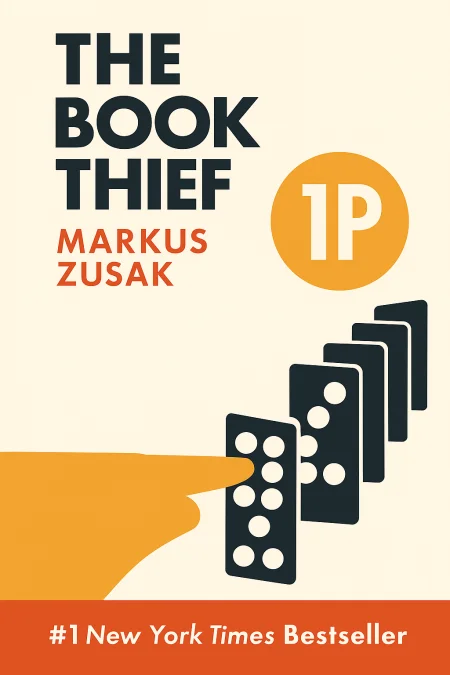
The Book Thief
A Historical Novel about Love, Loss and Resilience in Nazi Germany
Book Edition Details
Summary
A chill grips the air of 1939 Germany, where a young girl named Liesel stands at the precipice of transformation. Her fingers clasp onto a forgotten book, "The Gravedigger's Handbook," nestled in the snow—a forbidden treasure sparking an insatiable hunger for words. Under the shadow of the swastika, Liesel finds refuge and rebellion within the pages of stolen tomes, guided by her accordion-playing foster father. As Nazi flames threaten to consume the written word, her acts of literary larceny grow bolder. When her foster family shelters a Jewish man in their basement, Liesel’s secret world of books becomes a sanctuary and a battleground. Narrated by Death, Markus Zusak’s "The Book Thief" weaves a poignant tapestry of resilience and the transformative power of stories amidst humanity’s darkest hour.
Introduction
In the flickering candlelight of a basement during World War II, a young girl traces her finger across the pages of a stolen book, sounding out each word with painstaking care. Above her, the world burns with hatred and violence, but in this hidden sanctuary, something extraordinary unfolds—the transformation of a frightened child into a keeper of stories, a guardian of humanity's most precious gift: the power of words to heal, connect, and inspire hope even in the darkest times. This remarkable journey reveals how literature becomes more than entertainment when everything else fails. In an era when books are burned and voices silenced, we witness the profound courage required to choose compassion over cruelty, understanding over ignorance, and love over fear. Through the eyes of those who risk everything to preserve stories and protect the vulnerable, we discover that the most powerful resistance against dehumanization lies not in grand gestures, but in the quiet determination to maintain our capacity for empathy and connection. The lessons embedded in this wartime tale speak directly to our contemporary struggles with division, hatred, and the erosion of civil discourse. They remind us that in every generation, ordinary people face extraordinary choices about whether to stand by silently or act with courage, whether to spread fear or foster understanding, and whether to use words as weapons of destruction or instruments of healing and hope.
Death's Gentle Narration: Finding Beauty Amid War's Brutality
Death walks through bombed-out streets collecting souls, overwhelmed by the sheer volume of human destruction surrounding him. Yet this unlikely narrator finds himself captivated not by the violence, but by unexpected moments of tenderness that shine like stars against the darkness. He watches a foster father teach his daughter to read by lamplight, observes neighbors sharing their last crusts of bread, and witnesses the extraordinary power of stories to comfort terrified children huddled in air raid shelters. In the basement of a modest home on Himmel Street, Death discovers something that both puzzles and moves him—a young girl who steals books not for their material value, but for the worlds they contain. He sees her reading aloud to others during bombing raids, her voice cutting through fear like a beacon of hope. When she traces letters painted on basement walls with sandpaper, learning to transform mysterious symbols into meaning, Death recognizes something profound about humanity's refusal to surrender its capacity for growth and wonder, even in the face of overwhelming darkness. The narrator's gentle perspective transforms our understanding of what it means to survive in impossible circumstances. Through Death's eyes, we see that the most remarkable human quality is not our ability to endure suffering, but our determination to create beauty, meaning, and connection despite it. His observations reveal that even in humanity's darkest hour, there exists an unbreakable thread of dignity that manifests in the simple choice to care for others, to preserve stories, and to believe that love can triumph over hatred.
Stolen Books, Sacred Lessons: Liesel's Journey from Illiteracy to Storytelling
Nine-year-old Liesel arrives at her new home clutching a book she cannot read—The Gravedigger's Handbook, stolen from the snow beside her brother's grave. This charred volume represents her last connection to a shattered past, yet it becomes the key to an extraordinary future. Her foster father Hans discovers her secret and begins the patient work of teaching her to read, using paint and sandpaper to write letters on basement walls, transforming a cold underground space into a classroom of infinite possibility. Each stolen book marks a milestone in Liesel's transformation from victim to victor. When she rescues The Shoulder Shrug from the flames of a Nazi book burning, hiding it beneath her shirt as it burns against her ribs, she performs an act of quiet rebellion that reverberates far beyond the moment. In the mayor's wife's library, surrounded by thousands of volumes, she discovers that books are not merely objects but doorways to other worlds, other possibilities, other ways of understanding what it means to be human. The mayor's wife, Ilsa Hermann, recognizes a kindred spirit in this hungry young reader. Grieving the loss of her own son, she finds purpose in sharing her treasure trove of books with someone who truly hungers for stories. Their wordless understanding creates a bridge between two souls separated by class and circumstance but united by their recognition of literature's power to heal wounds that medicine cannot touch. Liesel's evolution from book thief to storyteller represents the ultimate triumph over those who would silence voices and burn ideas. In the same basement where she learned to read, she begins writing her own story, documenting the extraordinary ordinary people who taught her that words can be weapons of hope, instruments of resistance, and bridges of understanding that connect hearts across the vast distances created by fear and hatred.
Hidden Sanctuary: Love and Resistance in the Hubermann Basement
When Max Vandenberg appears at the Hubermanns' door in the middle of the night, he carries with him a copy of Mein Kampf—hollowed out to hide a key and a map. This Jewish refugee's survival depends entirely on the kindness of Hans Hubermann, who honors a decades-old promise to Max's father without hesitation, despite knowing that harboring a Jew means certain death for his entire family if discovered. The basement that once served as Liesel's classroom transforms into a sanctuary where humanity triumphs over hatred through daily acts of courage and compassion. Rosa Hubermann, typically sharp-tongued and demanding, reveals unexpected depths of tenderness as she quietly divides their meager food to include Max, never complaining about the additional burden their dangerous secret creates. Hans continues his accordion lessons with Liesel while Max hides below, the music serving as both cover for whispered conversations and a reminder that beauty can flourish even in the most perilous circumstances. Their home becomes a masterpiece of careful choreography, where every routine is designed to protect their hidden guest while maintaining the facade of normalcy. In the basement's dim light, an extraordinary friendship blooms between Liesel and Max. He creates handmade books for her, painting over pages of Hitler's manifesto to transform words of hatred into stories of hope and connection. The Standover Man and The Word Shaker become treasures more valuable than any published literature because they are born from genuine understanding between two souls who recognize each other's fundamental worth despite what the world says about their differences. Their acts of resistance prove that heroism often takes the form of simple human decency maintained at great personal risk. The Hubermanns demonstrate that ordinary people can perform extraordinary acts of moral courage not through dramatic confrontations with evil, but through the steady practice of treating others with dignity, sharing what little they have, and refusing to let fear extinguish their capacity for love and compassion.
Words as Lifelines: How Stories Heal When Everything Else Fails
In the crowded basement that serves as an air raid shelter, terror fills the space as bombs fall overhead and families huddle together waiting for death. Children cry, adults struggle to breathe, and panic threatens to overwhelm everyone until one clear voice cuts through the chaos. Liesel begins reading aloud from one of her rescued books, and gradually the fear subsides. Her words transport the frightened neighbors away from their immediate danger into a story that reminds them of their shared humanity and their capacity to endure. The power of storytelling reveals itself most profoundly in Max's recovery from a devastating illness. When fever and despair threaten to claim him, Liesel sits beside his bed day after day, reading aloud from her growing collection of books. Her voice becomes medicine more powerful than any doctor could prescribe, pulling him back from the brink through the simple act of sharing stories that affirm life's beauty and meaning even in the darkest circumstances. Words serve as both weapons and salvation throughout their community. While Hitler's speeches spread hatred and justify unspeakable cruelties, while propaganda transforms neighbors into enemies, Liesel's stolen books create pockets of resistance against the machinery of dehumanization. Each rescued volume represents a small victory against those who would control what people think and feel, each reading session becomes an act of defiance against forces that seek to reduce human beings to statistics and stereotypes. The ultimate triumph of words over violence occurs when Liesel survives the bombing that destroys her entire neighborhood precisely because she was in the basement writing her own story. Her survival allows her to carry forward the tales of those she loved, ensuring that their humanity is not forgotten. The book she creates in that underground sanctuary becomes a testament to literature's power to preserve what matters most about human experience—our capacity for love, growth, and connection that transcends even death itself.
Summary
Through one remarkable girl's journey from abandonment to belonging, we discover that the most powerful weapons against hatred and dehumanization are not armies or politics, but words, stories, and the courage to extend our humanity to others even when doing so requires tremendous risk. In the darkest chapter of human history, ordinary people find extraordinary ways to preserve their capacity for love and compassion, proving that literature and human connection can survive even the most determined efforts to extinguish them. The book thief's transformation teaches us that reading and storytelling are not mere entertainment but essential acts of resistance against forces that would reduce us to our worst impulses. When we choose to share stories that affirm rather than diminish human dignity, when we risk safety to show compassion, when we use words to build bridges rather than walls, we participate in the same quiet revolution that sustained these unforgettable characters. In our own times of division and uncertainty, their example reminds us that heroism is available to everyone through the simple choice to act with kindness when cruelty would be easier, to speak truth when silence would be safer, and to believe that our shared stories can guide us toward a more compassionate future.
Related Books
Download PDF & EPUB
To save this Black List summary for later, download the free PDF and EPUB. You can print it out, or read offline at your convenience.
By Markus Zusak
