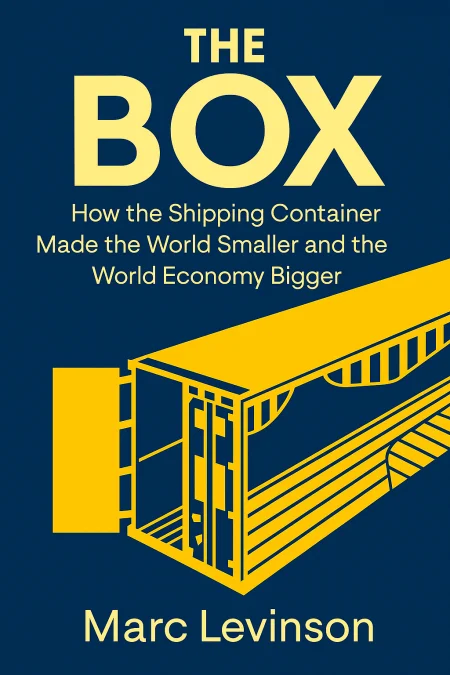
The Box
How the Shipping Container Made the World Smaller and the World Economy Bigger
Book Edition Details
Summary
In the bustling harbors of 1956, an unassuming oil tanker embarked on a voyage that would reshape the world. "The Box" chronicles the extraordinary transformation of shipping containers from overlooked metal boxes to the linchpins of global commerce. At its heart lies the relentless drive of Malcom McLean, the visionary entrepreneur whose audacious dreams bulldozed through barriers of skepticism and labor resistance, orchestrating a revolution in trade. This engrossing narrative unveils the seismic shifts in economic geography, as containerization slashed shipping costs, opening a floodgate of international trade that redefined industries and consumer landscapes. With unparalleled insight, Marc Levinson peels back the layers of this industrial epic, revealing how a simple idea sparked an era of globalization, turning once-sleepy ports into bustling hubs and forever altering the way goods traverse our planet.
Introduction
On a spring morning in 1956, fifty-eight aluminum boxes were loaded onto a converted tanker in Newark, New Jersey, marking the beginning of one of history's most profound economic transformations. This seemingly mundane event would ultimately reshape global manufacturing, alter the fortunes of entire cities, and create the interconnected world economy we know today. The story of containerization reveals how a simple technological innovation can unleash forces far beyond its creators' imagination, transforming not just how goods move across oceans, but where they are made and who makes them. This transformation raises fundamental questions about technological change and economic development that remain relevant today. How does a metal box become the catalyst for globalization? Why do some innovations succeed while others fail? What happens to workers and communities when revolutionary technology disrupts established industries? The container's journey from experimental concept to global standard offers crucial insights into the hidden forces that shape our interconnected world, making it essential reading for business leaders navigating technological disruption, policymakers grappling with economic change, and anyone curious about how transportation innovations can reshape entire civilizations.
From Innovation to Resistance: Birth and Early Battles (1950s-1960s)
The 1950s shipping industry was a world of staggering inefficiency and backbreaking labor. Cargo moved piece by piece, with armies of longshoremen wrestling thousands of individual crates, bags, and boxes into ship holds through cramped transit sheds. Ships spent more time in port than at sea, while handling costs consumed up to seventy-five percent of total shipping expenses. Into this antiquated world stepped Malcolm McLean, a North Carolina trucker with no maritime experience but an obsessive focus on cutting costs. McLean's breakthrough came from recognizing that the shipping industry's real business wasn't operating vessels, but moving freight. This insight led him to a radical concept: instead of loading thousands of individual items, why not put everything into large standardized boxes and move only the boxes? In 1956, his converted tanker Ideal-X demonstrated the concept's potential, completing its journey from Newark to Houston with loading costs of just 15.8 cents per ton compared to $5.83 for conventional cargo handling. The early container pioneers faced fierce resistance from an industry steeped in tradition. Maritime executives dismissed containers as suitable only for niche markets, never imagining they would revolutionize international trade. More significantly, dock workers recognized that containerization threatened their livelihoods, leading to bitter labor battles on both coasts. The International Longshoremen's Association fought desperately to preserve jobs that had sustained waterfront communities for generations. The resolution came through painful negotiations that established a crucial principle: workers displaced by technological progress deserved compensation, not just dismissal. The West Coast's Mechanization and Modernization Agreement and similar East Coast deals traded job security for guaranteed wages and early retirement benefits. These agreements proved essential for gaining worker acceptance of containerization, demonstrating that sustainable technological change requires social accommodation alongside technical innovation.
Breaking Barriers: Standardization and Labor Transformation (1960s-1970s)
The 1960s brought containerization's greatest challenge: achieving technical standardization while navigating complex international politics. Without common standards, each shipping line's containers remained incompatible with competitors' equipment, severely limiting the system's efficiency. The standardization battles revealed how seemingly technical decisions could determine corporate winners and losers, as companies fought to protect existing investments while regulators pushed for uniformity. Sea-Land and Matson had invested heavily in non-standard container sizes that worked well for their specific routes. When government pressure mounted to adopt universal dimensions, these pioneers faced a stark choice: write off millions in equipment or forfeit access to subsidies and government cargo. The eventual compromise satisfied no one completely but created the foundation for global container interchange, enabling the seamless movement of goods across different transportation modes and national borders. The Vietnam War provided an unexpected catalyst for container adoption, as military logistics demands overwhelmed traditional shipping methods. Container ships proved their worth moving supplies across the Pacific, while the war's end released shipping capacity for commercial use. This period demonstrated how external shocks could accelerate technological adoption, pushing reluctant industries toward innovations they might otherwise resist. Labor agreements reached during this decade established precedents that would influence technological transitions for generations. The principle that automation's benefits should be shared with displaced workers became embedded in industrial relations, creating a model for managing disruptive change. By the early 1970s, containerization had achieved critical mass, with major trade routes served by purpose-built vessels and ports investing billions in specialized facilities. The foundation was laid for the global supply chains that would define the following decades.
Global Expansion: Reshaping Trade Geography and Manufacturing (1970s-1990s)
The 1970s marked containerization's transformation from shipping innovation to economic force, as standardized boxes began reshaping global trade patterns and industrial geography. The oil crises initially threatened the container revolution, as soaring fuel costs made long-distance shipping expensive. However, containers' efficiency advantages proved so compelling that the technology continued spreading even as overall trade growth slowed, demonstrating the innovation's fundamental value proposition. This period witnessed the rise of new shipping powers and the decline of traditional maritime nations. Aggressive newcomers like Evergreen Marine and Maersk Line built larger, faster ships and offered global services that established carriers couldn't match. The result was a fundamental restructuring of the shipping industry, with many historic names disappearing while new giants emerged from countries that had previously played minor roles in international shipping. Containerization's impact extended far beyond maritime transport to transform manufacturing itself. The technology enabled companies to disaggregate production processes, locating each stage wherever costs were lowest while maintaining reliable supply chains. This "disintegration of production" created the global manufacturing networks that would define modern industry, allowing a single product to incorporate materials and components from dozens of countries. Port cities experienced dramatic transformations as containerization concentrated cargo handling in fewer, larger facilities. Traditional waterfront neighborhoods lost their maritime character as container terminals required vast automated spaces rather than dense urban docks. Cities like New York saw their ports migrate to New Jersey, while new container hubs emerged in previously minor locations. By the 1990s, the geography of global trade had been fundamentally redrawn, with efficiency rather than tradition determining where ships would call and cargo would flow.
Modern Supply Chains: Integration and Contemporary Challenges (1990s-Present)
The final decades of the twentieth century saw containerization mature into the backbone of global commerce, enabling the just-in-time manufacturing systems that define the modern economy. Companies like Walmart and Toyota pioneered new approaches to inventory management, using containers to move goods precisely when and where needed rather than stockpiling materials and finished products. This transformation made possible the consumer economy's remarkable variety and affordability. The rise of Asian manufacturing, particularly in China, created unprecedented container flows that strained port capacity worldwide. Shipping lines responded by building ever-larger vessels, with modern container ships capable of carrying over twenty thousand boxes. These giants achieved remarkable economies of scale but also created new vulnerabilities, as their size limited port accessibility and their breakdown could disrupt global supply chains. Recent decades have brought new challenges that test containerization's resilience. Security concerns following terrorist attacks led to extensive cargo screening requirements, while environmental pressures forced the industry to address emissions from ships and trucks. The 2008 financial crisis revealed how dependent global trade had become on container shipping, as economic disruption quickly translated into empty ships and idle ports. The container revolution has also highlighted questions of economic inequality and environmental sustainability. While the technology enabled remarkable cost reductions and consumer choice, it also facilitated the shift of manufacturing jobs from developed to developing countries and contributed to the decline of traditional industrial communities. The challenge for the future lies in harnessing containerization's efficiency while addressing its social and environmental costs, ensuring that the benefits of global trade are more widely shared and sustainably achieved.
Summary
The container revolution demonstrates how seemingly simple technological innovations can fundamentally reshape economic and social relationships on a global scale. What began as a practical solution to port inefficiency evolved into the foundation of modern international trade, enabling the complex supply chains that deliver everything from smartphones to automobiles. This transformation reveals the profound interconnectedness of technological, economic, and social change, showing how a standardized metal box could alter the fate of cities, workers, and entire nations. The history offers crucial lessons for understanding contemporary challenges and managing technological disruption in our own era. First, successful innovation requires more than technical superiority—it demands social accommodation, institutional adaptation, and the wisdom to share the costs and benefits of change. Second, the most profound transformations often emerge from mundane improvements rather than dramatic breakthroughs, suggesting we should pay attention to seemingly minor innovations that could reshape our world. Finally, the benefits of technological progress are rarely distributed equally, creating both opportunities and obligations to protect those displaced by change. As artificial intelligence, automation, and other technologies promise to transform work and society, we can learn from both the successes and failures of containerization. The key lies in anticipating change rather than merely reacting to it, investing in the infrastructure and institutions needed to harness innovation's benefits while protecting vulnerable communities. Understanding how the humble shipping container transformed the world economy provides essential perspective for navigating the technological disruptions that lie ahead, reminding us that the future belongs to those who can adapt to change while preserving human dignity and social cohesion.
Related Books
Download PDF & EPUB
To save this Black List summary for later, download the free PDF and EPUB. You can print it out, or read offline at your convenience.
By Marc Levinson
