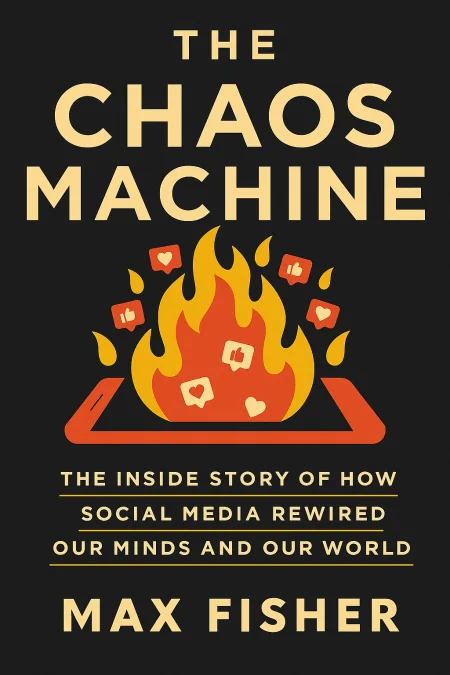
The Chaos Machine
The Inside Story of How Social Media Rewired Our Minds and Our World
Book Edition Details
Summary
In the frenetic world of social media, Max Fisher exposes a digital saga of manipulation and consequence. The Chaos Machine unveils the disturbing secrets behind Facebook, Twitter, and YouTube, revealing how their relentless pursuit of profit has rewired our global psyche. Fisher, an intrepid New York Times reporter, chronicles the insidious algorithms that prey on human vulnerability, steering users toward extremism and division. As the virtual chaos spills into real-world turmoil, from global unrest to the Capitol Insurrection, Fisher captures the explosive impact on democracies and minds alike. Yet amid this darkness, he introduces us to the unsung heroes—the whistleblowers and defectors—who dared to challenge the tech behemoths. This is not just a narrative of downfall, but a clarion call to reclaim our fractured world before it's irreversibly altered.
Introduction
Social media platforms promised to democratize information and connect humanity, yet they have fundamentally transformed into sophisticated systems that exploit human psychology for profit while systematically undermining democratic discourse. The core argument reveals how engagement-maximizing algorithms create perverse incentives that consistently reward divisive, extreme content over factual information and constructive dialogue. This technological architecture operates as a chaos machine, amplifying societal tensions and eroding the shared factual foundation necessary for democratic governance. The analysis employs a multi-faceted approach, examining psychological manipulation techniques, algorithmic behavior patterns, global case studies of real-world harm, and corporate resistance to meaningful reform. Through rigorous documentation of internal company communications, behavioral research, and cross-cultural evidence, a disturbing pattern emerges of how profit-driven systems have inadvertently created the most powerful radicalization and disinformation infrastructure in human history. Understanding these mechanisms becomes essential for grappling with contemporary challenges ranging from political polarization to ethnic violence, as democratic societies confront the reality that their information infrastructure may be fundamentally incompatible with rational discourse and social cohesion.
The Engineering of Addiction and Tribal Division
The fundamental design of social media platforms deliberately exploits psychological vulnerabilities rooted in human evolutionary psychology, creating addictive usage patterns that serve corporate interests while undermining individual agency. Variable reward schedules borrowed from gambling psychology trigger dopamine responses that make users compulsively check their devices, transforming natural social behaviors into profit-generating activities. Features like likes, shares, and notification systems function as digital slot machines, providing intermittent reinforcement that keeps users engaged far beyond their conscious intentions. These platforms capitalize on deeply embedded tribal instincts that evolved for small-group cooperation but become destructive when scaled to global networks. Social identity theory demonstrates how humans naturally form in-groups and out-groups, developing fierce loyalty to their chosen tribe while viewing outsiders with suspicion or hostility. Digital algorithms amplify these tendencies by creating echo chambers where users primarily encounter information that confirms existing beliefs and reinforces group identity, gradually isolating them from contradictory perspectives. The business model creates systematic bias toward divisive content because anger and outrage generate more engagement than balanced, nuanced perspectives. Algorithmic systems learn to identify which content triggers the strongest emotional responses from individual users, then serve increasingly provocative material to maximize time spent on platform. This transforms public discourse into a competition for attention through extreme positions, making moderate voices virtually invisible in algorithmic feeds. Machine learning models become increasingly sophisticated at exploiting these vulnerabilities, creating personalized radicalization pathways where users are gradually exposed to more extreme content that aligns with their initial biases. The platforms maintain plausible deniability by framing this manipulation as user preference satisfaction, obscuring the reality that algorithmic curation actively shapes rather than merely reflects user interests, systematically pushing individuals toward more polarized positions for profit maximization.
Algorithmic Amplification of Extremism and Misinformation
Recommendation algorithms designed to predict user preferences inadvertently create systematic pipelines that guide users from mainstream content toward increasingly extreme viewpoints across all topics and political orientations. YouTube's recommendation system consistently directs viewers from moderate political content toward conspiracy theories and fringe ideologies, not through conscious bias but through optimization for watch time that rewards sensational over factual content. This pattern appears universally across different cultures and languages, suggesting fundamental flaws in engagement-driven algorithmic design. The amplification process operates through multiple reinforcing mechanisms that compound extremist content distribution. Material that provokes strong emotional reactions receives higher engagement scores, leading to broader algorithmic promotion. Users who interact with controversial content are then served increasingly similar material, creating feedback loops that gradually shift their information diet toward more radical sources. The platforms' emphasis on novelty and engagement rewards content creators who produce progressively more provocative material to maintain audience attention and algorithmic visibility. Misinformation spreads faster and wider than accurate information because false claims often provide more emotionally satisfying explanations than complex truths. Conspiracy theories offer simple narratives that explain complicated problems, providing psychological comfort to users experiencing uncertainty or anxiety. Algorithmic systems, unable to distinguish between truth and falsehood, promote whatever content generates the strongest user response, regardless of accuracy or social consequences, creating information environments where lies consistently outcompete facts. The scale and speed of algorithmic amplification far exceed traditional media gatekeeping mechanisms, allowing single pieces of misinformation to reach millions of users within hours. This represents a fundamental transformation in how information flows through society, with profit-maximizing algorithms rather than editorial judgment determining what billions of people see and believe. The global reach of these platforms means false information can simultaneously destabilize multiple societies, creating coordinated effects that would have been impossible in previous media environments.
Global Case Studies: From Myanmar to Brazil
The devastating real-world consequences of algorithmic amplification become undeniable when examining specific cases where social media platforms directly contributed to violence and democratic breakdown across multiple countries. Myanmar represents the most extreme manifestation, where Facebook became the primary vector for hate speech against the Rohingya minority, with inflammatory posts reaching massive audiences and directly inciting genocidal violence. The platform's recommendation systems systematically amplified dehumanizing content while suppressing moderate voices, creating artificial consensus around extremist narratives that convinced ordinary citizens that mass violence was necessary and justified. Brazil demonstrates how YouTube's algorithm can reshape entire political landscapes through systematic promotion of far-right content creators spreading conspiracy theories and anti-democratic messages. The platform's recommendation system helped elect Jair Bolsonaro by amplifying extremist voices that would have remained marginal without technological amplification. Teachers became targets of coordinated harassment campaigns that began with misleadingly edited videos promoted by algorithmic systems, creating climates of fear that undermined educational institutions and democratic discourse throughout the country. Similar patterns emerged across Germany, Sri Lanka, India, and the United States, where platforms consistently identified and promoted the most divisive content available, gradually shifting public opinion toward extremist positions through algorithmic manipulation. In each case, the companies possessed internal research documenting their systems' harmful effects but chose to maintain engagement-maximizing algorithms rather than implement available solutions that might reduce user activity and advertising revenue. The global nature of these platforms creates international networks of extremist movements that coordinate across borders through algorithmic recommendations that treat separate grievances as related content. Conspiracy theories, hate speech, and anti-democratic ideologies flow freely between countries, allowing local tensions to be weaponized by international actors seeking to destabilize democratic societies. This represents a new form of information warfare where algorithms serve as weapons and human attention becomes the battlefield for competing authoritarian and democratic visions.
Corporate Resistance and the Path Forward
Technology companies have systematically resisted meaningful reforms that would reduce their platforms' harmful effects, prioritizing growth and profits over social responsibility while deploying sophisticated public relations strategies to deflect criticism. Internal documents reveal that executives were repeatedly warned about their systems' role in promoting extremism and misinformation, yet consistently chose to maintain engagement-maximizing algorithms rather than implement changes that might reduce user activity. When forced to respond to public pressure, companies typically implement superficial modifications that preserve core business models while creating appearances of reform. The fundamental problem lies not in specific content but in algorithmic systems that determine information flow for billions of people through engagement optimization that systematically rewards divisive material. Content moderation efforts, while necessary, cannot address the underlying issue of amplification mechanisms that make harmful content more visible than constructive discourse. Meaningful reform requires changing basic incentive structures that govern these platforms, moving away from advertising models that depend on capturing human attention through emotional manipulation. Several potential solutions could address systemic problems without destroying beneficial aspects of social media connectivity. Algorithmic transparency would allow users and researchers to understand how content selection operates, enabling informed choices about information consumption. Chronological feeds could replace engagement-optimized algorithms, returning control over information flow to users rather than profit-maximizing systems. Alternative business models, including subscription services, could eliminate dependence on attention-capturing advertising that drives harmful amplification cycles. The path forward requires coordinated action from multiple stakeholders, including government regulation that addresses algorithmic design rather than just content, corporate accountability measures that prioritize social welfare over shareholder returns, and public awareness of how these systems operate to manipulate human behavior. Democratic societies must recognize that allowing private companies to control information flow through engagement-maximizing algorithms represents an existential threat to rational discourse and social cohesion, requiring urgent intervention to preserve democratic institutions.
Summary
The evidence demonstrates that social media platforms function as sophisticated chaos machines that exploit human psychology to generate profit through systematic amplification of division and extremism, creating the most powerful radicalization infrastructure in human history. The core insight reveals how algorithms optimized for engagement metrics inevitably reward emotionally provocative content over factual accuracy, transforming global information systems into engines of polarization that undermine the rational discourse necessary for democratic governance. This represents a fundamental challenge to democratic society, as the technological infrastructure of modern communication actively works against the shared factual understanding and constructive dialogue essential for effective self-government. Understanding these dynamics becomes crucial for anyone seeking to comprehend the current crisis of democratic institutions and the urgent need for technological reform that prioritizes social welfare over corporate profits, offering essential insights for navigating an information environment deliberately designed to exploit human vulnerabilities for commercial gain.
Related Books
Download PDF & EPUB
To save this Black List summary for later, download the free PDF and EPUB. You can print it out, or read offline at your convenience.
By Max Fisher
