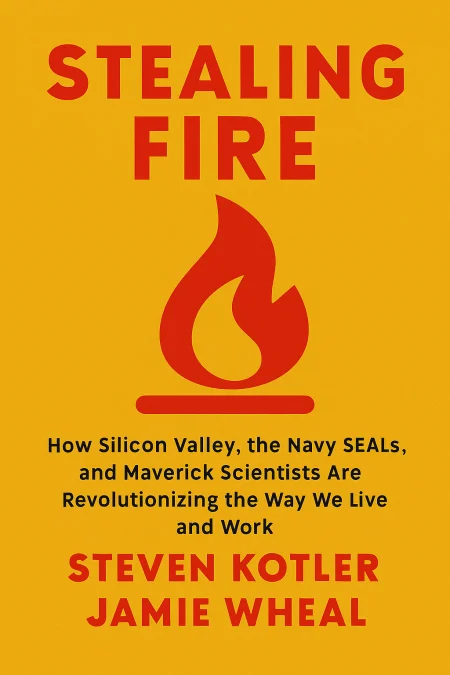
Stealing Fire
How Silicon Valley, the Navy SEALs, and Maverick Scientists Are Revolutionizing the Way We Live and Work
Book Edition Details
Summary
In the hidden crucible of innovation, where Silicon Valley visionaries, elite military minds, and boundary-pushing scientists converge, a seismic shift in performance is quietly underway. Steven Kotler and Jamie Wheal's "Stealing Fire" unveils this clandestine revolution, where altered states of consciousness become the secret weapon for extraordinary success. These pioneers defy conventional wisdom, opting not for relentless grit or mindless repetition, but for the mind-expanding power of rare mental states. From the dynamic offices of Google to the adrenaline-charged realm of Red Bull athletes, Kotler and Wheal journey through a world where creativity and productivity soar beyond traditional limits. This is more than a narrative; it's a manifesto for those daring enough to question the status quo and redefine human potential. Discover the blueprint for unleashing a new era of achievement and satisfaction, as psychology, technology, and neurobiology converge in an unprecedented dance of human evolution.
Introduction
In the heart of Silicon Valley, a young engineer sits in meditation before the most important presentation of her career. As her breathing deepens and her mind quiets, something extraordinary happens. The anxiety that had been consuming her for weeks simply dissolves. Time seems to slow down. Her awareness expands beyond the confines of her individual concerns, and suddenly she can see the elegant solution that had been eluding her team for months. When she opens her eyes, she knows with absolute certainty that everything has changed. This moment of transformation isn't unique to tech innovators. Across every domain of human excellence, from elite military units to championship athletes, from breakthrough artists to visionary leaders, peak performers have discovered something profound: our greatest achievements don't emerge from our ordinary waking consciousness, but from those rare moments when we transcend our everyday sense of self entirely. These altered states of consciousness, characterized by selflessness, timelessness, effortlessness, and heightened awareness, represent one of humanity's most powerful yet underutilized resources for unlocking extraordinary performance and deep fulfillment. For centuries, these experiences remained shrouded in mystery, accessible only to mystics, warriors, and artists willing to risk everything in pursuit of transcendence. But today, advances in neuroscience, psychology, and technology are finally giving us the tools to understand, access, and harness these states safely and reliably. What emerges is a revolutionary understanding of human potential that promises to transform how we work, create, heal, and live.
The SEAL Team Switch: When Individual Warriors Become Collective Intelligence
Commander Rich Davis had led countless missions, but nothing had prepared him for what he witnessed that night in Afghanistan. His team of Navy SEALs was tasked with capturing Al-Wazu, one of Al-Qaeda's most dangerous operatives, alive and unharmed. As they approached the target compound, Davis watched his men undergo a transformation that defied explanation. The individual soldiers seemed to dissolve into something greater, their separate identities merging into a single, fluid organism moving with supernatural coordination. When they finally located Al-Wazu asleep in a chair with an AK-47 across his lap, every SEAL in the room processed the same critical detail simultaneously—their target's closed eyes—and made the split-second decision not to fire. It was a bloodless capture that would have been impossible without this collective state of heightened awareness. Davis later described it as flipping "the switch," entering a realm where fear divided and intelligence multiplied exponentially. This phenomenon of collective flow extends far beyond military operations. When Google's founders needed to find a CEO who could scale their company without destroying its innovative spirit, they took their final candidate to Burning Man, the radical festival in Nevada's desert. They needed to see if Eric Schmidt could handle chaos, adapt to the unexpected, and most importantly, merge with their team rather than dominate it. Under the festival's transformative conditions, Schmidt demonstrated the collaborative consciousness that would help guide Google from a hundred million to nearly forty billion in revenue. These stories reveal a profound truth about human potential: our greatest achievements emerge not from individual brilliance but from our ability to transcend the boundaries of separate self and tap into collective intelligence. When teams learn to access these states together, they become capable of solving problems and achieving outcomes that would be impossible for any individual member working alone.
The Neuroscience Revolution: Mapping the Brain's Hidden Performance Pathways
Dr. Andrew Newberg never expected to become a pioneer in consciousness research. As a neuroscientist at the University of Pennsylvania, he was simply curious about what happened in the brain during profound spiritual experiences. Using advanced imaging technology, he studied Franciscan nuns during intense prayer and Tibetan monks in deep meditation. What he discovered revolutionized our understanding of human consciousness and opened entirely new pathways for enhancing performance. During these peak states, a specific region of the brain—the right parietal lobe—showed dramatic decreases in activity. This area normally helps us navigate space by determining where our body ends and the world begins. When it goes quiet, that boundary dissolves completely. As far as the brain can tell, the individual has become one with everything around them. It wasn't mystical speculation; it was measurable neurobiology revealing the mechanism behind humanity's most transcendent experiences. Robin Carhart-Harris at Imperial College London extended this research, discovering that these same neurological changes occur across a wide range of peak performance states. Whether triggered by meditation, extreme sports, creative flow, or certain therapeutic compounds, the brain undergoes predictable transformations. Networks associated with self-criticism and mental chatter go offline, while new connections form between normally separate regions, leading to enhanced creativity, accelerated learning, and breakthrough problem-solving abilities. The research reveals that these states consistently produce four key characteristics: selflessness, where the inner critic falls silent; timelessness, where we become fully present; effortlessness, where motivation becomes intrinsic; and richness, where we gain access to information normally beyond our reach. Together, these create a neurobiological recipe for peak performance that can be understood, measured, and most importantly, cultivated through deliberate practice.
Silicon Valley's Secret Laboratory: From Burning Man to Billion-Dollar Breakthroughs
Every year, tens of thousands of the world's most successful entrepreneurs, innovators, and creative professionals make a pilgrimage to Nevada's Black Rock Desert for what appears to be an elaborate art festival. But Burning Man has evolved into something far more significant: a massive laboratory for consciousness experimentation where breakthrough innovations are born from collective transcendence. Elon Musk conceived both SolarCity and Hyperloop while attending the festival. Tony Hsieh restructured Zappos around principles he discovered there. Countless startups and social movements have emerged from this annual gathering of minds exploring the outer reaches of human potential. The festival's radical environment—where money becomes meaningless, creativity is the only currency, and community emerges organically—strips away conventional thinking patterns and social conditioning. Participants report profound shifts in perspective that persist long after returning to ordinary reality. They've experienced what anthropologists call "communitas"—a state of unified consciousness that transcends individual limitations and unlocks collective intelligence. Meanwhile, technology entrepreneur Mikey Siegel left his dream job at NASA to pursue what he calls "enlightenment engineering," creating devices that can guide people into transcendent states using biofeedback and carefully designed experiences. His work represents a broader movement toward democratizing access to consciousness-altering technologies that were once available only to mystics and extreme athletes. This convergence of ancient wisdom and cutting-edge technology is creating unprecedented opportunities for human enhancement. Meditation apps guide millions into flow states. Virtual reality systems can induce awe and wonder on demand. Neurofeedback devices train optimal brainwave patterns. What was once the province of spiritual adepts is becoming accessible to anyone willing to step outside their comfort zone and explore the full spectrum of human consciousness.
The Dark Side of Transcendence: Weaponization and the Ethics of Consciousness
Dr. John Lilly's groundbreaking research into brain stimulation in the 1950s unlocked the ability to trigger intense pleasure states by directly activating neural reward circuits. When government agencies learned of his discoveries, they immediately recognized their potential for control and coercion. Despite Lilly's insistence on keeping his research declassified and available for humanitarian purposes, military contractors found ways to weaponize his techniques, developing methods for psychological manipulation that would haunt intelligence operations for decades. This dark pattern repeats throughout history: powerful consciousness-altering technologies emerge from legitimate research, only to be co-opted for exploitation and control. The same neurochemical pathways that produce transcendent experiences can be manipulated to create dependency, compliance, or confusion. Today's digital landscape presents new challenges, as social media platforms deploy sophisticated algorithms designed to capture and monetize our attention by triggering addictive neurochemical responses. The commercialization of consciousness raises equally troubling questions. When peak experiences become products to be consumed rather than skills to be developed, we risk creating a culture of spiritual materialism where the very states that should liberate us from ego-driven pursuits become new forms of status and acquisition. Virtual reality environments can trigger profound altered states, but they also enable unprecedented surveillance of our most intimate mental processes. Yet awareness of these dangers also points toward solutions. Open-source approaches to consciousness research, ethical frameworks for technology development, and education that empowers individuals to navigate this landscape with wisdom and discernment offer hope for a future where these powerful tools serve human flourishing rather than exploitation. The key lies in ensuring that access to consciousness-enhancing technologies remains democratized and that their development is guided by principles of transparency, consent, and collective benefit.
Summary
The convergence of neuroscience, psychology, technology, and ancient wisdom has opened unprecedented access to states of consciousness that can dramatically enhance human performance, creativity, and well-being. From Navy SEALs achieving superhuman coordination to Silicon Valley innovators unlocking breakthrough solutions, from trauma patients finding healing to artists accessing profound inspiration, these altered states represent one of our species' most powerful yet underutilized resources for transformation and growth. The evidence is overwhelming: our greatest breakthroughs don't come from thinking harder, but from learning to think differently. When we temporarily step outside our ordinary sense of self and tap into expanded awareness, we consistently perform at levels that seemed impossible under normal consciousness. The implications ripple through every domain of human endeavor, promising to revolutionize how we approach education, healthcare, business, relationships, and personal development. Yet with this power comes profound responsibility. The same techniques that can liberate human potential can also be weaponized for control or commercialized for profit. The path forward requires both bold exploration and careful wisdom—embracing the transformative potential of consciousness research while developing ethical frameworks that protect individual autonomy and collective well-being. When we learn to navigate these extraordinary states with skill and integrity, we discover that the fire of human potential burns brightest not in isolation but in service to others, illuminating possibilities we never knew existed.
Related Books
Download PDF & EPUB
To save this Black List summary for later, download the free PDF and EPUB. You can print it out, or read offline at your convenience.
By Steven Kotler
