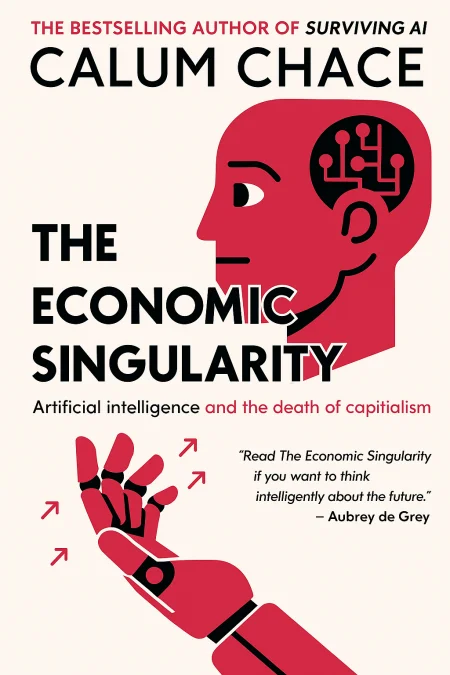
The Economic Singularity
Artificial Intelligence and the Death of Capitalism
Book Edition Details
Summary
In the not-so-distant tomorrow, the relentless march of artificial intelligence looms as both our greatest ally and existential challenge. Calum Chace's "The Economic Singularity" delves into a future where intelligent machines eclipse human capabilities, crafting a reality where traditional jobs vanish into obsolescence. From the quick-serve counters to the hallowed halls of legal and journalistic endeavor, no profession remains untouched. As self-driving cars lead the charge, humanity stands at a crossroads—do we cling to outdated economic models or embrace a revolutionary system that may redefine prosperity? Chace doesn't just present the risks; he offers a visionary exploration of a world where automation promises unprecedented freedom, urging us to plan wisely or face societal upheaval.
Introduction
Standing at the crossroads of technological revolution, we witness a transformation as profound as the shift from agriculture to industry centuries ago. Just as the steam engine once displaced countless manual workers, artificial intelligence now threatens to automate cognitive tasks that define modern employment. This isn't merely another wave of technological change—it represents a fundamental reimagining of work itself. The parallels with history are both comforting and unsettling. During the Industrial Revolution, displaced agricultural workers eventually found new opportunities in factories and cities. But what happens when machines can think, learn, and adapt faster than humans? The Luddites of the early 1800s feared their looms would steal their livelihoods; today's professionals face algorithms that can diagnose diseases, write articles, and even compose music with superhuman precision. This exploration reveals how we might navigate the coming economic singularity—that pivotal moment when human labor becomes largely obsolete. It's essential reading for policymakers grappling with employment futures, business leaders planning workforce strategies, and anyone curious about how we'll organize society when traditional jobs disappear. The questions raised here aren't academic exercises but urgent challenges that will reshape civilization within our lifetimes.
The History of Automation: From Industrial Revolution to Information Age
The mechanical transformation of human labor began not with a bang but with the steady hiss of steam. Thomas Newcomen's 1712 steam engine marked the true beginning of our automated age, pumping water from mines with a power that transcended human muscle. This wasn't merely about efficiency—it represented humanity's first step toward liberating itself from the physical constraints that had governed every previous civilization. The progression from Newcomen's primitive engine to James Watt's refined version revealed a pattern that would repeat across centuries. Each technological leap enabled not just better performance, but entirely new possibilities. Canals gave way to railways, manual looms to mechanized factories, and human calculators to electronic computers. Yet at each stage, displaced workers found new roles in the expanding economy. Farm laborers became factory workers, craftsmen became machine operators, and society grew wealthier despite—or perhaps because of—these disruptions. The industrial revolution's deeper significance lay in its demonstration that human ingenuity could continuously reinvent the nature of work itself. When horses reached their "peak" around 1900, numbering 25 million in America alone, their subsequent decline to just 3 million revealed a crucial distinction. Horses had nothing beyond muscle power to offer; humans possessed cognitive abilities that became increasingly valuable as machines handled physical tasks. This cognitive advantage seemed to guarantee our continued relevance in any automated future. The information age accelerated this pattern while fundamentally altering its character. Where industrial automation replaced human brawn, digital systems began supplementing—and eventually competing with—human brains. The secretary, once ubiquitous in offices across America, virtually disappeared as executives learned to interact directly with computers. Yet even as entire job categories vanished, new ones emerged faster than old ones died, creating a false sense that technological displacement would always remain manageable.
The AI Revolution: Why This Time Is Different
The artificial intelligence emerging today represents a qualitative leap beyond previous automation waves. Unlike the specialized machines of earlier eras, modern AI systems demonstrate increasingly general capabilities in pattern recognition, natural language processing, and decision-making. When Google's DeepMind mastered not just chess but the far more complex game of Go, it signaled that machines were developing something approaching cognitive flexibility rather than merely computational brute force. What makes this revolution unprecedented is the exponential rate of improvement driving it. Moore's Law has sustained a doubling of computer power every eighteen months for over half a century, but recent breakthroughs in machine learning have accelerated progress beyond even these impressive gains. Systems that struggled with simple image recognition just a decade ago now outperform human radiologists in detecting certain cancers. Voice recognition, natural language translation, and even creative tasks like writing and musical composition have fallen within the realm of artificial capability. The economic implications ripple far beyond traditional blue-collar concerns. Lawyers find AI systems reviewing legal documents faster and more accurately than junior associates. Financial advisors compete with robo-advisors that never sleep, never make emotional decisions, and analyze vast datasets beyond human comprehension. Even creative professionals face AI systems that can generate compelling prose, compose music, and produce visual art with minimal human guidance. Perhaps most significantly, these systems improve continuously through exposure to data and experience. Unlike human workers who plateau in their capabilities, AI systems become more competent with each iteration. This creates a trajectory where temporary human advantages in complex cognitive tasks may prove fleeting, as machines rapidly close gaps in reasoning, creativity, and social intelligence that once seemed insurmountably human.
The Great Transition: Challenges and Scenarios for Post-Work Society
The specter of widespread technological unemployment forces us to confront fundamental questions about economic organization and human purpose. If machines can perform most economically valuable tasks better and cheaper than humans, traditional market mechanisms for distributing income break down. The solution most commonly proposed—Universal Basic Income—represents more than mere policy adjustment; it signals a potential transformation from work-based to abundance-based economics. Yet UBI alone cannot address the deeper challenge of social cohesion in a post-work world. History offers both encouraging and troubling precedents. European aristocracies lived fulfilling lives without wage labor for centuries, finding meaning in governance, arts, and intellectual pursuits. Retired people today often report higher life satisfaction than their working-age counterparts. These examples suggest humans can thrive without traditional employment structures, provided basic needs are met and purposeful activities remain available. The danger lies not in unemployment itself but in the potential fracturing of society into separate castes. If a small elite controls the AI systems that generate most economic value, while everyone else depends on their beneficence for survival, we risk creating what one scholar calls "the gods and the useless." Advanced technologies for cognitive and physical enhancement could accelerate this divergence, potentially splitting humanity into different species with vastly different capabilities and prospects. The path forward requires careful navigation between multiple scenarios. Optimistic projections envision smooth transitions to post-scarcity economies where machines handle drudgery while humans pursue creativity, relationships, and personal growth. Pessimistic scenarios involve social collapse, violent upheaval, or permanent subjugation of the many by the technologically enhanced few. The choices we make in coming decades—about AI governance, wealth distribution, and social organization—will largely determine which future emerges.
Summary
The convergence of artificial intelligence and automation presents humanity with perhaps its greatest transition since the agricultural revolution. While technological displacement has historically created new opportunities even as it destroyed old ones, the comprehensive nature of AI suggests this pattern may not hold indefinitely. Machines that can think, learn, and adapt threaten to eliminate not just specific jobs but entire categories of human economic utility. The central tension running throughout this transformation involves balancing technological benefits against social stability. Artificial intelligence promises unprecedented prosperity through radical efficiency gains, yet concentrates economic power in ways that could undermine the very market systems that created such wealth. Democratic capitalism thrived when human labor remained essential; its compatibility with machine-dominated production remains uncertain. Three imperatives emerge for navigating this transition successfully. First, we must monitor early indicators of technological displacement and begin serious planning for post-work economic structures before crisis forces hasty decisions. Second, we need frank discussions about wealth redistribution and social organization that transcend traditional ideological boundaries. Finally, we must consider whether preserving human agency requires collective ownership of AI systems rather than allowing their concentration in private hands. The window for shaping these outcomes remains open, but the choices we make today will echo through generations.
Related Books
Download PDF & EPUB
To save this Black List summary for later, download the free PDF and EPUB. You can print it out, or read offline at your convenience.
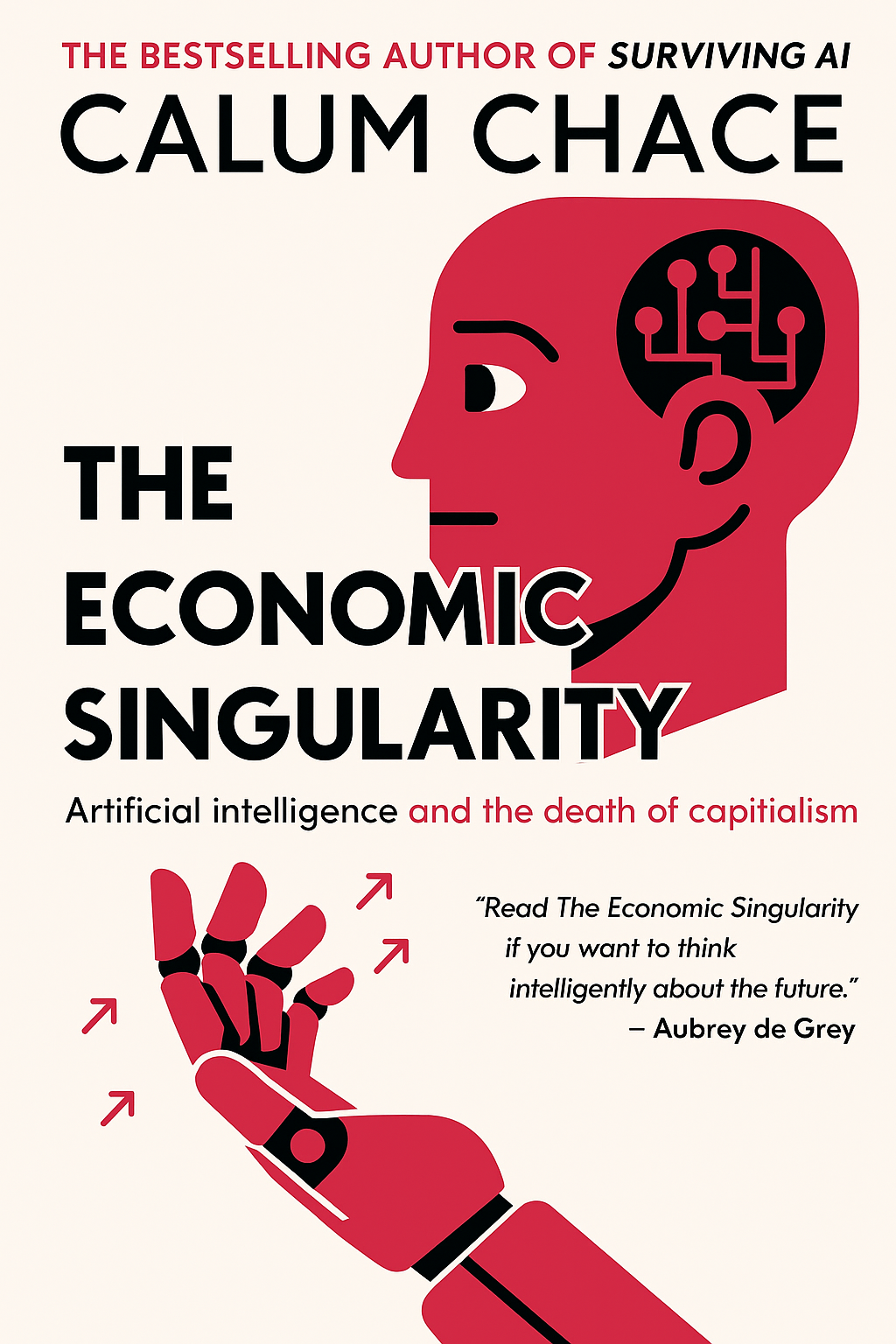
By Calum Chace
