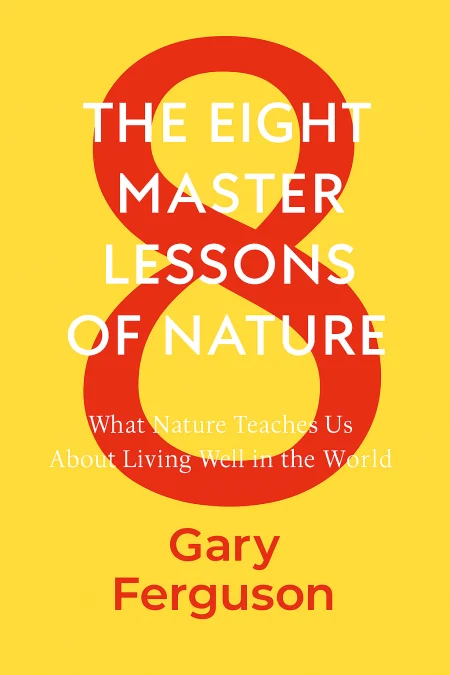
The Eight Master Lessons of Nature
What Nature Teaches Us About Living Well in the World
Book Edition Details
Summary
In a world seemingly estranged from its roots, Gary Ferguson's "The Eight Master Lessons of Nature" offers a beacon of reconnection. As we drift amidst urban sprawl and technological noise, this book is a call to rediscover the profound wisdom embedded in the natural tapestry around us. Through a tapestry of scientific insight, historical perspective, and philosophical depth, Ferguson unveils how the very essence of nature courses through our veins, offering guidance on navigating life’s complexities. Each lesson—whether gleaned from the resilience of ancient trees or the intuitive intelligence of wildlife—promises to transform our understanding of wellness and interdependence. This book is not merely an exploration but an invitation to embrace a harmonious relationship with the Earth, sparking hope and a newfound wonder for the natural world that patiently awaits our return.
Introduction
Have you ever wondered why a simple walk in the woods can leave you feeling more centered and alive than hours of scrolling through social media? Or why certain moments in nature—watching a sunset, listening to birdsong, feeling rain on your skin—seem to unlock something profound within us that we didn't even know we were missing? The natural world isn't just a backdrop to our human drama; it's been our teacher for millions of years, quietly demonstrating principles of living that we've only recently begun to understand through modern science. Nature operates according to elegant laws that create resilience, beauty, and abundance across every ecosystem on Earth. From the microscopic networks of fungi that connect forest trees in underground communication systems, to the complex social structures of wolf packs that maintain harmony through cooperation rather than domination, the natural world offers us a masterclass in how to thrive. These aren't merely poetic metaphors—they're practical blueprints for creating more fulfilling relationships, building sustainable communities, and finding our place in the interconnected web of life. As we face unprecedented challenges in our modern world, perhaps it's time to remember that we are not separate from nature, but part of it, and that our wellbeing is intimately connected to the health of the living systems that surround us.
Mystery and Connection: How Nature Reveals Life's Hidden Relationships
When Albert Einstein found himself stuck on a particularly challenging problem, he had an unusual habit. He would leave his Princeton office and walk into a small patch of forest maintained especially for him, known as the Institute Woods. But he wasn't simply clearing his head, as you or I might do with a change of scenery. Einstein was deliberately overwhelming his intellect by contemplating the incomprehensible complexity of even the smallest patch of woodland—the countless interactions between soil, roots, leaves, insects, and sky that no human mind could ever fully grasp. This intentional encounter with mystery was Einstein's secret weapon for accessing what he called "the source of all true art and science." He understood that breakthrough insights don't come from having all the answers, but from maintaining a relationship with the vast unknown. Modern quantum physics has proven him right—showing us that at the subatomic level, reality is far more mysterious and fluid than we ever imagined. The same electron can be in multiple places at once, particles can tunnel through seemingly impenetrable barriers, and the very act of observation changes what we observe. In our everyday lives, we're surrounded by similar wonders that can restore our sense of awe and expand our perception. Consider that 99.99999 percent of your body is empty space between atoms, yet somehow this emptiness creates the solid reality of your existence. Or that when you walk down the street, you're not actually touching the ground—the magnetic force of electrons in your shoes pushes away from the electrons in the pavement, leaving you perpetually floating just above the surface. These aren't abstract concepts but invitations to see the world as the dynamic, interconnected, and fundamentally mysterious place it actually is. Rather than being troubled by what we don't know, we can learn to find comfort in mystery, using it as Einstein did—as a doorway to creativity and wonder. When we quiet the chattering mind that insists on having explanations for everything, we open ourselves to experiencing the world through our senses and intuition. The ancient Greeks taught us to observe nature objectively, standing apart from what we study. But modern science reveals that we are always participants in what we observe, never separate from the living systems that sustain us. This shift from separation to participation is perhaps the most profound lesson nature has to offer—that in a world of infinite mystery, our deepest wisdom comes not from knowing everything, but from embracing our place in the magnificent unknown.
Diversity and Leadership: The Essential Power of Feminine Wisdom
In the savannahs of Kenya, a fifty-year-old elephant matriarch moves through her herd with quiet authority, constantly scanning the horizon and testing the air with her trunk. Her leadership isn't based on size or aggression—though few would want to challenge her—but on decades of accumulated wisdom about finding water during droughts, avoiding lions, and navigating the complex social dynamics of her family. When severe dry spells hit, younger matriarchs often keep their herds in familiar territory, leading to the tragic loss of calves. But this elder female will guide her family across dozens of miles to distant water sources she remembers from decades past, ensuring everyone's survival. This pattern of feminine leadership isn't unique to elephants. In species after species—from orcas to lions to bonobos—females hold critical leadership roles, not through dominance but through their remarkable skill at building coalitions and maintaining relationships essential to survival. Among orcas, adult males are eight times more likely to die within a year of their mother's death, highlighting how central feminine wisdom is to community wellbeing. These leaders are master problem-solvers who prevent conflicts before they start and coordinate the complex teamwork necessary for raising young and finding food. For thousands of years, human cultures also celebrated this feminine wisdom through stories of great goddesses who created and sustained life through their powers of connection and creativity. Ancient myths told of divine feminine forces that brought order from chaos, not through conquest but through dance and creativity that gave birth to stars, planets, and all living things. The feminine was associated with the cycles of nature—seasons, tides, growth and renewal—and with the mysterious processes that bind all life together in relationship. Yet for roughly four thousand years, human societies have increasingly suppressed this feminine wisdom in favor of masculine-dominated systems that prioritize competition, control, and hierarchy. We've relegated the essential qualities of the feminine—cooperation, intuition, nurturing relationships—to the background, creating imbalanced societies that often work against rather than with the patterns of nature. Even today, despite decades of progress toward gender equality, our institutions and cultural narratives still undervalue the collaborative, relationship-centered approaches that both human and animal communities need to thrive. Reclaiming this balance isn't about diminishing masculine strengths, but about recognizing that sustainable success requires both energies working in partnership, just as we see throughout the natural world where the most resilient communities integrate both masculine agency and feminine wisdom.
Energy and Resilience: Learning Efficiency from Animal Teachers
Picture a waterfall three times taller than the Empire State Building, stretching around the entire equator, with billions of tons of water cascading over its edge every second. That's science writer Oliver Morton's way of helping us imagine the staggering amount of energy that reaches Earth from the sun—more power in just ninety minutes than humans consume from all sources in an entire year. Given such abundance, it might seem puzzling that nature places such tremendous emphasis on efficiency. Yet from the tiniest hummingbird to the slowest sloth, every creature has evolved exquisite strategies for making the most of available energy without wasting a drop. The three-toed sloth of Central America has mastered what might be called the art of doing less. Living entirely on leaves—a food source that's abundant but nutritionally poor—sloths have evolved an entire lifestyle around energy conservation. They hang upside down to reduce the calories needed for balance, lower their body temperature to save fuel, and move so slowly that they become mobile ecosystems, hosting algae in their fur that provides both camouflage and supplemental nutrition when they groom themselves. Even their digestion operates in slow motion, taking a full month to process a single meal. At the opposite extreme, hummingbirds consume up to three times their body weight daily, their wings beating fifty times per second in a blur of motion. Yet even these aerial dynamos are efficiency experts, entering deep torpor each night to conserve energy, dropping their heart rate from five hundred beats per minute to fifty, and reducing their body temperature by nearly fifty degrees. They've also eliminated the downy feathers most birds use for warmth, opting instead for these dramatic metabolic adjustments that allow them to restart their engines each dawn. Perhaps most remarkably, migrating geese have perfected the art of cooperation as energy conservation. Flying in their famous V formation, each bird benefits from the aerodynamic lift created by the wings of the bird ahead, reducing energy expenditure by up to seventy percent compared to solo flight. They rotate leadership positions so no individual bears the full burden, maintain constant communication to coordinate their movements, and even care for any member who falls behind or becomes injured. Their efficiency isn't just individual but collective, demonstrating how working together can multiply the effectiveness of individual effort while creating resilient communities that ensure everyone's survival.
Growth Through Disruption: Nature's Art of Rising Again
In the scorching summer of 1988, massive wildfires swept through Yellowstone National Park, creating walls of flame over one hundred feet high that blackened more than a third of the ecosystem. To many observers, it looked like an apocalyptic end to one of America's most treasured landscapes. But nature had a different story to tell. Within months of the fires, the forest floor exploded with new growth—fireweed, twisted-stalk, and spirea pushing up through the ash, while grasses flourished in sunlight that hadn't touched the ground for nearly a century. This apparent destruction was actually renewal in action. Fire releases nutrients that have been locked up in trees and ground plants for decades, creating superrich soil that feeds an explosion of new life. Lodgepole pine cones, designed by evolution to open only when touched by flame, scattered millions of seeds across the burned landscape. Elk discovered that plants growing in the burned areas contained thirty percent more nutrients than vegetation on unburned land, giving them the extra nourishment needed to survive harsh winters. Within a few years, beetles moved into the dead timber, followed by woodpeckers and other birds eager to feed on the insect bounty. What looks like catastrophe from a human perspective is often opportunity from nature's viewpoint. Healthy fire doesn't destroy forest ecosystems—it renews them, clearing out accumulated debris and creating conditions for new growth that often results in greater diversity and resilience than before. The key is understanding what remains intact after the disturbance: Are the seeds protected? Is the soil still fertile? Are the essential connections—pollinators, water systems, underground networks—still functional? When these foundations survive, recovery isn't just possible but inevitable. This same principle applies to the disruptions in our own lives. Personal crises, relationship endings, job losses, and even traumatic events can function like forest fires—devastating in the moment but potentially clearing away what no longer serves us and creating space for new growth. The difference between recovery and continued suffering often depends on what remains intact in our lives: our core values, supportive relationships, basic health, and connection to something larger than ourselves. Like forests after fire, we humans have remarkable capacity for resilience, especially when we understand that disruption and renewal are natural partners in the dance of life, and that what feels like an ending often contains the seeds of a more vibrant beginning.
Summary
The natural world operates as an interconnected web where mystery and known science dance together, diversity creates strength, feminine wisdom guides sustainable communities, energy flows with exquisite efficiency, and disruption becomes the catalyst for renewal. These aren't merely observations about plants and animals—they're blueprints for living that can transform how we approach relationships, work, challenges, and our place in the larger web of life. Nature shows us that we thrive not by conquering and controlling, but by participating, cooperating, and embracing our role as part of something infinitely larger and more mysterious than ourselves. As we face an uncertain future on a rapidly changing planet, perhaps the most important question we can ask is: How might our lives look different if we trusted the same principles that have sustained life on Earth for billions of years? What would happen if we approached our daily challenges with the patient wisdom of old-growth forests, the cooperative spirit of migrating geese, the resilient adaptability of plants rising from wildfire ash, and the humble acknowledgment that the greatest mysteries often hold the deepest truths? The answers lie not in some distant future technology or perfect system, but in remembering that we are nature, and that our wellbeing has always been inseparable from the health of the living world that surrounds and sustains us.
Related Books
Download PDF & EPUB
To save this Black List summary for later, download the free PDF and EPUB. You can print it out, or read offline at your convenience.
By Gary Ferguson
