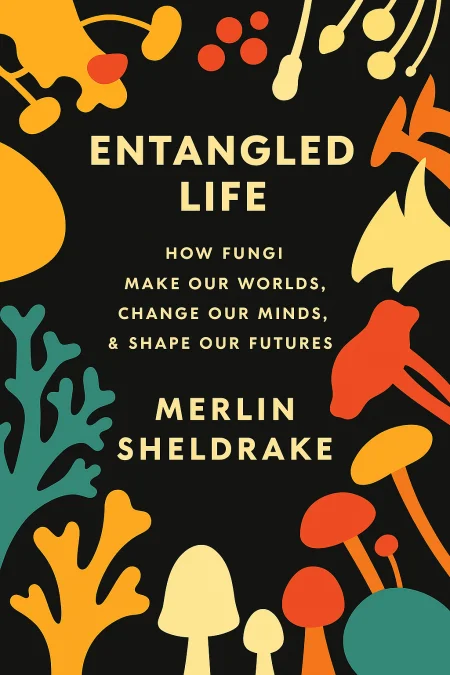
Entangled Life
How Fungi Make Our Worlds, Change our Minds and Shape Our Futures
Book Edition Details
Summary
Beneath our feet and beyond our sight lies a realm of life that defies categorization and challenges our understanding of existence. Fungi, neither plant nor beast, weave a tapestry of intrigue across Earth’s landscapes and within our very bodies. Merlin Sheldrake invites readers into this shadowy world in "Entangled Life," where molds, yeasts, and mushrooms rewrite the rules of intelligence, survival, and connectivity. From the psychedelic whispers of ancient rituals to groundbreaking eco-technologies, fungi offer a new lens through which to view our world. They digest the indigestible, thrive in the inhospitable, and quietly shape the destiny of all living things. This is not just a tale of nature’s hidden architects, but a mind-expanding exploration of the unseen forces that sustain and transform life as we know it.
Introduction
Beneath every step you take lies an invisible network more complex than the internet, older than the oldest trees, and more essential to life than you might ever imagine. This hidden world belongs to fungi—organisms that are neither plant nor animal, yet without which neither could exist. While we notice mushrooms sprouting after rain or mold growing on forgotten bread, we remain largely blind to the fungal universe that surrounds and sustains us. Fungi are the master recyclers of our planet, the underground internet connecting forests, and the chemical wizards that have given us everything from antibiotics to bread to wine. They challenge our most basic assumptions about individuality, intelligence, and what it means to be alive. In exploring their secret lives, we discover not just a hidden kingdom of life, but a new way of understanding the interconnected nature of existence itself. From the microscopic networks threading through soil to the largest living organisms on Earth, fungi reveal that life is far more collaborative, creative, and mysterious than we ever suspected. Their ancient partnerships literally built the world we inhabit, while their ongoing relationships continue to sustain every ecosystem on the planet.
Chemical Communication: How Fungi Speak Without Words
Imagine trying to navigate the world using only your sense of smell, but with a nose so sensitive it could detect a single drop of perfume in an Olympic swimming pool. This is how fungi experience their environment—through an intricate language of chemicals that makes our human communication seem crude by comparison. Unlike animals that can move toward food or away from danger, fungi must make sense of their world through molecular messages drifting through soil and air. Fungi speak in chemistry because their entire surface acts like one giant tongue and nose combined. Every part of their thread-like bodies can taste and smell the world around them, detecting the chemical signatures of food, friends, enemies, and potential mates. When you smell the earthy aroma of a truffle, you're intercepting a sophisticated chemical conversation—the fungus is broadcasting its readiness to be eaten, having evolved its scent over millions of years to perfectly match the preferences of the animals it needs to disperse its spores. This chemical communication system is far more complex than simple attraction or repulsion. Fungi can produce cocktails of hundreds of different molecules, each carrying specific information. They use chemical passwords to recognize their own kind, deploy molecular weapons against competitors, and release hormones that manipulate the behavior of plants and animals. Some fungi even produce the same neurotransmitters found in animal brains, suggesting that the chemical basis of communication is far older and more universal than we once believed. The implications extend far beyond the fungal kingdom. Many of our most important medicines, from penicillin to modern cancer drugs, are actually fungal chemical messages that we've learned to intercept and repurpose. By understanding how fungi communicate, we're not just decoding an ancient language—we're discovering new ways to heal, to grow food, and to understand the chemical conversations that have been shaping life on Earth for over a billion years.
Living Networks: Mycelial Intelligence and Problem-Solving
Picture a vast underground internet made not of cables and routers, but of living threads that can think, learn, and make decisions without a brain. This is mycelium—the thread-like body of fungi that forms networks of staggering complexity beneath our feet. These networks can solve problems that would challenge a computer, navigate mazes more efficiently than humans, and coordinate their behavior across distances that would span entire cities. The secret lies in their unique form of distributed intelligence. While animals centralize their thinking in brains, fungi spread their decision-making across millions of growing tips, each one sensing the environment and responding in real-time. When a mycelial network encounters food, it doesn't just grow toward it randomly—it evaluates multiple pathways, reinforces the most efficient routes, and prunes away less useful connections. Scientists have watched fungi recreate the Tokyo subway system and find the shortest path through complex mazes, all without any central planning or control. What makes this even more remarkable is that mycelial networks can communicate with themselves using electrical signals similar to those in animal nervous systems. When one part of a fungal network encounters food or danger, it can send electrical messages racing through the network at speeds that would make our neurons proud. These signals coordinate behavior across the entire organism, allowing a network that might stretch for kilometers to respond as a unified whole. This distributed intelligence offers profound lessons for human technology and organization. Researchers are already using fungal networks as living computers and sensors, while engineers study their self-organizing principles to design more resilient systems. The fungi remind us that intelligence doesn't require a brain—it can emerge from the interactions of simple components working together, a principle that's revolutionizing everything from artificial intelligence to urban planning.
Wood Wide Web: Underground Fungal Internet Systems
Beneath every forest lies a hidden internet more ancient and complex than our digital networks—a living web of fungal threads that connects trees in relationships of startling intimacy and sophistication. These underground networks, dubbed the "wood wide web," reveal that what we think of as individual trees are actually participants in vast, interconnected communities where resources, information, and even chemical warnings flow between species. Through hair-thin fungal threads that can stretch for hundreds of meters, trees share carbon, nitrogen, water, and defense compounds with their neighbors. A large tree might support a struggling seedling in the shade by sending it sugars through fungal intermediaries. When attacked by insects, a tree can broadcast chemical alarm signals through the network, warning its neighbors to boost their defenses. Even dying trees contribute to this economy, downloading their remaining nutrients to the community before they fall. The fungi that make these networks possible are far from passive cables—they're active brokers with their own interests and intelligence. They can favor certain trees over others, charge different exchange rates for their services, and even manipulate the flow of resources to maximize their own benefit. Some fungi maintain relationships with dozens of different tree species simultaneously, creating a complex marketplace where plants and fungi negotiate trades in real-time based on supply and demand. This underground economy challenges everything we thought we knew about forests and competition in nature. Rather than individual trees fighting for survival, we find cooperative networks where the health of the community supports the success of individuals. The wood wide web suggests that forests think and behave more like superorganisms than collections of separate trees—a revelation that's transforming how we approach conservation, agriculture, and our understanding of intelligence in nature.
Ancient Partnerships: Fungi's Role in Life Evolution
Four hundred million years ago, Earth's landmasses were largely barren rock and sand, with complex life confined to the oceans. The colonization of land by plants represents one of evolution's greatest achievements, but it might never have happened without fungal partners. These ancient alliances didn't just enable terrestrial life—they fundamentally reshaped our planet's climate and atmosphere, creating the conditions that made all subsequent life possible. Early plants faced enormous challenges on land that they had never encountered in aquatic environments. They needed to extract nutrients from soil rather than absorbing them directly from water, and they had to cope with the harsh realities of terrestrial life. Fungi provided elegant solutions to both problems. Their thread-like networks could reach far into soil to gather scarce nutrients like phosphorus, while their structure helped retain precious moisture around plant roots. In essence, fungi became the first root systems, allowing plants to establish themselves on land before they evolved proper roots of their own. This partnership was so successful that it triggered a cascade of global changes. As plants spread across continents with their fungal allies, they began pulling massive amounts of carbon dioxide from the atmosphere through photosynthesis. The weathering of rocks accelerated as fungal acids broke down minerals, leading to chemical changes that locked away atmospheric carbon. This biological transformation led to dramatic drops in global temperatures and may have triggered ice ages, fundamentally altering Earth's climate system. Today, over ninety percent of plant species still maintain these ancient partnerships with fungi. The relationship has become so integral to plant life that most species cannot survive without their fungal partners. Modern agriculture often disrupts these relationships through intensive farming practices, leading to degraded soils and increased dependence on artificial fertilizers. Understanding and restoring these ancient alliances may be crucial for developing sustainable systems that can feed our growing population while maintaining the healthy ecosystems that fungi helped create hundreds of millions of years ago.
Summary
The secret world of fungi reveals that life on Earth operates through networks of cooperation and communication far more sophisticated than we ever imagined, challenging our fundamental assumptions about individuality, intelligence, and survival. From the chemical conversations that coordinate underground ecosystems to the living partnerships that enabled life to colonize land, fungi demonstrate that the most successful strategies in nature often involve collaboration rather than competition. As we face unprecedented environmental challenges, the fungal model of resilience through connection offers both practical solutions and a profound shift in perspective—reminding us that we too are part of these ancient networks, and that our future may depend on learning to think and act more like the fungi that have been quietly sustaining life on Earth for over a billion years. How might embracing this interconnected view of life change the way we approach everything from medicine to agriculture to our relationship with the natural world? What other forms of intelligence might we discover if we look beyond our assumptions about what it means to think, communicate, and solve problems?
Related Books
Download PDF & EPUB
To save this Black List summary for later, download the free PDF and EPUB. You can print it out, or read offline at your convenience.
By Merlin Sheldrake
