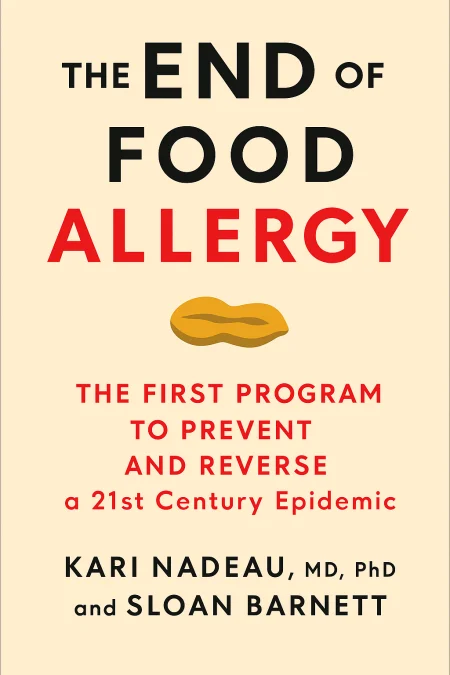
The End of Food Allergy
The First Program to Prevent and Reverse a 21st Century Epidemic
Book Edition Details
Summary
Amidst the rising tide of food allergies, "The End of Food Allergy" heralds a groundbreaking shift in how we view and treat this pervasive issue. Dr. Kari Nadeau's pioneering research at Stanford shatters the notion of allergies as immutable foes, unveiling the potential of immunotherapy—a methodical reintroduction of allergens—to reshape immune responses. Together with Sloan Barnett, a mother navigating her children's allergies, they offer a beacon of hope for families besieged by fear and uncertainty. This book marries rigorous science with heartfelt storytelling, guiding readers through revolutionary treatments that promise to alter lives in mere months. It's a transformative journey that challenges age-old medical constraints, offering a vision of a future where food allergies are no longer a life sentence.
Introduction
Imagine walking into a restaurant where a single bite of the wrong dish could send you to the hospital, or watching parents frantically read ingredient labels as if they were decoding secret messages. This is the daily reality for millions of people living with food allergies, a condition that has mysteriously exploded from a medical rarity into a widespread phenomenon affecting nearly one in ten adults and even more children. What makes this surge particularly puzzling is that our ancestors seemed largely immune to these reactions, yet today's generation faces unprecedented rates of life-threatening responses to common foods like peanuts, milk, and eggs. Behind this modern epidemic lies a fascinating tale of immune system confusion, where our body's most sophisticated defense mechanisms turn against us in spectacular fashion. Scientists have discovered that food allergies represent one of biology's most intriguing cases of mistaken identity, where specialized immune cells launch full-scale attacks against harmless proteins as if they were dangerous invaders. Yet perhaps most remarkably, researchers are now pioneering revolutionary treatments that can actually retrain these confused immune systems, transforming once-deadly foods into medicine that builds tolerance rather than triggers terror. Through this exploration, you'll uncover how cutting-edge immunotherapy is rewriting the rules of allergy treatment, why combining traditional medications with probiotics creates unexpected healing synergies, and how diagnostic breakthroughs are revealing the hidden mechanisms that drive these complex biological reactions.
Understanding Food Allergy Mechanisms and Diagnostic Methods
Food allergies represent one of the most fascinating examples of biological mistaken identity in human medicine. At its core, a food allergy occurs when your immune system, which evolved to protect you from genuinely dangerous threats like bacteria and viruses, incorrectly identifies harmless food proteins as mortal enemies. This confusion triggers a cascade of defensive reactions that can range from mild discomfort to life-threatening emergencies, all because your body's security system has essentially been given the wrong photograph of the suspect. The starring villain in this biological drama is a specialized antibody called Immunoglobulin E, or IgE for short. Think of IgE antibodies as highly trained security guards stationed throughout your body, each programmed to recognize specific molecular signatures. When someone develops a peanut allergy, their immune system creates millions of IgE antibodies specifically designed to detect peanut proteins. These antibodies attach themselves to immune cells called mast cells and basophils, which are essentially biological grenades packed with inflammatory chemicals like histamine. The moment a peanut protein enters the body and encounters these primed antibodies, it triggers these cells to explode simultaneously, releasing their chemical payload and causing the familiar symptoms we associate with allergic reactions. What makes food allergies particularly intriguing is their remarkable specificity and unpredictability. Your immune system can distinguish between incredibly similar proteins with surgical precision, which explains why someone might react violently to peanuts but remain perfectly fine around other legumes, or why they might tolerate cooked eggs but react to raw ones. Environmental factors play a crucial role in this process, with the hygiene hypothesis suggesting that our increasingly sanitized modern world may actually contribute to food allergies by depriving developing immune systems of the microbial training they need to properly distinguish friends from foes. Diagnosing food allergies requires sophisticated detective work that combines multiple investigative approaches, each with its own strengths and limitations. Skin prick tests can reveal whether IgE antibodies are present by introducing tiny amounts of allergen into the skin and observing reactions, but they're notorious for producing false positives that suggest allergies where none exist. Blood tests measuring specific IgE levels provide additional clues about immune system activity, but they suffer from similar reliability issues. The gold standard remains the oral food challenge, where patients consume gradually increasing amounts of suspected allergens under careful medical supervision, providing definitive answers about true allergic status while carrying inherent risks that require expert management.
Oral Immunotherapy Clinical Trial Results and Outcomes
Oral immunotherapy represents perhaps the most counterintuitive breakthrough in modern allergy treatment, operating on the revolutionary principle that the cure for food allergies might actually involve eating the very foods that threaten patients' lives. This approach fundamentally challenges decades of medical wisdom that focused exclusively on avoidance, instead proposing that carefully controlled exposure can retrain the immune system to tolerate previously dangerous substances. The concept resembles how people can gradually build tolerance to environmental toxins through controlled exposure, but requires extraordinary precision and medical oversight to avoid triggering the severe reactions it aims to prevent. Clinical trials spanning multiple continents and involving thousands of participants have demonstrated remarkable success rates across various food allergies, with results that seemed almost impossible just a generation ago. In landmark peanut allergy studies, researchers found that approximately 60 to 80 percent of participants could eventually consume significant quantities of peanut protein without experiencing dangerous reactions, transforming from individuals who might react to microscopic traces into people who could safely eat multiple whole peanuts. Similar success rates have been documented for milk, egg, and other common food allergies, with some patients achieving tolerance levels that allow them to consume normal serving sizes of previously forbidden foods. The treatment process itself resembles a carefully orchestrated negotiation between medical science and the immune system, beginning with doses so minuscule they're measured in milligrams of protein powder mixed into pudding or applesauce. Over months or years, these doses gradually increase under strict medical supervision, allowing the immune system to slowly adjust its response patterns. Researchers have documented measurable biological changes throughout this process, including shifts from harmful IgE antibodies toward protective IgG4 antibodies, along with changes in T-cell populations that promote tolerance rather than inflammatory reactions. However, this revolutionary treatment comes with significant challenges that patients and families must carefully consider. Many participants experience mild to moderate allergic reactions during treatment, which doctors actually expect as part of the desensitization process, but more concerning are cases where patients experience severe reactions requiring emergency intervention with epinephrine. Long-term follow-up studies have revealed that some patients lose their hard-won tolerance if they stop consuming their allergens regularly, suggesting that successful treatment may require lifelong maintenance rather than representing a permanent cure. Despite these limitations, oral immunotherapy offers unprecedented hope to families who previously faced a lifetime of vigilant avoidance and constant fear of accidental exposure.
Treatment Combinations: Omalizumab, Probiotics, and Alternative Approaches
The cutting edge of food allergy treatment now involves sophisticated combinations that enhance both the safety and effectiveness of traditional oral immunotherapy, with the most promising approach involving omalizumab, a medication originally developed for severe asthma that works by intercepting and neutralizing IgE antibodies before they can trigger allergic reactions. When patients receive regular omalizumab injections before and during oral immunotherapy, they can often progress through treatment protocols much faster and with significantly fewer dangerous reactions, essentially providing a pharmaceutical safety net that allows doctors to be more aggressive with allergen dosing. Clinical trials combining omalizumab with oral immunotherapy have produced dramatically improved outcomes that seemed impossible with either treatment alone. Patients who might normally require years to achieve meaningful tolerance can often reach their therapeutic goals within months, while multi-food allergy studies have shown that patients can be safely desensitized to multiple allergens simultaneously when protected by omalizumab. This represents a quantum leap in treatment efficiency, transforming what was once a lengthy, risky process into a more manageable therapeutic journey that can address multiple allergies concurrently rather than requiring separate treatment courses for each problematic food. The emerging role of probiotics in food allergy treatment reflects our growing understanding of how gut bacteria influence immune system development and function throughout life. Certain beneficial bacterial strains appear capable of promoting immune tolerance, potentially making oral immunotherapy more effective and durable. In particularly intriguing studies, children receiving peanut oral immunotherapy combined with specific probiotic bacteria showed higher rates of sustained tolerance even years after treatment ended, compared to those receiving standard treatment protocols, suggesting that these microscopic allies might help cement the immune system changes that successful treatment requires. Alternative approaches continue emerging from research laboratories worldwide, each offering unique advantages for different patient populations and circumstances. Epicutaneous immunotherapy delivers allergens through specially designed skin patches rather than oral consumption, potentially offering safer desensitization routes for patients who cannot tolerate oral approaches. Traditional Chinese herbal medicine formulas are undergoing rigorous scientific evaluation for their ability to modulate immune responses, while researchers explore ways to modify food proteins themselves, potentially creating hypoallergenic versions of common allergens that retain nutritional value while losing their dangerous properties. The future of food allergy treatment likely lies not in any single breakthrough approach, but in personalized combination therapies tailored to individual patients' specific needs, medical histories, and treatment goals.
Summary
The science behind food allergies reveals a profound paradox at the heart of human biology, where our immune system's most sophisticated protective mechanisms can become our greatest threat when they misidentify harmless dietary proteins as dangerous invaders requiring full-scale defensive responses. Through decades of painstaking research, scientists have not only decoded the intricate biological processes underlying these reactions but have also developed revolutionary treatment approaches that can actually reprogram immune systems to accept previously life-threatening foods, representing a fundamental transformation from a world where food allergies meant lifelong avoidance and constant vigilance to one where tolerance can be restored through carefully designed medical interventions. As we witness these groundbreaking advances in food allergy treatment, fascinating questions emerge about the broader implications for medical science and human health. Could similar immune system retraining approaches prove effective for other allergic conditions like environmental sensitivities or even autoimmune diseases where the body attacks its own tissues? How might our growing understanding of the microbiome's role in immune function reshape prevention strategies for the next generation? For readers captivated by the intersection of immunology, cutting-edge medicine, and the remarkable adaptability of human biology, this rapidly evolving field offers compelling insights into how scientific innovation can challenge long-held medical assumptions and transform millions of lives through the power of biological reprogramming.
Related Books
Download PDF & EPUB
To save this Black List summary for later, download the free PDF and EPUB. You can print it out, or read offline at your convenience.
By Kari Nadeau
