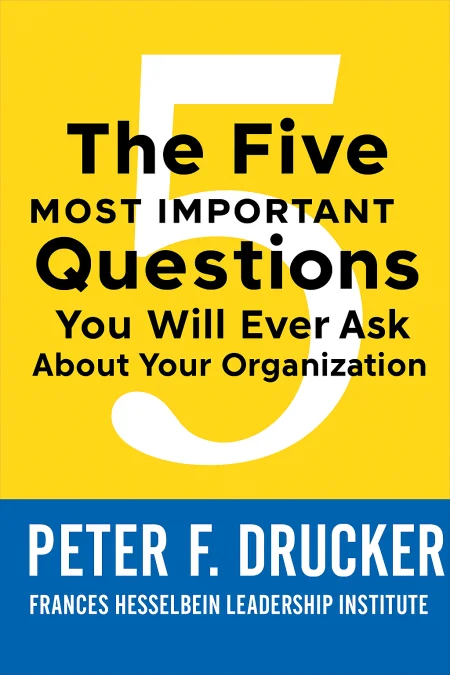
The Five Most Important Questions You Will Ever Ask About Your Organization
Revitalize your business with these five questions
byPeter F. Drucker, Frances Hesselbein Leadership Institute
Book Edition Details
Summary
In the realm of organizational brilliance, five probing questions stand as sentinels to success, thanks to the timeless insights of Peter Drucker. This compact powerhouse of a book, infused with the wisdom of today’s luminary thinkers, is a catalyst for transformative introspection. It beckons leaders to dissect the soul of their enterprise, unveiling the ‘why’ behind every action and decision. More than a guide, it’s a call to action—sparking spirited dialogue and propelling teams toward unprecedented excellence. While rooted in the nonprofit sector, its lessons transcend boundaries, offering universal strategies for any entity eager to make an indelible impact. Prepare to reimagine your path and elevate your organization to new heights.
Introduction
Every organization, regardless of size or sector, faces moments when leaders must step back and ask fundamental questions about their purpose and direction. Whether you're running a small nonprofit, leading a Fortune 500 company, or managing a government agency, the same critical challenges emerge: Are we truly making a difference? Do we understand who we serve? Are we using our resources effectively? These questions become even more urgent in times of rapid change, when traditional approaches may no longer deliver the results we seek. The path to organizational excellence isn't found in complex strategies or expensive consultants, but in the discipline of asking the right questions and having the courage to act on the answers. When organizations embrace this systematic approach to self-examination, they discover not just where they are, but where they need to go and how to get there.
Defining Your Mission and Customers
At the heart of every great organization lies a clear understanding of its fundamental purpose and the people it serves. Your mission isn't just a statement on the wall—it's the driving force that should guide every decision and action. A truly effective mission statement should be so clear and compelling that it could fit on a t-shirt, yet powerful enough to inspire everyone in your organization to say, "Yes, this is something I want to be remembered for." Consider the transformation that occurred at a major hospital emergency room when administrators took time to truly examine their mission. Initially, like most hospitals, they defined their purpose as "health care." But through careful reflection, they realized something profound: the hospital doesn't actually take care of health—it takes care of illness. More specifically, the emergency room's real mission was to give assurance to the afflicted. This simple but powerful realization changed everything about how they operated. Once they understood their true mission, the hospital team discovered that their function was actually to tell eight out of ten people that nothing was seriously wrong—that a good night's sleep would fix their problem, or that while a baby might have convulsions from the flu, there was nothing life-threatening happening. The doctors and nurses were providing something invaluable: peace of mind. This insight led to a revolutionary change in their approach: they ensured that every person who came in was seen by a qualified professional in less than a minute, because that was the only way to truly give assurance. To define your mission effectively, you must work out an exacting match of three critical elements: your opportunities in the external environment, your unique competencies, and your deepest commitments. Start by looking outside your organization at changing demographics, emerging needs, and gaps that need to be filled. Then honestly assess where you can dig in and make a real difference with your particular strengths and resources. Remember that your mission should never be subordinated for money or convenience. Stay true to your core values even when attractive opportunities arise that don't align with your purpose. Keep asking yourself: What do we want to be remembered for? This question will guide you toward a mission that not only inspires action today but creates a legacy for tomorrow.
Creating Value and Measuring Results
Understanding what your customers truly value requires moving beyond assumptions to systematic investigation. Too often, organizations become so convinced they're doing the right things that they stop asking whether they're actually delivering value from their customers' perspective. The most important rule to remember is that there are no irrational customers—people behave rationally based on their own realities and situations. A homeless shelter discovered this truth when they decided to directly ask their customers what they valued most. The shelter's staff believed they were providing excellent value through nutritious meals and clean beds. However, when board and staff members conducted face-to-face interviews with homeless individuals, they learned something startling. While the food and beds were appreciated, they did little to satisfy what people really wanted: not to be homeless anymore. The customers revealed their deeper need: "We need a place of safety from which to rebuild our lives, a place we can at least temporarily call a real home." This revelation completely transformed the shelter's approach. They abandoned their old assumptions and rules, asking instead, "How can we make this shelter a safe haven?" They eliminated the fear that came with being turned back on the street each morning and began working with individuals to understand what a rebuilt life meant to them personally. The new approach also required more from customers—instead of simply showing up hungry, residents had to make commitments to work on their problems and plans in order to stay. To truly understand customer value, you must engage in systematic listening rather than guessing. Create opportunities for direct dialogue with both your primary customers and supporting stakeholders. Look for patterns in feedback, but also pay attention to individual stories that reveal deeper truths about what people need and aspire to achieve. Make customer feedback an ongoing discipline, not a one-time event. Regularly survey those you serve, conduct depth interviews, and create mechanisms for continuous input. Then integrate what you learn into every aspect of your planning and operations, ensuring that the customer's voice is always part of your discussions and decisions.
Building Your Strategic Action Plan
A strategic plan is far more than a document—it's your organization's roadmap for converting intentions into measurable results. Effective planning begins with clear, overarching goals that flow directly from your mission and focus your resources where they can have maximum impact. If you have more than five goals, you essentially have none, because you're spreading yourself too thin to achieve excellence in any area. The mental health center founded by a dedicated husband-and-wife team exemplifies how focused planning can achieve seemingly impossible results. Their primary customers were people diagnosed with schizophrenia who had experienced failure after failure in treatment. Rather than accepting that these individuals were "incurable," the center developed specific measures of progress: Did participants attend group sessions regularly? Did psychiatric hospitalizations decrease? Could individuals recognize their condition by saying "I have had an episode" rather than blaming external forces? Could they set realistic goals for their next steps? After two or more years of intensive, planned intervention, many participants could function independently in the world. Some returned to live with their families, others held steady jobs, and a few even completed graduate school. The center's success came from having one clear bottom line: whether the lives of primary customers fundamentally changed. This singular focus guided every decision about resource allocation and program development. Your plan must balance five critical elements: abandonment of what doesn't work, concentration on your successes, innovation for future opportunities, calculated risk-taking, and systematic analysis of uncertain areas. Begin by honestly assessing what programs or approaches should be abandoned—not because they're bad, but because they're no longer the best use of your limited resources. Build your plan with broad participation from those who will implement it, establishing clear accountability for who will do what by when. Include both qualitative measures that capture the depth of change and quantitative metrics that demonstrate scope and scale. Most importantly, design your plan as a living document that allows for continuous learning and adjustment based on results. Remember that planning is not about predicting the future, but about positioning your organization to create the future you envision.
Summary
The journey toward organizational excellence begins with the courage to ask fundamental questions and the discipline to act on what you discover. As Peter Drucker emphasized, "The most important thing is to ask these questions"—because within the questions themselves lies the power to transform not just what you do, but who you become as an organization. When you consistently examine your mission, understand your customers, create genuine value, measure real results, and plan strategically, you build the foundation for sustained impact and meaningful change. The ultimate test of any organization isn't the elegance of its strategies or the sophistication of its systems, but whether it actually changes lives for the better. Start today by gathering your team and working through these five essential questions, then commit to making this inquiry a regular discipline that keeps your organization focused, effective, and true to its highest purpose.
Related Books
Download PDF & EPUB
To save this Black List summary for later, download the free PDF and EPUB. You can print it out, or read offline at your convenience.
By Peter F. Drucker
