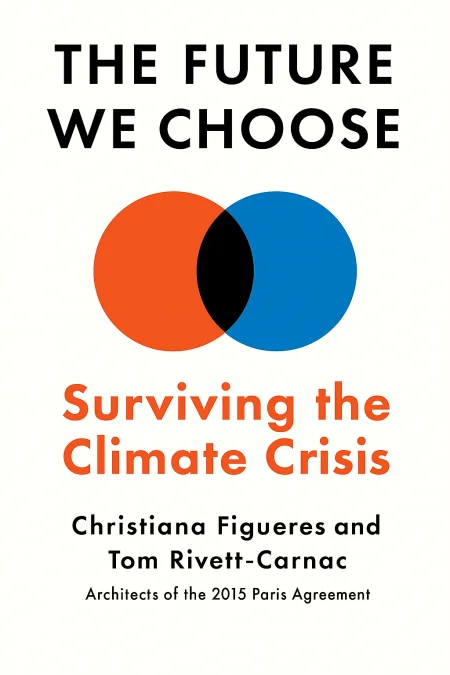
The Future We Choose
Surviving the Climate Crisis
byChristiana Figueres, Tom Rivett-Carnac
Book Edition Details
Summary
In a world teetering on the brink, "The Future We Choose" offers a pivotal blueprint for action amid the escalating climate crisis. Christiana Figueres and Tom Rivett-Carnac, key architects behind the Paris Agreement, deliver a narrative charged with urgency and hope. They paint two starkly different futures: one plagued by environmental collapse and the other flourishing under a balanced ecosystem. This book isn't just a call to action; it's a manifesto for resilience, urging us to confront the climate emergency with courage and optimism. Governments, corporations, and individuals alike are called upon to forge a sustainable path forward. As we stand at this crossroads, the question looms: which future will we choose?
Introduction
In the autumn of 2015, thousands of negotiators from nearly 200 nations gathered in Paris for what would become the most consequential climate talks in history. Just weeks earlier, terrorist attacks had shaken the city, yet world leaders pressed forward, understanding that the stakes were too high to delay. The question hanging over those tense days was simple yet profound: would humanity finally unite to address the greatest challenge it had ever faced? This book emerges from the epicenter of those historic negotiations, written by two architects of the Paris Agreement who witnessed firsthand both the fragility and the power of human cooperation in crisis. Their account reveals not just the political maneuvering behind closed doors, but the deeper psychological and spiritual transformation required to navigate our climate emergency. Through vivid scenarios of two possible futures, they illuminate the stark choice before us and the mindset shifts necessary to choose wisely. The authors offer both unflinching realism about our predicament and stubborn optimism about our capacity to respond. This is essential reading for anyone seeking to understand not just what we must do, but who we must become to ensure a livable future. Their message resonates far beyond environmental circles, speaking to leaders, parents, students, and citizens who recognize that our response to climate change will define the next chapter of human civilization.
Two Worlds: The Climate Crossroads of 2020-2050
We stand at an unprecedented moment in human history, poised between two radically different futures. For the first time, our species possesses both the knowledge and the power to consciously determine the trajectory of life on Earth. The choices we make in this critical decade will echo through centuries, shaping the world our children and their children will inherit. The crossroads before us is stark and unforgiving. Down one path lies a world ravaged by climate chaos, where extreme weather has become the norm, where vast regions have become uninhabitable, and where the social fabric unravels under the pressure of resource scarcity and mass displacement. Cities flood regularly, crops fail repeatedly, and the very air becomes difficult to breathe. This is not distant science fiction but the logical endpoint of our current trajectory. Down the other path lies a world transformed, where humanity has risen to meet its greatest challenge and emerged stronger. Here, clean energy powers thriving cities adorned with forests, where innovation has unlocked abundance rather than scarcity, and where the transition to sustainability has created more jobs, healthier communities, and deeper connections to the natural world. This regenerative future remains within our grasp, but only if we act with unprecedented speed and scale. The window for choice is rapidly closing. Every fraction of a degree of warming matters enormously, every year of delay makes the challenge exponentially harder, and every decision we make locks in consequences for generations. We are the last generation that can prevent catastrophic climate change and the first that must live with its consequences. The responsibility is overwhelming, but so too is the opportunity to write the greatest comeback story in human history.
From Copenhagen Failure to Paris Success (2009-2015)
The journey from the ruins of Copenhagen to the triumph of Paris represents one of the most remarkable transformations in international diplomacy. In December 2009, the UN climate talks in Copenhagen collapsed spectacularly amid recriminations, walkouts, and bitter divisions between rich and poor nations. The Danish hosts had promised "Hopenhagen" but delivered only disappointment and disarray. The failure cut deep because so much had been at stake. World leaders had arrived with great fanfare, environmental groups had mobilized millions of supporters, and the scientific community had issued increasingly urgent warnings. Yet when the moment came, national interests trumped global necessity, and the talks devolved into chaos. One Venezuelan negotiator banged her nameplate on the table until her hand bled, screaming about coups against the United Nations. Blood became the metaphor for a process that seemed fatally wounded. Into this wreckage stepped new leadership determined to change not just the negotiating positions but the entire psychology of climate diplomacy. The key insight was that the impossible had to be made possible through a fundamental shift in mindset. Instead of focusing on what couldn't be done, the new approach emphasized what could be achieved when nations recognized their shared destiny. The transformation required six years of patient relationship-building, creative problem-solving, and stubborn optimism in the face of repeated setbacks. By 2015, a new spirit of cooperation had emerged, driven partly by the growing evidence of climate impacts and partly by the recognition that clean energy represented an economic opportunity, not just an environmental obligation. When the gavel finally came down in Paris, 195 nations had unanimously agreed to limit warming to well below two degrees Celsius, with an aspiration to keep it to 1.5 degrees. The impossible had become inevitable through the power of collective human will.
Three Mindsets: The Transformation of Human Consciousness
The climate crisis demands more than new technologies and policies; it requires a fundamental evolution in how we see ourselves and our relationship to the world. Three interconnected mindsets form the foundation of the transformation we need, each representing a radical departure from the thinking that created our current predicament. Stubborn optimism stands as the first pillar, a fierce determination to believe in possibility even when the evidence seems overwhelming. This is not naive hope but a disciplined practice of focusing on solutions while fully acknowledging the magnitude of the challenge. It means choosing to see every setback as information rather than defeat, every small victory as proof that larger ones are possible. Stubborn optimism becomes a force that shapes reality by refusing to accept failure as inevitable. Endless abundance represents the second mindset shift, moving beyond the scarcity thinking that has driven centuries of competition and extraction. This perspective recognizes that cooperation unlocks resources and possibilities that competition destroys. When we move from a zero-sum to a positive-sum worldview, we discover that everyone can win when we align our efforts with natural systems that regenerate rather than deplete themselves. Radical regeneration completes the transformation, replacing our extractive relationship with the Earth with one of active restoration and care. This mindset sees humans not as separate from nature but as participants in a living system that thrives on diversity, resilience, and mutual support. It recognizes that healing the planet and healing ourselves are the same project, requiring us to become conscious stewards rather than unconscious consumers. These three mindsets work together to create a new form of consciousness adequate to our unprecedented challenges. They offer a path beyond the despair and paralysis that climate change often triggers, providing instead a framework for purposeful action grounded in hope, abundance, and regeneration.
Ten Actions: The Pathway to Regenerative Civilization
The transition to a regenerative future requires concrete action across ten critical domains, each representing a vital thread in the tapestry of transformation. These actions operate at multiple levels simultaneously, requiring changes in individual behavior, corporate strategy, and government policy, all working in concert toward a common goal. The first set of actions focuses on mindset and foundation: letting go of the old world of fossil fuels and extraction, facing our grief about what we've lost while holding a vision of what we can still create, and defending the truth against the forces of misinformation and denial. These psychological and cultural shifts create the space for more tangible changes to take root and flourish. The middle group addresses our economic and social systems: seeing ourselves as citizens rather than consumers, moving decisively beyond fossil fuels to renewable energy, reforesting the Earth on a massive scale, and investing in a clean economy that serves all life rather than just human profit. These changes require unprecedented cooperation across sectors and unprecedented speed in implementation. The final actions tackle the deeper structural challenges: using technology responsibly as a tool for regeneration rather than further extraction, building gender equality as essential to wise decision-making, and engaging fully in the politics necessary to make all the other changes possible. Each action reinforces the others, creating momentum that can overcome even the most entrenched resistance. Success requires pursuing all ten actions simultaneously, recognizing that partial measures will not suffice when facing an existential challenge. The scale and urgency may seem daunting, but history shows that humans are capable of remarkable transformation when survival is at stake. The pathway is clear; what remains is the will to walk it together.
Summary
The climate crisis represents humanity's greatest test, but also its greatest opportunity for conscious evolution. The central tension running through our historical moment is between the momentum of extraction and the imperative of regeneration, between the habits of separation and the necessity of cooperation, between the comfort of denial and the courage required for transformation. This confrontation with planetary limits has forced us to confront the limits of our current ways of thinking and being. The solutions to climate change are not merely technical but fundamentally spiritual and cultural, requiring us to remember our deep interconnection with all life and to act from that remembrance. The choice before us is not just between different energy systems but between different versions of ourselves. The pathway forward demands three essential commitments: first, we must cultivate stubborn optimism that refuses to accept defeat while acknowledging the full magnitude of our challenge; second, we must embrace the abundance that flows from cooperation and regeneration rather than competition and extraction; finally, we must engage in the concrete actions necessary to transform our energy systems, our economies, our politics, and ultimately ourselves. The future we choose will be determined not by fate but by the depth of our commitment to life itself.
Related Books
Download PDF & EPUB
To save this Black List summary for later, download the free PDF and EPUB. You can print it out, or read offline at your convenience.
By Christiana Figueres
