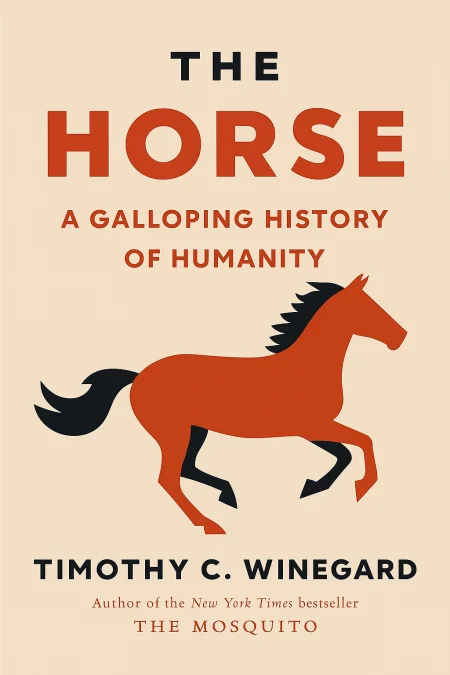
The Horse
A Galloping History of Humanity
Book Edition Details
Summary
In the grand tapestry of human history, one creature stands as both muse and partner in our evolution: the horse. More than a mere beast of burden, its swift and powerful form has been instrumental in shaping the world as we know it. From the vast steppes of Eurasia to the bustling streets of New York, horses have played a pivotal role in the rise and fall of civilizations, fueling conquests and aiding in the establishment of empires. They transformed travel and trade, drove innovations in agriculture, and even altered the genetic makeup of humanity itself. "The Horse" is a captivating chronicle that gallops through the ages, unveiling the indelible hoofprints left on our cultural and technological landscapes. It’s a stirring tale of endurance and influence, illuminating how these majestic animals have not just accompanied us on our journey, but have defined it.
Introduction
Around 5,500 years ago on the windswept grasslands of the Eurasian Steppe, a moment occurred that would forever alter the trajectory of human civilization. A daring individual approached a wild horse and, in an act that combined desperation with vision, climbed onto its back. This seemingly simple encounter between human and horse unleashed what we might call the greatest partnership in history—a collaboration so profound that it touches every aspect of our modern world, from the languages we speak to the borders of our nations. Most of us today see horses as noble companions relegated to racetracks and riding schools, yet for over five millennia, these magnificent creatures were the engines of human progress. They were humanity's first great technology, predating the wheel and rivaling agriculture in their transformative impact. This exploration reveals how horses became the invisible hand guiding human history, powering the rise of empires, facilitating trade across continents, and deciding the fate of civilizations through their speed, strength, and partnership with human ambition. Understanding this relationship illuminates three fundamental questions that shaped our world: How did mastery of the horse create the first truly global civilizations capable of projecting power across vast distances? Why did agricultural societies with superior numbers and resources repeatedly fall to mounted nomads? And what can the horse's eventual replacement by machines teach us about technological disruption and human adaptation? Whether you're fascinated by military history, intrigued by the rise and fall of empires, or curious about the hidden forces that created our interconnected world, this journey through five thousand years of human-horse partnership offers fresh insights into the dynamics that continue to shape our modern age.
From Domestication to Empire: The Ancient Horse Revolution (3500 BCE-500 CE)
The story begins not with conquest, but with survival and an environmental crisis that forced both humans and horses to adapt or perish. Around 3500 BCE, climate change transformed the lush forests of the Pontic-Caspian Steppe into vast grasslands, threatening the extinction of wild horse populations that had survived the Ice Age. Archaeological evidence from sites like Botai in Kazakhstan reveals how human communities gradually learned to partner with these magnificent creatures, initially for milk and meat, then for transportation and warfare. This domestication process unleashed the Indo-European expansion, one of history's most dramatic demographic transformations. Mounted warriors and herders spread from their steppe homeland across Europe, Asia, and into India, carrying languages that would evolve into most modern European tongues. These horse-riding peoples didn't simply migrate—they conquered, establishing themselves as ruling elites and imposing their culture on existing populations. The same mobility that enabled this expansion also created the first long-distance trade networks, connecting civilizations separated by thousands of miles and laying the groundwork for global commerce. The military revolution was equally profound. The development of cavalry warfare transformed conflict from local skirmishes into continental campaigns. Alexander the Great's conquests exemplified this new reality, as his Companion Cavalry became the spearhead of an empire stretching from Greece to India. His success demonstrated that horses were force multipliers, enabling rapid movement across vast distances and providing the mobility necessary to maintain control over conquered territories. The psychological impact was as significant as the tactical advantage—the thundering charge of mounted warriors became a defining image of military might. By 500 CE, horses had fundamentally altered the balance of power across Eurasia. The Roman Empire's relative weakness in cavalry contributed to its vulnerability against mounted barbarian tribes, while Chinese dynasties bankrupted their treasuries pursuing "heavenly horses" from Central Asia. This period established patterns that would define the next millennium: the inherent advantage of mobility over static defense, the crucial importance of controlling horse-breeding regions, and the transformative power of technologies that compress distance and time. The ancient horse revolution had created the template for all future forms of globalization.
Cavalry Kingdoms and Medieval Warfare: The Age of Mounted Dominance (500-1500 CE)
As the Roman Empire crumbled under pressure from mounted barbarian tribes, a new social order emerged across Eurasia built entirely around the horse. The stirrup, that revolutionary Chinese invention, transformed warfare by allowing heavily armored knights to fight effectively from horseback while maintaining stability and leverage. This technological shift gave birth to feudalism in Europe, a hierarchical system where land was granted in exchange for military service, and that service was measured in mounted warriors capable of delivering devastating cavalry charges. The Islamic conquests of the seventh and eighth centuries demonstrated the continued supremacy of mobile forces on a global scale. Arabian horsemen, mounted on swift desert steeds and inspired by religious fervor, carved out an empire stretching from Spain to Central Asia in barely a century. Their success lay in combining the speed and mobility inherited from nomadic traditions with disciplined military organization. When these forces finally met serious resistance at the Battle of Tours in 732, it was Charles Martel's heavy cavalry that turned the tide, revealing the clash between different cavalry traditions that would define medieval warfare. The period reached its climax with the rise of the Mongols under Genghis Khan, who created the largest contiguous land empire in human history through their mastery of mounted warfare. Each Mongol warrior maintained multiple horses, enabling them to cover incredible distances without rest and strike with devastating speed. Their composite bows, fired from horseback with deadly accuracy, made traditional fortifications obsolete. The Mongol Empire's rapid expansion demonstrated how horses could compress both time and space, allowing relatively small forces to project power across continental distances and maintain control through superior mobility and communication networks. This era established horses as the foundation of entire social systems and administrative structures. The knight was not merely a warrior but the cornerstone of medieval society, his mounted status literally elevating him above common foot soldiers. Horse-powered communication networks, exemplified by the Mongol Yam system, enabled empires to maintain control over vast territories through rapid transmission of orders and information. The enormous expense of maintaining warhorses and their equipment created military aristocracies that would dominate politics for centuries, while the period concluded with horses facilitating both the Crusades and the rise of centralized nation-states, setting the stage for the age of exploration and global conquest that would follow.
Colonial Expansion and Plains Warriors: Horses Transform the New World (1500-1900 CE)
The arrival of horses in the Americas after 1492 triggered one of history's most dramatic biological and cultural transformations. When Spanish conquistadors brought horses to the Caribbean and mainland, they reintroduced a species extinct in the Americas for over 9,000 years. This reunion proved as significant as any military campaign, fundamentally altering the balance of power between European colonizers and indigenous peoples while reshaping entire ecosystems and ways of life across two continents. The immediate impact was both military and psychological. Indigenous peoples, who had never encountered horses, initially viewed mounted conquistadors as supernatural beings—centaur-like creatures combining human intelligence with animal power. This psychological advantage proved crucial in early encounters, enabling relatively small Spanish forces to overwhelm much larger indigenous armies and establish control over vast territories. The conquest of the Aztec and Inca empires demonstrated how horses served as force multipliers, allowing European colonizers to project power far beyond their numerical strength. Yet the most profound transformation occurred as horses escaped Spanish control and spread across the Great Plains of North America. Indigenous peoples quickly recognized their potential and became master horsemen themselves, with tribes like the Comanche, Lakota, and Apache developing sophisticated horse cultures that enabled them to dominate vast territories and resist European expansion for centuries. The horse transformed these societies from sedentary farmers into mobile hunters and warriors, creating a golden age of Plains Indian culture that would become iconic in American mythology while demonstrating the democratizing power of transformative technologies. The period concluded with tragic irony as the same Industrial Revolution that provided Plains tribes with horses through trade also supplied their enemies with railroads, telegraphs, and repeating rifles. The defeat of the last horse warriors at Wounded Knee in 1890 marked not just the end of the Indian Wars, but the beginning of the end for horse-based military power worldwide. Meanwhile, feral horse populations had exploded across suitable habitats from Argentina to the western United States, creating new ecosystems while horse-enabled expansion of cattle ranching and agriculture transformed landscapes across the Americas. By 1900, horses had become so integral to American life that the young nation had developed its own distinct equestrian culture, even as mechanization was preparing to render it obsolete.
Industrial Twilight: The Final Century of Horse Supremacy (1800-1950 CE)
The nineteenth and early twentieth centuries marked both the zenith and twilight of the horse age, as industrialization paradoxically increased rather than decreased human dependence on equine power. Urban centers like London, Paris, and New York became horse-powered metropolises, with hundreds of thousands of horses pulling omnibuses, delivery wagons, fire engines, and private carriages through crowded streets. The "Great Manure Crisis" of the 1890s, when cities literally began drowning in horse waste, illustrated just how central these animals had become to modern civilization and the urgent need for technological solutions. The World Wars of the twentieth century represented the final great military campaigns of the horse age, with over sixteen million horses serving during World War I alone and suffering eight million casualties in what became the bloodiest conflict for horses in history. These animals hauled artillery, carried supplies, and transported wounded soldiers across mechanized battlefields, even as new technologies like tanks, airplanes, and motor vehicles began challenging their supremacy. The contrast was starkest in World War II, where heavily mechanized Allied forces faced German armies that still depended largely on horses for transport, with German reliance on over two million horses highlighting industrial weaknesses rather than strength. The transition from horse to machine power accelerated dramatically during the interwar period and reached completion by 1950. Henry Ford's assembly-line production of automobiles and tractors finally provided practical alternatives to horse power, while the internal combustion engine offered advantages in speed, reliability, and maintenance that horses could not match. Tractors replaced farm horses, automobiles eliminated urban horse transport, and mechanized armies made cavalry obsolete, completing a technological revolution that had been building for decades. Yet this transformation represented not the end of the human-horse relationship, but its evolution into new forms focused on recreation, sport, therapy, and conservation. More significantly, the infrastructure, trade networks, cultural patterns, and institutional frameworks created during five millennia of horse-human partnership remained embedded in modern civilization. Roads built for horse-drawn vehicles became highways for automobiles, communication networks established for mounted messengers evolved into global telecommunications systems, and the mobility and connectivity that horses had made possible provided the foundation for our modern interconnected world. The age of the horse had ended, but its legacy continued to shape the mechanized civilization that followed.
Summary
The domestication of the horse around 3500 BCE represents one of history's most consequential technological breakthroughs, comparable in transformative impact to the development of agriculture, writing, or the steam engine. For over five millennia, horses served as the primary engines of human expansion, conquest, and cultural exchange, enabling the rise and fall of empires, the spread of languages and religions, and the creation of the interconnected world we inhabit today. From the Indo-European migrations that reshaped prehistoric Europe to the Mongol conquests that linked East and West, from the Spanish colonization of the Americas to the mechanized warfare of the twentieth century, horses were not merely witnesses to history but active participants in shaping its course through their unique combination of speed, strength, and trainability. This partnership reveals fundamental truths about technological disruption and human adaptation that remain relevant in our current age of rapid change. The horse revolution demonstrates how transformative technologies often emerge from partnerships with natural systems rather than attempts to dominate them, and how the most successful societies actively embrace and improve upon innovations rather than simply adopting them. It shows how increased mobility and connectivity, while enabling unprecedented achievements, also accelerate the spread of conflicts, diseases, and environmental changes across vast distances. Most importantly, it illustrates how the infrastructure and skills developed for one technological era often provide the foundation for the next, meaning that investments in learning and adaptation pay dividends across multiple cycles of change. As we navigate contemporary challenges of globalization, artificial intelligence, and environmental disruption, the history of human-horse partnership offers three crucial insights for building sustainable progress. First, the most powerful technologies are often biological or hybrid systems that work with natural processes rather than against them. Second, technological advantages are temporary, but the societies that master them shape the future by creating new forms of organization, communication, and cultural exchange. Finally, successful adaptation requires recognizing that profound changes often result not from human intentions alone, but from complex partnerships between humans, technology, and the natural world. Understanding this five-thousand-year collaboration helps us better navigate our current relationship with emerging technologies, recognizing that our choices today will shape civilization for millennia to come.
Related Books
Download PDF & EPUB
To save this Black List summary for later, download the free PDF and EPUB. You can print it out, or read offline at your convenience.
By Timothy C. Winegard
