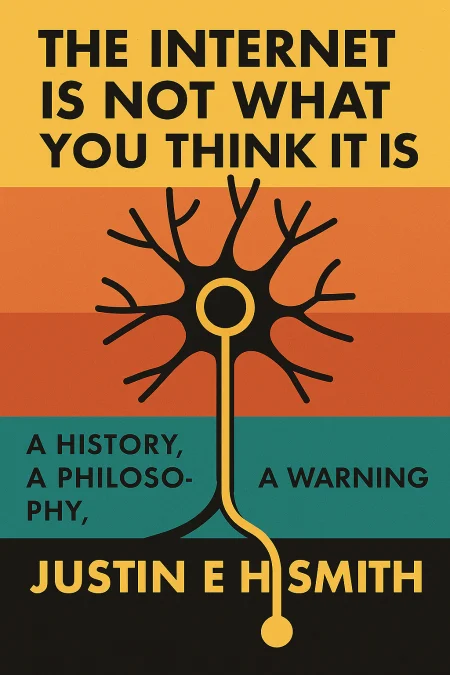
The Internet Is Not What You Think It Is
A History, A Philosophy, A Warning
Book Edition Details
Summary
In a world where pixels blur the line between reality and illusion, Justin Smith unearths the lost dreams that once danced at the heart of the internet. "The Internet Is Not What You Think It Is" unfolds like a tapestry woven from centuries of ambition and invention, stretching back to when human imagination first dared to connect minds across unseen distances. From the whispering trees of nature to the rhythmic pulse of silk looms, Smith charts an extraordinary journey that challenges our understanding of digital landscapes. Yet, as this narrative threads through history, a stark revelation emerges: the utopian visions that once fueled our digital odyssey now falter under the weight of relentless social media storms and a ravenous information economy. Blending rich philosophy with a sharp-eyed critique, Smith invites us to question the very essence of connectivity and the future it beckons.
Introduction
The internet stands at the center of a profound crisis that extends far beyond mere technological disruption. While tech leaders promise social connection and democratic participation, the reality reveals something more troubling: a system that systematically harvests human attention as a natural resource, transforming users into data sources while undermining their capacity for sustained thought and genuine deliberation. This crisis emerges not from technological failure, but from a fundamental misunderstanding of what the internet actually represents in the broader sweep of human and natural history. The analysis here traces the internet's true genealogy through centuries of philosophical and technological development, revealing it as neither unprecedented disruption nor neutral tool, but as the latest manifestation of ancient human drives toward connection and communication. By examining historical precedents from Leibniz's calculating machines to medieval weaving technologies, from ancient theories of cosmic interconnection to early modern information processing dreams, a different picture emerges. The internet appears not as an alien force imposed upon humanity, but as a natural outgrowth of species-specific capacities for symbolic exchange and network formation that stretch back to the earliest human societies. This genealogical perspective offers both sobering insights into current predicaments and grounds for more thoughtful engagement with technological futures.
Smith's Central Thesis: The Internet as Natural Extension
The fundamental argument presented here challenges the prevailing narrative of technological exceptionalism that treats the internet as a radical departure from human history. Instead, the internet represents the most recent expression of communication networks that have existed throughout the natural world for millions of years. When elephants send seismic signals across kilometers or sperm whales click messages across ocean basins, they engage in forms of telecommunication that differ from human internet use primarily in scale and complexity, not in essential character. This perspective reframes human technological development as continuous with rather than opposed to natural processes. The same principles governing plant communication through airborne chemicals or fungal networks connecting forest root systems also underlie human information networks. What appears as artificial intelligence or technological revolution actually represents the activation of capacities inherent in living systems from the beginning. The internet becomes not humanity's conquest over nature, but nature expressing itself through human activity. The implications prove far-reaching for understanding current technological predicaments. If the internet represents a natural extension of human communicative capacity, then problems like addiction, surveillance, and social fragmentation stem not from technology itself, but from particular economic and social arrangements that corrupt these natural capacities. The solution lies not in rejecting technology, but in reorganizing it according to principles that support rather than undermine human flourishing. This requires understanding the internet as part of the broader ecological reality in which human beings are embedded, rather than as an escape from or transcendence of natural limitations.
Historical Genealogy: From Ancient Networks to Digital Systems
The internet's history extends far beyond the recent decades of digital development to encompass centuries of speculation about universal connection and mechanical reasoning. Ancient Stoic philosophers conceived the cosmos as a unified living system where changes in distant parts instantaneously affect the whole, providing the conceptual foundation for later telecommunication dreams. Medieval scholars like Ramon Llull designed mechanical systems for processing symbolic information, while Roger Bacon's legendary brazen head promised to answer any question put to it. These early visions gained practical expression through figures like Leibniz, whose binary calculus and mechanical calculators established principles still governing digital systems today. His conviction that formal reasoning could resolve human conflicts by reducing disputes to calculation demonstrates the utopian aspirations that have consistently driven information technology development. The transition from medieval alchemy to modern computation involved not abandonment of magical thinking, but its channeling into mechanical forms that promised similar powers through different means. The crucial insight emerges from tracing these genealogical connections across centuries. Each generation believed it was creating something unprecedented, yet consistently built upon and extended earlier projects. The optical telegraph of the 1790s, electrical systems of the 1840s, and digital networks of recent decades all represent variations on persistent themes of instantaneous communication and mechanical reasoning. Understanding this continuity reveals that current technological disruptions follow patterns established long ago, suggesting that future developments will likely extend rather than transcend historical precedents. Contemporary problems with internet technology thus reflect not technological novelty, but the working out of tensions embedded in these projects from their origins. The dream of rational discourse mediated by machines has consistently confronted the reality that mechanical systems cannot capture the full complexity of human judgment and deliberation. Recognizing this genealogical depth provides perspective on current predicaments while suggesting resources for addressing them.
Challenging Technological Exceptionalism and AI Mythology
The contemporary discourse surrounding artificial intelligence rests on fundamental philosophical confusions that obscure rather than clarify the nature of mechanical information processing. Claims about imminent machine consciousness or artificial general intelligence typically conflate computational ability with genuine understanding, assuming that sufficiently complex algorithms will spontaneously develop the capacity for judgment, emotion, and self-awareness. Yet no amount of increased processing power or algorithmic sophistication bridges the gap between mechanical operations and conscious experience. This confusion reflects a broader tendency to anthropomorphize machines while simultaneously mechanizing human beings. Social media platforms transform users into data sources whose behavior gets modeled as algorithmic processes, while artificial systems receive attribution of human-like qualities they cannot possess. The result creates a double distortion where humans understand themselves as crude versions of their own technological creations, while machines receive credit for capacities that exist only in human minds that interpret their outputs. The historical perspective reveals that every generation has been tempted to imagine its most sophisticated machines as approaching consciousness or intelligence. Medieval scholars attributed reasoning to mechanical calculators, while nineteenth-century theorists described steam engines as thinking systems. Contemporary claims about artificial intelligence represent the latest variation on this persistent pattern of projection rather than genuine technological breakthrough. The machines remain sophisticated tools for processing information according to predetermined patterns, regardless of their speed or complexity. Recognizing these limitations does not diminish the significant capabilities of contemporary information systems, but locates them properly within the domain of mechanical assistance rather than artificial mentality. The most sophisticated algorithms excel at pattern recognition, prediction, and optimization within clearly defined parameters, but cannot engage in the open-ended reflection and judgment that characterizes conscious thought. Understanding this distinction proves crucial for developing appropriate relationships with technological systems that enhance rather than replace human capacities.
Evaluating the Ecological Metaphor and Its Implications
The conception of the internet as a natural outgrowth of communication networks that permeate living systems provides both illuminating insights and important limitations that require careful evaluation. On one hand, this ecological perspective successfully challenges the artificial separation between human technology and natural processes that has obscured the internet's deeper significance. Recognizing continuities between fungal networks, animal communication systems, and digital information exchange reveals the internet as part of broader patterns of connection and information flow that characterize living systems generally. This framework proves particularly valuable for understanding the internet's capacity to generate emergent properties that exceed the intentions of its human creators. Like ecological systems that develop complex interdependencies through countless individual interactions, the internet exhibits self-organizing behaviors that resist centralized control or prediction. The rise of social media phenomena, viral content distribution, and algorithmic recommendation systems all demonstrate how simple rules governing individual interactions can produce complex system-level behaviors that no single agent designs or controls. However, the ecological metaphor also risks obscuring important differences between natural and technological systems that matter for practical decision-making. Natural ecosystems develop through evolutionary processes operating over vast timescales, while human technological systems emerge through conscious design decisions made by particular individuals and institutions with specific interests and objectives. The internet's current configuration reflects deliberate choices about surveillance, data extraction, and attention manipulation rather than inevitable natural development. Furthermore, natural systems typically exhibit resilience and self-regulation that prevent any single component from dominating the whole system's behavior, while technological networks can be captured and directed by concentrated economic and political power in ways that serve narrow interests rather than systemic health. The ecological perspective must therefore be balanced with critical analysis of the social and economic forces shaping internet development, recognizing both natural continuities and historically specific forms of technological organization that remain subject to human choice and change.
Summary
The internet emerges from this analysis not as unprecedented technological revolution, but as the most recent expression of communicative capacities that have evolved with human beings throughout their history and that connect them to broader patterns of information exchange characterizing living systems generally. This genealogical understanding reveals current technological predicaments as arising not from the essential nature of digital systems, but from particular social and economic arrangements that corrupt these systems' potential for supporting human flourishing. The path forward requires neither wholesale rejection of internet technology nor uncritical embrace of its current forms, but thoughtful reorganization guided by understanding of both technological capabilities and human needs developed through centuries of philosophical and practical investigation into the nature of communication, community, and conscious life.
Related Books
Download PDF & EPUB
To save this Black List summary for later, download the free PDF and EPUB. You can print it out, or read offline at your convenience.

By Justin E.H. Smith
