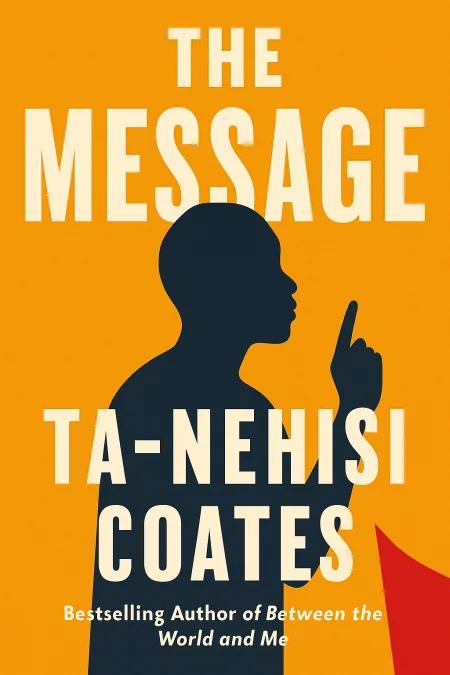
The Message
Exploring Myths that Shape our Identity and Reality
Book Edition Details
Summary
In "The Message" (2024), Ta-Nehisi Coates challenges us to question the narratives that shape our understanding of the world. From the bustling streets of Dakar to the solemn remnants of slave castles, he confronts the African roots of his Afrocentric upbringing. In Columbia, South Carolina, Coates encounters the fervor and friction of a community grappling with the aftermath of a racial awakening. His journey reaches a crescendo in Palestine, where the stark contrast between myth and reality becomes undeniable. Coates weaves these experiences into a tapestry of truth, urging us to see beyond the stories we've been told. This masterful exploration of myth and identity invites readers to engage with the raw, unvarnished truths that underlie our collective consciousness.
Introduction
Political writing has always existed at the intersection of art and activism, where the craft of language meets the urgent demands of social transformation. This exploration reveals how writers from marginalized communities carry a unique burden and opportunity: their words must not only achieve literary excellence but also serve the broader project of human liberation. The author demonstrates that for those whose humanity has been historically questioned, even the most intimate and particular aspects of writing become inherently political acts. Through a synthesis of memoir, journalism, and cultural criticism, the narrative traces how educational systems, media institutions, and political powers work to contain and control the stories that can be told. The journey spans from West African shores to Palestinian territories, from American classrooms to South African apartheid collaborations, revealing the consistent patterns by which oppressive systems seek to manage narrative and memory. Readers will witness how the act of bearing witness through writing becomes both a form of resistance and a sacred responsibility to ancestors and future generations.
Writing as Political Action: Beyond Literary Luxury
Writing emerges not as an aesthetic luxury but as an essential tool of political struggle when practiced by those whose very humanity remains contested. The fundamental premise challenges the notion that literature can exist in a neutral space, separate from the power structures that shape society. For communities whose existence has been denied or diminished, every act of storytelling becomes a declaration of human worth and complexity. The craft itself transforms under these conditions. Technical mastery of language, rhythm, and narrative structure serves purposes beyond artistic achievement. These tools become instruments for expanding the boundaries of who counts as human, for making visible what has been systematically erased, and for haunting readers with truths they cannot easily dismiss. The goal transcends mere persuasion to achieve a deeper haunting that reshapes consciousness. This political dimension of writing manifests most clearly in the relationship between style and content. When marginalized writers achieve technical excellence while maintaining authentic connection to their communities, they demonstrate that intellectual sophistication and cultural rootedness are not opposing forces. Instead, they create a synthesis that challenges dominant narratives about who possesses the capacity for complex thought and artistic creation. The responsibility inherent in this position cannot be understated. Writers from oppressed communities serve as both artists and stewards, carrying forward ancestral voices while creating new possibilities for future generations. Their success or failure has implications that extend far beyond individual careers to the collective project of liberation itself.
The Colonial Mythology of Vindicationist Narratives
The construction of racial hierarchies has always required elaborate intellectual scaffolding to justify material exploitation. Historical analysis reveals how scholars like Josiah Nott and George Gliddon systematically distorted archaeological and anthropological evidence to support theories of Black inferiority. Their work on ancient Egypt exemplifies the broader project of severing African peoples from any claim to civilization or achievement. These scholarly distortions created what might be called "vindicationist pressure" on subsequent generations of Black intellectuals. Faced with systematic denial of their humanity and history, many Black writers and thinkers felt compelled to construct counter-narratives that emphasized African greatness, ancient kingdoms, and royal lineages. While understandable as a response to dehumanization, this vindicationist tradition carries its own limitations and contradictions. The fundamental problem with vindicationist approaches lies not in their factual claims about African civilizations, but in their acceptance of the oppressor's basic framework. By arguing that Black people deserve respect because of past kingdoms and pharaohs, these narratives implicitly accept the premise that human worth derives from political power and monumental architecture. This framework ultimately serves the interests of those who measure value through domination rather than inherent dignity. A more radical approach rejects both the denigration of Africa and the need to prove worthiness through ancient achievements. Human dignity resides in consciousness and experience, not in stone monuments or political hierarchies. The challenge for contemporary writers is to move beyond both the lies of racial pseudoscience and the reactive myths of vindicationist thinking toward a more complex understanding of human value that transcends the colonizer's categories entirely.
Educational Systems as Tools of Ideological Control
Educational institutions function as crucial sites for reproducing political order through the cultivation of particular forms of consciousness. Paulo Freire's concept of "banking education" illuminates how traditional pedagogical methods train students to receive, memorize, and repeat information without developing critical faculties that might challenge existing power structures. This system serves oppressive interests by creating citizens who adapt to the world as it is rather than imagining how it might be transformed. The banking model particularly damages students whose learning styles or cultural backgrounds differ from institutional norms. Those who require kinesthetic engagement, storytelling approaches, or collaborative learning environments often find themselves labeled as deficient or disruptive. This labeling process serves ideological functions beyond individual academic assessment, creating artificial hierarchies that mirror and justify broader social inequalities. Contemporary attacks on critical race theory and related educational content represent sophisticated extensions of these control mechanisms. By mobilizing parental concerns and legislative power, opponents of transformative education seek to eliminate precisely those analytical tools that might enable students to understand systemic oppression. The language of protecting children from "discomfort" or "divisive concepts" masks a deeper project of intellectual containment. The alternative involves creating educational spaces where students develop genuine critical consciousness through engagement with challenging materials and perspectives. This requires moving beyond both reactionary censorship and liberal guilt-management toward pedagogical approaches that treat students as capable of grappling with complex truths about power, history, and social organization. The goal is not to indoctrinate students with particular conclusions but to equip them with analytical capabilities that serve human liberation rather than elite control.
Palestine and the Reckoning with American Complicity
The examination of Israeli policies toward Palestinians reveals the contemporary operation of colonial logics that many Americans assume belong to distant history. Direct observation of checkpoints, settlements, and military occupation demonstrates how apartheid-style systems continue to function with explicit American support and financial backing. This reality forces a confrontation with the gap between democratic rhetoric and imperial practice. The historical connections between Zionist ideology and American colonial precedents are neither accidental nor incidental. Early Zionist leaders explicitly modeled their project on American westward expansion, viewing Palestinians through the same dehumanizing lens that Americans applied to Indigenous peoples. This parallel extends to the creation of mythological narratives that erase indigenous presence while celebrating settler achievement as civilizational progress. American journalism and cultural production have played crucial roles in obscuring these realities through selective reporting, passive voice constructions, and the systematic exclusion of Palestinian perspectives. The near-complete absence of Palestinian writers from major American publications represents a form of narrative apartheid that enables material apartheid. By controlling who can speak and what stories can be told, media institutions participate directly in the maintenance of oppressive systems. The reckoning required involves more than policy criticism or tactical disagreement with particular Israeli actions. It demands acknowledgment that American institutions, resources, and narratives have been central to the creation and maintenance of a system that denies basic human rights to millions of people. This recognition leads necessarily to questions about the nature of American democracy itself and the possibility of genuine transformation rather than cosmetic reform.
Summary
The central insight emerging from this analysis is that writing, when practiced by those whose humanity is systematically denied, becomes an inherently political act that carries both tremendous power and profound responsibility. The examination reveals how oppressive systems consistently seek to control narrative as a means of managing consciousness, whether through educational censorship, media exclusion, or the creation of false historical mythologies. The journey through various sites of struggle demonstrates that the capacity to tell one's own story represents a fundamental form of freedom that dominant powers work tirelessly to constrain. Rather than viewing this political dimension as a burden that compromises artistic integrity, the analysis suggests that engaging directly with questions of power and justice can deepen rather than diminish literary achievement. This work will resonate most strongly with readers committed to understanding how cultural production intersects with political transformation and those seeking to develop their own capacity for bearing witness through language to the struggles of our time.
Related Books
Download PDF & EPUB
To save this Black List summary for later, download the free PDF and EPUB. You can print it out, or read offline at your convenience.
By Ta-Nehisi Coates
