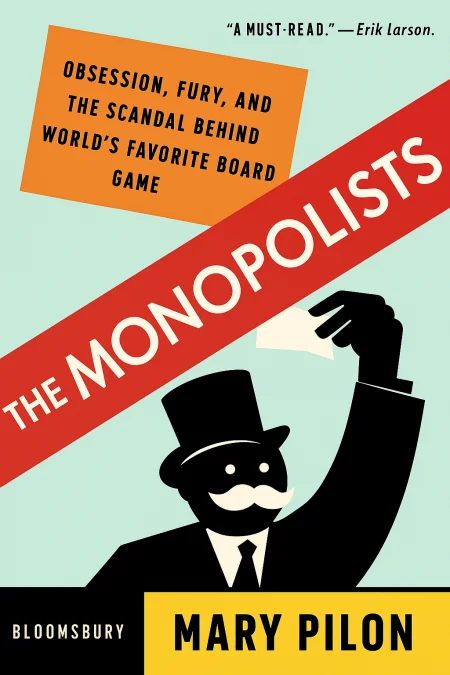
The Monopolists
Obsession, Fury and the Scandal Behind the World's Favorite Board Game
Book Edition Details
Summary
In the colorful tapestry of American capitalism, Monopoly stands as an unlikely symbol—a game whose roots are as twisted and tangled as the paths to victory on its board. "The Monopolists" spins a riveting yarn about this iconic pastime, unraveling the buried truth of its inception. Forget the myth of a Depression-era hero selling his creation to Parker Brothers; this tale is far richer. Meet Ralph Anspach, the relentless academic who uncovered the tale of Lizzie Magie, the forgotten feminist whose "Landlord's Game" laid the foundation. Her vision, starkly opposed to the winner-takes-all ethos of Monopoly, was embraced by thinkers from Lincoln’s era to FDR’s Brain Trust. This narrative isn’t just about a board game—it’s a detective story of corporate greed and cultural transformation, offering a rare glimpse into the underbelly of American enterprise.
Introduction
In the depths of the Great Depression, a family game night would unknowingly ignite one of the most fascinating legal battles in American corporate history. When economics professor Ralph Anspach created Anti-Monopoly in 1973, he thought he was simply making a board game that would teach his sons about the dangers of economic monopolies. What he discovered instead was a century-long web of deception, forgotten inventors, and corporate manipulation that had buried the true origins of America's most beloved board game. This remarkable story reveals how a forgotten woman inventor's progressive vision was systematically erased from history, replaced by a carefully crafted corporate mythology. It exposes the ruthless business practices that allowed a small New England game company to build an empire on someone else's ideas, and shows how one man's quest for truth ultimately challenged the very foundations of American trademark law. The tale illuminates fundamental questions about creativity, ownership, and power that remain startlingly relevant in our digital age. For anyone curious about the hidden forces that shape our culture, the untold stories behind familiar brands, or the ongoing struggle between individual inventors and corporate giants, this history offers both cautionary tales and inspiring examples of persistence against overwhelming odds. It demonstrates how even our most innocent childhood entertainments can carry profound political messages and reveal the deeper currents of American society.
The Forgotten Inventor: Lizzie Magie and the Landlord's Game (1903-1935)
At the dawn of the twentieth century, while America's robber barons were consolidating their industrial empires, an unlikely revolutionary was quietly designing what would become the world's most famous board game. Elizabeth Magie, known to her friends as Lizzie, was a stenographer in Washington D.C. whose evenings were spent crafting something far more ambitious than entertainment. Working by lamplight in her modest home, she was creating a teaching tool that would expose the fundamental injustices of American capitalism. Lizzie's inspiration came from the radical economic theories of Henry George, whose book "Progress and Poverty" had become a bestseller second only to the Bible. George argued that land should belong to everyone, not be monopolized by wealthy speculators who grew rich simply by owning property while others struggled to afford basic shelter. In 1903, Lizzie patented her Landlord's Game, featuring a square board with properties around the perimeter, a "Go to Jail" space, railroads, and utilities. Players could choose between two sets of rules: one that rewarded monopoly-building, demonstrating capitalism's inherent unfairness, and another that shared wealth more equitably, showing George's single-tax utopia in action. The game spread organically through progressive intellectual circles, from the single-tax community of Arden, Delaware, to economics classrooms at Columbia University and the University of Pennsylvania. Players made their own boards by hand, adapting the rules and property names to local conditions. At Quaker schools and in radical communes, the game became a vehicle for political education, allowing players to experience firsthand how monopolies concentrated wealth and impoverished competitors. What Lizzie could never have imagined was how thoroughly her creation's original message would be inverted. The game she designed to critique capitalism would eventually become its most celebrated symbol, while her own role as inventor would be systematically erased from history. Her story reveals how women's contributions to innovation were routinely minimized or ignored, and how radical ideas could be co-opted and transformed into their exact opposites by corporate interests seeking profit over principles.
Corporate Conquest: Parker Brothers and the Darrow Myth (1935-1975)
By the mid-1930s, as America struggled through the Great Depression, a very different version of events was taking shape in the offices of Parker Brothers in Salem, Massachusetts. The company's president, Robert Barton, had inherited a failing business from his father-in-law and desperately needed a hit product to survive the economic downturn. When Charles Darrow, an unemployed Philadelphia salesman, brought them a game called Monopoly, Barton saw opportunity knocking. Darrow's version was essentially identical to the folk game that had been circulating for decades among Quakers in Atlantic City, complete with all the local street names and even a spelling error that had originated with earlier players. He had learned the game from neighbors who had themselves learned it from others, in an unbroken chain stretching back to Lizzie Magie's original creation. But when Barton asked for the game's history, Darrow spun a tale of desperate innovation, claiming he had invented it himself to entertain his family during their darkest economic hours. Parker Brothers embraced and embellished this origin story because it perfectly captured the American Dream mythology that Depression-era consumers craved. Here was proof that individual ingenuity could triumph over adversity, that a common man could create something valuable from nothing. The company launched an aggressive campaign to acquire all competing versions of the game, purchasing Lizzie Magie's patents for a mere five hundred dollars while buying out other publishers for thousands. They systematically buried evidence of the game's true origins while promoting Darrow as a genius inventor. The Darrow myth became one of the most successful corporate narratives in American history, repeated in millions of game boxes, countless magazine articles, and eventually school textbooks. It demonstrated how powerful companies could literally rewrite history to serve their commercial interests, transforming a complex story of collective creativity into a simple tale of individual triumph. The strategy worked brilliantly: Monopoly became Parker Brothers' flagship product and one of the best-selling games of all time, while its true inventors remained forgotten and its original anti-capitalist message was completely reversed.
Legal Revolution: Ralph Anspach's Fight Against Monopoly (1973-1984)
Four decades later, the carefully constructed Darrow legend would face its most serious challenge from an unexpected source. Ralph Anspach, a economics professor at San Francisco State University, had created his own board game called Anti-Monopoly to teach his sons about the dangers of economic concentration during the 1973 oil crisis. When Parker Brothers sued him for trademark infringement, Anspach could have simply changed his game's name and moved on. Instead, he chose to fight back, launching a legal odyssey that would ultimately expose the greatest deception in board game history. What began as a trademark dispute quickly evolved into something far more significant: a quest to uncover the truth about Monopoly's origins. Anspach and his lawyers embarked on a remarkable investigation, tracking down elderly players who remembered the folk game from the 1920s and 1930s. They discovered Charles Todd, who had taught Darrow how to play, and Ruth Harvey, who had created the Atlantic City version that Darrow had copied. Most importantly, they uncovered the patents and newspaper articles that revealed Lizzie Magie's pioneering role as the game's true inventor. The legal battle consumed nearly a decade of Anspach's life and drove him deep into debt, but it gradually revealed the systematic way Parker Brothers had covered up the game's real history. Under oath, company president Robert Barton admitted that they had known all along that Darrow hadn't invented the game, and court documents showed how the company had deliberately acquired and buried competing versions while promoting their fabricated origin story. The case exposed not just corporate deception but the broader ways that trademark law could be used to stifle competition and control cultural narratives. When the Ninth Circuit Court of Appeals finally ruled in Anspach's favor in 1982, the decision sent shockwaves through corporate America. The court explicitly stated that "the reference to Darrow as the inventor or creator of the game is clearly erroneous," and found that Parker Brothers' trademark on the word "Monopoly" was invalid because the term had become generic. The victory represented more than just one man's triumph over a corporate giant; it demonstrated how determined individuals could challenge even the most entrenched myths and force powerful institutions to confront uncomfortable truths about their past.
Summary
The true story of Monopoly reveals a fundamental tension that runs throughout American history: the conflict between collective creativity and individual ownership, between grassroots innovation and corporate control. What emerged from this investigation was not a simple tale of good versus evil, but a complex illustration of how ideas evolve, how credit is assigned, and how powerful interests can shape the stories we tell ourselves about innovation and success. The game that millions know as a celebration of capitalism began as a critique of it, created by a forgotten woman whose progressive politics were systematically erased by the very system she sought to reform. This history offers crucial lessons for our current era of rapid technological change and increasing corporate concentration. It reminds us to question official narratives, especially those that seem too neat or that perfectly align with existing power structures. It demonstrates the importance of preserving diverse voices and perspectives, particularly those of women and marginalized communities whose contributions are often minimized or forgotten entirely. Most importantly, it shows how individual persistence and legal courage can challenge even the most entrenched corporate mythologies. The Monopoly story suggests that we should approach claims of singular genius with healthy skepticism, recognizing that most innovations emerge from collaborative processes and build on previous work. It encourages us to support independent creators and small businesses against the homogenizing forces of corporate consolidation. And it reminds us that the stories we tell about success and failure, innovation and creativity, have profound implications for how we understand ourselves and our society, making it essential that these narratives reflect truth rather than convenient fiction.
Related Books
Download PDF & EPUB
To save this Black List summary for later, download the free PDF and EPUB. You can print it out, or read offline at your convenience.
By Mary Pilon
