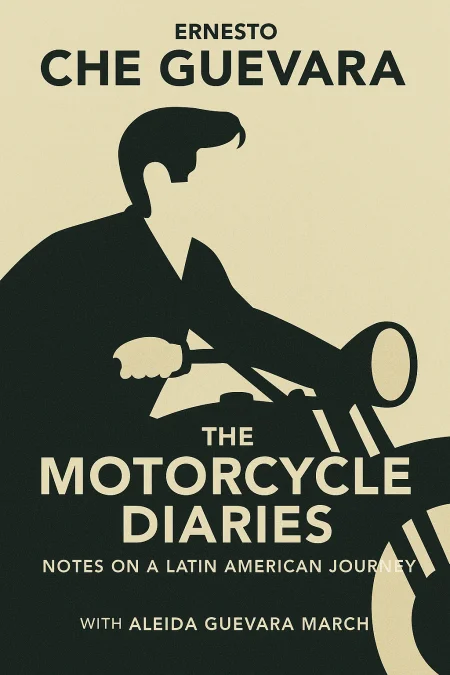
The Motorcycle Diaries
A Motorcycle, a Continent, and a Revolutionary Awakening
byErnesto Che Guevara, Aleida Guevara March
Book Edition Details
Summary
A 23-year-old Ernesto Guevara embarks on a transformative ride across South America, his youthful exuberance and keen eye documenting a continent in all its vibrant complexity. The Motorcycle Diaries, now reimagined with rare photographs and intimate reflections, offers readers an evocative window into Guevara’s early journey from curious traveler to revolutionary thinker. Aleida Guevara's heartfelt preface and Cintio Vintier's illuminating introduction frame this coming-of-age adventure, which is as much about discovering oneself as it is about engaging with the world. Dive into the raw and passionate narratives that reveal not only the landscapes of a diverse continent but also the burgeoning social consciousness of a man destined to become an icon.
Introduction
In the summer of 1951, a young Argentine medical student named Ernesto Guevara set off on a motorcycle journey that would transform not only his understanding of Latin America, but his very identity. At twenty-three, Ernesto was driven by wanderlust and a desire for adventure, traveling with his biochemist friend Alberto Granado across the diverse landscapes of South America. What began as a carefree exploration of distant lands gradually evolved into a profound awakening to the harsh realities of poverty, inequality, and human suffering that plagued the continent. This transformative journey reveals the emergence of social consciousness in a privileged young man who would later become one of the most iconic revolutionary figures of the twentieth century. Through encounters with indigenous communities, leper colonies, and working-class families, Ernesto's perspective shifted from that of a casual observer to an engaged witness of injustice. The diary entries from this expedition capture not only the external adventures of two young travelers, but the internal evolution of a future revolutionary leader. Readers will discover how personal experiences with human suffering sparked a lifelong commitment to social justice, how exposure to different cultures and peoples broadened a narrow worldview, and how the seeds of revolutionary consciousness were planted during these formative months of discovery across Latin America.
Setting Out: Dreams of Adventure and Discovery
The journey began with the romantic idealism of youth and the intoxicating promise of the open road. Ernesto Guevara and Alberto Granado embarked from Argentina in December 1951, their ancient Norton motorcycle dubbed "La Poderosa II" loaded with dreams as much as supplies. For Ernesto, still consumed with his medical studies, this represented an escape from the confining walls of lecture halls and hospitals into a world of unlimited possibility. The initial motivation was pure adventure—two young men seeking to explore the magnificent landscapes and diverse cultures of their continent. Their early days were filled with the typical mishaps and small triumphs of inexperienced travelers. Mechanical breakdowns, punctured tires, and nights spent sleeping rough under the stars were met with good humor and determination. The motorcycle's frequent failures forced them to rely on the kindness of strangers, introducing them to the warmth and generosity that would characterize their reception throughout Latin America. These early encounters with ordinary people—farmers, mechanics, police officers—began to chip away at their privileged assumptions about the world beyond their middle-class Argentine bubble. The journey's initial phase was marked by a spirit of carefree exploration, with Ernesto documenting their adventures with the enthusiasm of a young man discovering his freedom. Yet even in these lighthearted early entries, hints of deeper awareness begin to emerge. The contrast between their own relative comfort and the hardships endured by those who helped them along the way planted the first seeds of social consciousness that would later bloom into revolutionary conviction.
Awakening: Encountering Poverty and Injustice Across Latin America
As Ernesto and Alberto penetrated deeper into the heart of South America, the romanticized vision of their adventure gave way to harsh confrontations with reality. In Chile's copper mines, they witnessed the brutal exploitation of workers toiling in dangerous conditions for meager wages, their lives shortened by silica poisoning and industrial accidents. The contrast between the wealth extracted from these operations and the poverty of those who performed the backbreaking labor left a profound impression on the young medical student. The encounter with indigenous communities proved particularly transformative. Among the Quechua and Aymara peoples of Peru, Ernesto observed firsthand the systematic marginalization and dehumanization of Latin America's original inhabitants. He saw proud ancient civilizations reduced to subservience, their descendants living in conditions of poverty that seemed almost medieval in their severity. The sight of indigenous children with distended bellies from malnutrition, of families crowded into single-room hovels, of people whose "stares are tame, almost fearful" challenged every comfortable assumption about progress and civilization. Perhaps most significantly, the extended stay at the San Pablo leper colony in Peru brought Ernesto face to face with society's most marginalized members. Here, among those afflicted with Hansen's disease, he encountered not monsters or objects of pity, but human beings possessed of dignity, warmth, and profound wisdom. The patients' gratitude for simple acts of human recognition—shaking hands without gloves, sitting and talking as equals—revealed the devastating psychological impact of social ostracism. These experiences began to crystallize Ernesto's understanding that medicine alone could not address the root causes of human suffering when poverty, discrimination, and systemic inequality remained unaddressed.
Transformation: From Medical Student to Revolutionary Consciousness
The accumulation of these encounters gradually transformed Ernesto's understanding of his role as a future doctor and his responsibilities as a privileged member of society. Initially motivated by personal ambition and the desire to make significant medical discoveries, he began to see his profession through the lens of social justice. The realization dawned that treating individual patients while ignoring the systemic conditions that created illness and suffering was fundamentally inadequate. His evolving political consciousness found expression in increasingly sophisticated analysis of Latin America's problems. He began to understand the connections between foreign economic domination, particularly by U.S. interests, and the perpetuation of poverty and inequality across the continent. The observation of American tourists photographing indigenous ceremonies as exotic curiosities while remaining oblivious to the people's actual living conditions symbolized for him the broader pattern of exploitation disguised as benevolent interest. The diary entries from this period reveal a young man grappling with the implications of his newfound awareness. Ernesto's famous toast at the leper colony, proposing solidarity with "a United Latin America," marked a crucial moment in his political awakening. No longer content to view himself merely as an Argentine, he began to embrace a continental identity rooted in shared struggles against common oppressors. This expanded sense of identity would prove crucial to his later revolutionary activities across Latin America. The journey's climactic moment came during a night-time encounter with a mysterious European exile who spoke prophetically about the coming revolutionary transformation of Latin America. This conversation, recorded in his diary's final entry, crystallized Ernesto's emerging conviction that he would stand with the oppressed masses in the inevitable struggle for justice, even if it meant sacrificing his comfortable bourgeois existence.
The Path Forward: Embracing the Struggle for Social Justice
By the journey's end, the young man who had set out as Ernesto Guevara, aspiring doctor and casual adventurer, had been fundamentally transformed. The experiences of eight months traveling through Latin America had awakened a revolutionary consciousness that would define the rest of his life. The comfortable assumptions of his privileged upbringing had been shattered by direct encounters with poverty, exploitation, and human dignity in the face of systematic oppression. The transformation was not merely intellectual but deeply emotional and spiritual. The warmth and generosity shown by the continent's poorest inhabitants, their maintenance of dignity despite crushing circumstances, and their quiet strength in the face of injustice had won Ernesto's heart as much as his mind. He could no longer see these people as abstract objects of study or charity, but as brothers and sisters whose liberation was intrinsically connected to his own moral development. The diary's conclusion reveals a young man who understood that meaningful change required more than individual good intentions or professional expertise. The realization that "to be a revolutionary doctor, there must first be a revolution" marked his recognition that systemic problems demanded systemic solutions. Personal charity and individual achievement, however well-intentioned, could not address the structural inequalities that condemned millions to lives of unnecessary suffering. This journey thus represents the crucial bridge between Ernesto Guevara's comfortable middle-class origins and his emergence as Che Guevara, international revolutionary. The experiences documented in these pages provided the moral foundation and emotional conviction that would sustain him through years of struggle, from the Cuban revolution to his final campaign in Bolivia. The transformation begun on the dusty roads of Latin America would ultimately reshape not only one young man's destiny, but the political landscape of an entire continent.
Summary
Ernesto Guevara's transformative journey across Latin America reveals how direct exposure to injustice and human suffering can awaken even the most privileged individuals to their moral responsibilities toward others. His evolution from comfortable medical student to committed revolutionary demonstrates that authentic social consciousness emerges not from abstract theorizing, but from genuine encounters with those who bear the greatest burdens of systemic inequality. The diary entries capture a universal process of awakening—the moment when comfortable assumptions about the world give way to uncomfortable truths about how societies actually function. For contemporary readers, Guevara's experience offers two crucial insights: first, that meaningful understanding of social problems requires stepping outside one's comfort zone to encounter different realities firsthand, and second, that such encounters impose moral obligations that cannot be easily dismissed. His journey suggests that those blessed with privilege and education have particular responsibilities to use their advantages in service of justice rather than merely personal advancement. This account will resonate especially with young people questioning their role in society, healthcare professionals seeking to understand the social dimensions of their work, and anyone interested in how individual transformation can become a catalyst for broader social change.
Related Books
Download PDF & EPUB
To save this Black List summary for later, download the free PDF and EPUB. You can print it out, or read offline at your convenience.
By Ernesto Che Guevara
