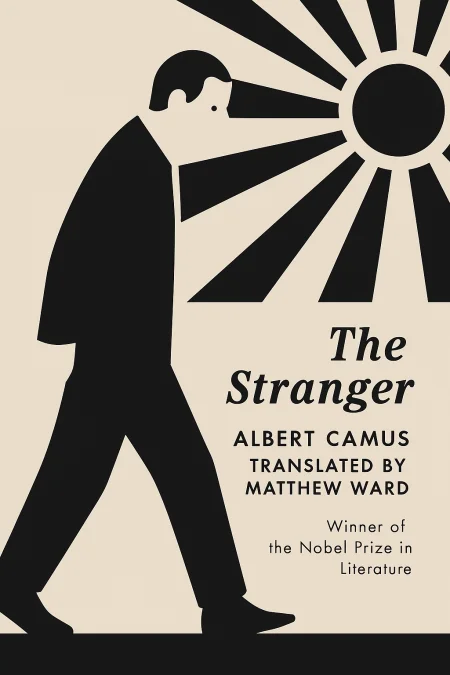
The Stranger
A Philosophical Journey Into Alienation
Book Edition Details
Summary
In the blistering heat of an Algerian summer, an unremarkable man named Meursault finds himself ensnared in the web of fate, following a murder that defies logic and reason. Albert Camus’ "The Stranger" thrusts readers into a world where the ordinary meets the existential, challenging perceptions of guilt and innocence. Through the stark portrayal of Meursault’s indifferent gaze, Camus strips away societal norms, revealing the raw confrontation of humanity with the absurd. This provocative narrative compels us to question the very fabric of morality and justice. Lauded as a masterpiece, it captures the haunting dissonance between societal expectation and personal truth, making it an enduring beacon in literary exploration.
Introduction
In the blazing heat of French colonial Algeria, a man attends his mother's funeral without shedding a tear, embarks on a casual love affair the very next day, and ultimately commits a senseless murder on a sun-drenched beach. Meursault's story unfolds as one of literature's most provocative explorations of human indifference and the search for meaning in an apparently meaningless world. Through his peculiar detachment from conventional emotions and social expectations, this enigmatic protagonist challenges our fundamental assumptions about guilt, responsibility, and the human condition. His journey from emotional numbness through violent action to final awakening reveals the profound tensions between individual authenticity and societal demands. Readers will discover how Meursault's radical honesty exposes the absurdity of human existence, how his crime becomes a mirror reflecting society's own contradictions, and ultimately how his confrontation with death leads to an unexpected embrace of life's fundamental freedom.
The Indifferent Son: Mother's Death and Emotional Detachment
When the telegram arrives announcing his mother's death, Meursault responds with characteristic emotional flatness, uncertain even of the date she died. His mechanical preparation for the funeral—arranging time off work, borrowing a black tie, catching the bus to Marengo—reveals a man going through the motions of grief without feeling its weight. At the nursing home, he declines to view his mother's body, smokes cigarettes during the vigil, and drinks coffee while elderly residents keep watch over the coffin. This emotional detachment extends beyond mere numbness to a radical honesty about human relationships. Meursault acknowledges that he and his mother had grown apart, that placing her in the home was practical rather than cruel, and that she had found companionship there he could never provide. His refusal to perform conventional grief isn't callousness but authenticity—he won't manufacture emotions he doesn't feel or engage in social rituals that seem hollow to him. The funeral procession under the scorching Algerian sun becomes a physical ordeal that mirrors Meursault's psychological state. While other mourners struggle with their emotions, he battles heat exhaustion and fatigue. His focus on immediate physical sensations rather than abstract emotional concepts establishes a pattern that will define his entire existence. The day after burying his mother, he goes swimming and begins a love affair with Marie, actions that will later be used to condemn him as a moral monster.
The Accidental Killer: Violence Under the Algerian Sun
The fatal encounter on the beach emerges from a web of casual relationships and simmering tensions that Meursault observes but doesn't fully comprehend. His friendship with Raymond, a man of dubious reputation involved with Arab women, draws him into a conflict that escalates beyond anyone's control. When Raymond's former mistress's brother and friend confront them on the beach, violence seems inevitable, yet Meursault remains a reluctant participant in events he neither initiated nor particularly cares about. The confrontation unfolds in the blazing heat of the afternoon sun, with Meursault experiencing the physical world with intense clarity while remaining emotionally disconnected from the human drama. After Raymond is wounded, Meursault takes his friend's gun and returns to the beach, ostensibly to walk and think. His encounter with the Arab becomes a battle between his consciousness and the overwhelming sensory assault of sun, heat, and light reflecting off the man's knife. The shooting itself occurs almost without conscious decision. The sun's glare, the Arab's threatening gesture with the knife, and Meursault's physical discomfort coalesce into a moment of violence that seems to happen to him rather than being chosen by him. His firing of four additional shots into the already dead body remains inexplicable even to himself—an action that transforms accidental manslaughter into something far more sinister in the eyes of society. This moment shatters the calm indifference that has defined his existence and propels him into a world where his authentic self will be judged by standards he neither understands nor accepts.
The Condemned Man: Trial and Society's Judgment
The courtroom becomes a theater where Meursault's life is dissected and reconstructed to fit society's need for moral clarity. The prosecution focuses less on the actual crime than on his behavior at his mother's funeral, his relationship with Marie, and his association with Raymond. His failure to cry, his decision to swim and attend movies immediately after the burial, and his apparent lack of remorse become evidence of a fundamentally corrupt nature that made murder inevitable. During the examination by the magistrate, Meursault encounters society's insistence that he explain his actions in terms of conventional motives and emotions. When he attempts to describe the role of the sun in his crime, he sounds absurd even to himself. His honest admission that he feels no regret—not because he's proud of killing, but because regret requires an emotional engagement with the past that he doesn't experience—horrifies court officials who expect either defiance or repentance. The trial reveals the gap between Meursault's authentic self and society's expectations. Witnesses testify about his character, but their words feel disconnected from his inner experience. Even his lawyer constructs a defense based on conventional understanding of human psychology, portraying him as a dutiful son temporarily unbalanced by grief. The prosecutor's demand for the death penalty rests not on the severity of his crime but on his perceived threat to social order—his refusal to play by emotional and moral rules that everyone else accepts without question.
The Awakened Stranger: Embracing Life's Absurd Freedom
In his death cell, Meursault undergoes a profound transformation that paradoxically occurs as his physical freedom disappears entirely. Initially obsessed with impossible escape scenarios and legal technicalities, he gradually accepts the fundamental absurdity of his situation. The arbitrary nature of justice—that his sentence depends on men who change their underwear and represent "the French people"—reveals the absurdity of all human institutions and certainties. His confrontation with the prison chaplain catalyzes his final awakening. The priest's insistence on divine meaning and eternal salvation strikes Meursault as another form of escape from life's essential reality. In a burst of passionate anger, he rejects not only religious comfort but all the false hopes and artificial meanings that people use to avoid confronting existence's fundamental indifference. His rage burns away his last illusions, leaving him with a clear vision of life's true nature. In the aftermath of this explosive encounter, Meursault achieves a state of peace he has never known before. He realizes that his mother, near death in the nursing home, must have experienced a similar liberation from conventional concerns and false hopes. Looking up at the star-filled sky, he opens himself to what he calls "the benign indifference of the universe" and recognizes that this indifference, rather than being terrifying, is actually liberating. For the first time, he understands that he has been happy and still is happy, because he has finally stopped trying to find meaning where none exists and accepted life on its own terms.
Summary
Meursault's journey from emotional numbness to existential awakening illustrates the paradoxical path to authentic living through the acceptance of life's fundamental absurdity. His story suggests that genuine freedom begins not with the pursuit of meaning or purpose, but with the courageous acknowledgment that the universe offers neither, and that this absence of inherent meaning is precisely what makes individual choice and authentic existence possible. Rather than finding this vision nihilistic, readers might consider how Meursault's final peace emerges from his willingness to embrace uncertainty and live without the comfort of false absolutes. His transformation invites us to examine our own dependencies on external validation and conventional meanings, challenging us to discover what remains when we strip away society's expectations and confront existence in its raw, unmediated form.
Related Books
Download PDF & EPUB
To save this Black List summary for later, download the free PDF and EPUB. You can print it out, or read offline at your convenience.
By Albert Camus
