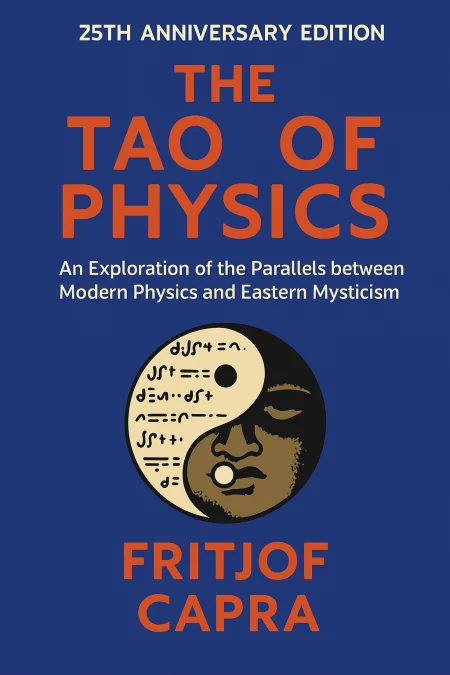
The Tao of Physics
An Exploration of the Parallels Between Modern Physics and Eastern Mysticism
Book Edition Details
Summary
When scientific rigor meets the wisdom of the ancients, a dance of ideas emerges, reshaping our understanding of the universe. In "The Tao of Physics," Fritjof Capra invites readers to witness the mesmerizing interplay between quantum physics and Eastern mysticism, a union as surprising as it is enlightening. This updated edition, enriched by a reflective preface and insightful afterword, delves into the book’s reception and the evolving landscape of science over the past twenty-five years. Capra's exploration reveals profound connections between the philosophical depths of Hinduism, Buddhism, and Taoism, and the mind-bending theories of relativity and quantum mechanics. A must-read for those who find wonder in the convergence of science and spirituality, this book promises to challenge and inspire your worldview with each page turned.
Introduction
Imagine standing at the edge of two vastly different worlds: on one side, the sterile laboratories where physicists smash particles at incredible speeds to unlock the secrets of matter; on the other, the serene meditation halls where Eastern mystics have sought ultimate truth for millennia. These realms seem impossibly distant, yet a remarkable discovery awaits us. When twentieth-century physics ventured into the subatomic world, it encountered phenomena so strange and paradoxical that the mechanical worldview of classical science began to crumble. Particles that exist as probabilities rather than solid objects, matter that dances in and out of existence, and a universe where the observer cannot be separated from the observed. What emerged was a reality strikingly similar to the one described by Hindu sages, Buddhist monks, and Taoist philosophers thousands of years ago. This exploration reveals how modern physics and ancient wisdom converge on a single, profound truth: the universe is not a collection of separate objects, but an interconnected web of relationships where everything participates in a cosmic dance of energy and consciousness.
The Revolutionary Physics of the 20th Century
The twentieth century brought physics face to face with mysteries that shattered our most fundamental assumptions about reality. When scientists began probing the atom, expecting to find the ultimate building blocks of matter, they instead discovered a realm where common sense simply doesn't apply. Electrons, for instance, don't orbit the nucleus like tiny planets as we might imagine. Instead, they exist as "probability clouds" that collapse into definite positions only when observed. This strange behavior forced physicists to abandon the notion of particles as solid, discrete objects. Einstein's relativity theory delivered another stunning blow to our intuitive understanding of the world. Space and time, which seemed absolutely separate and unchanging, were revealed to be interwoven aspects of a four-dimensional fabric that bends and warps in the presence of matter and energy. A clock runs slower when moving at high speeds, and objects shrink in the direction of their motion. These aren't just mathematical curiosities but verified experimental facts that demonstrate how deeply our everyday experience can mislead us about the true nature of reality. Perhaps most revolutionary of all was the discovery that energy and matter are interchangeable, expressed in Einstein's famous equation E=mc². This revelation means that the solid, permanent substances we take for granted are actually frozen energy, capable of transforming into pure light and motion. The very ground beneath our feet, the air we breathe, even our own bodies are revealed to be temporary patterns in an endless dance of energy. Modern physics thus demolished the mechanistic worldview that had dominated Western thought for centuries, replacing it with a vision of reality as fluid, interconnected, and fundamentally dynamic. The implications extend far beyond physics laboratories. Quantum mechanics showed that the act of observation fundamentally alters what is observed, making it impossible to maintain the classical separation between subject and object. We cannot stand apart from nature as detached observers; we are embedded participants in the very reality we seek to understand. This participatory universe bears little resemblance to the clockwork cosmos of Newton and more to the living, responsive reality described in Eastern philosophy.
Eastern Mystical Worldviews and Universal Unity
For thousands of years, the mystics of India, China, and Tibet have spoken of a reality that transcends the world of separate objects and events that dominates ordinary consciousness. In Hinduism, this ultimate reality is called Brahman, described in the Upanishads as the unchanging ground of all existence from which the countless forms of the world arise and into which they eventually dissolve. The individual soul, Atman, is not separate from this cosmic consciousness but is its very essence. The profound realization "Tat tvam asi" (That thou art) expresses the fundamental insight that the deepest self and the ultimate reality are one and the same. Buddhist philosophy approaches this unity from a different angle, emphasizing the interdependence of all phenomena rather than an underlying substance. The doctrine of pratityasamutpada (dependent origination) reveals that nothing exists independently; everything arises in dependence upon conditions and causes in an intricate web of relationships. What we perceive as solid, permanent things are actually processes, constantly changing patterns with no fixed essence. The Buddhist concept of sunyata (emptiness) doesn't mean nothingness, but rather the absence of independent, inherent existence in all phenomena. Chinese Taoism describes this underlying unity as the Tao, literally "the Way," which is both the source and the process by which all things come into being and pass away. The Tao cannot be captured in concepts or words, yet it manifests through the dynamic interplay of yin and yang, the complementary opposites whose dance creates the endless variety of forms in the natural world. Unlike Western thought, which tends to see opposites as conflicting, Taoist philosophy recognizes them as interdependent aspects of a deeper harmony. What unites these diverse traditions is their insistence that ordinary consciousness, which divides the world into separate subjects and objects, self and other, is fundamentally mistaken. This separative awareness, called maya (illusion) in Hinduism and avidya (ignorance) in Buddhism, must be transcended to realize the true nature of existence. Through meditation, contemplation, and direct experience, mystics claim to perceive a reality in which all boundaries dissolve and the fundamental interconnectedness of everything becomes vividly apparent. This is not merely a philosophical position but a transformative vision that has guided spiritual seekers across cultures and centuries in their quest for ultimate understanding.
Quantum Reality and the Dynamic Dance of Matter
The quantum world revealed by modern physics is a realm where matter behaves more like music than machinery. At the subatomic level, particles don't have definite properties until they are observed; instead, they exist in "superposition states" that contain all possible outcomes simultaneously. When a physicist measures an electron's position, for instance, the measurement itself causes the electron to "choose" a specific location from its cloud of possibilities. This isn't due to limitations in our instruments but represents a fundamental feature of reality itself. The implications become even more startling when we consider quantum entanglement, where particles that have interacted remain mysteriously connected regardless of the distance separating them. Measuring one instantly affects the other, leading Einstein to famously dismiss this "spooky action at a distance" as impossible. Yet experiments have repeatedly confirmed this phenomenon, suggesting that the universe is far more interconnected than classical physics ever imagined. The boundaries between separate objects begin to blur when we recognize that particles are not isolated entities but nodes in a vast network of relationships. Perhaps most significantly, quantum field theory reveals that the vacuum of empty space is not empty at all, but seethes with virtual particles constantly appearing and disappearing. These fluctuations in the quantum vacuum are not merely theoretical constructs but have measurable effects on atoms and can even be harnessed in technology. What we think of as solid matter emerges from this dancing emptiness like waves rising from an ocean. The distinction between something and nothing, between matter and void, dissolves into a more fundamental understanding of reality as pure activity or process. The dynamic nature of quantum reality extends to the very existence of particles themselves. In high-energy collisions, particles are routinely created from pure energy and destroyed again, their mass converting back into the kinetic energy of other particles. What we call a "particle" is better understood as a temporary pattern of energy, a brief stabilization in the endless flow of cosmic creativity. This ceaseless creation and destruction of matter bears a striking resemblance to the cosmic dance described in Hindu philosophy, where Shiva Nataraja dances the universe into existence and dissolution in eternal cycles. Modern physics has thus revealed a cosmos that is intrinsically creative, participatory, and alive, far removed from the dead, mechanical universe of classical thought.
Bootstrap Philosophy and Cosmic Interconnectedness
The bootstrap hypothesis represents perhaps the most radical departure from traditional scientific thinking, proposing that the universe has no fundamental level at all. Instead of seeking ultimate building blocks, this approach suggests that everything in existence arises from the mutual self-consistency of all its parts. Each particle "pulls itself up by its own bootstraps" through its relationships with all other particles, with none being more fundamental than any other. This means that the properties we observe in nature are not imposed by external laws but emerge from the requirement that the whole system be internally consistent. In this view, the familiar search for deeper and deeper levels of reality, from molecules to atoms to quarks and beyond, is fundamentally misguided. There are no "basic building blocks" waiting to be discovered because the universe doesn't work that way. Instead, every particle is a composite of all other particles, each one both containing and contained by all the rest. A proton, for instance, can be understood as a bound state of various combinations of other particles, but those constituent particles are themselves bound states that include the original proton. This circular interdependence creates a web of relationships where nothing exists independently. The mathematical framework that describes this bootstrap reality is S-matrix theory, which focuses on the probabilities for particles to interact and transform into one another rather than trying to describe their internal structure. In this approach, force and matter are no longer separate concepts. The forces between particles are themselves particles being exchanged, and the particles we observe are temporary crystallizations of these ongoing interactions. The entire edifice of physics becomes a self-sustaining pattern of relationships with no need for external support or foundational elements. This bootstrap vision extends beyond particle physics to potentially encompass consciousness itself. If the universe is truly a self-determining web of relationships, then human awareness may not be separate from physical processes but an integral aspect of how the cosmos comes to know itself. The observer and the observed, mind and matter, would then be complementary aspects of a deeper unity that transcends both. Such a view approaches the mystical insight that consciousness is not produced by the brain but is the very fabric of reality, the medium in which all phenomena arise and pass away. The bootstrap universe is thus not merely a collection of interacting objects but a living, self-aware totality in which every part participates in the consciousness of the whole.
Summary
Modern physics has led us to a profound realization: the mechanistic worldview that dominated Western thought for centuries is fundamentally inadequate to describe the true nature of reality. Instead, we find ourselves in a participatory universe where consciousness and cosmos are intimately intertwined, where the boundaries between observer and observed dissolve, and where the solid, separate objects of everyday experience reveal themselves as temporary patterns in an underlying field of dynamic relationships. This vision, emerging from humanity's most rigorous scientific investigations, mirrors with stunning accuracy the insights that Eastern mystics have proclaimed for millennia through direct contemplative experience. The convergence suggests that there may be multiple valid ways of knowing reality, each offering its own perspective on the fundamental mystery of existence. As we face the challenges of the twenty-first century, how might we integrate the analytical power of scientific inquiry with the wisdom traditions that recognize the profound interconnectedness of all life? What new forms of understanding might emerge when the precision of physics meets the transformative insights of mystical experience?
Related Books
Download PDF & EPUB
To save this Black List summary for later, download the free PDF and EPUB. You can print it out, or read offline at your convenience.
By Fritjof Capra
