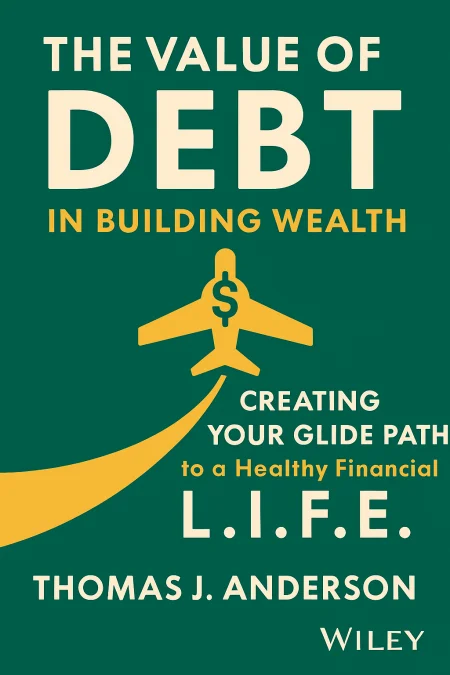
The Value of Debt in Building Wealth
Creating Your Glide Path to a Healthy Financial L.I.F.E
Book Edition Details
Summary
In a world where financial freedom often feels like a distant dream, Thomas J. Anderson's masterful guide, "The Value of Debt in Building Wealth," shatters conventional wisdom by redefining debt as a strategic ally rather than an adversary. Anderson invites you to embark on a transformative journey where debt becomes a catalyst for wealth creation. Through insightful discussions on student loans, mortgages, and credit lines, this book equips you with the tools to navigate life's pivotal financial decisions—be it renting or buying, choosing fixed or floating debt, or determining optimal debt-to-income ratios. Anderson's fresh perspective empowers you to craft a robust personal balance sheet, ensuring liquidity and flexibility without compromising your aspirations. Dive into this eye-opening narrative and unlock strategies that could alter your financial landscape forever, leaving your future self grateful for the newfound wisdom.
Introduction
What if everything you've been taught about debt is wrong? While most of us have been conditioned to believe that all debt is inherently evil, a financial burden that must be eliminated as quickly as possible, this conventional wisdom has actually created a generation of Americans living paycheck to paycheck. The truth is far more nuanced and empowering than we've been led to believe. The key lies in understanding that not all debt is created equal, and that strategic debt at low interest rates can actually accelerate wealth building when combined with disciplined asset accumulation. The goal isn't to avoid debt entirely but to use it as a tool for creating liquidity, flexibility, and long-term financial growth. This balanced approach will reduce stress, increase financial security and flexibility, and dramatically improve your chances of achieving true financial freedom.
The L.I.F.E. Glide Path: From Launch to Equilibrium
The L.I.F.E. framework provides a dynamic roadmap that evolves with your financial circumstances, guiding you through four distinct phases: Launch, Independence, Freedom, and Equilibrium. Each phase corresponds to your net worth relative to your annual income, creating specific debt ratios and savings targets that recognize your relationship with debt should change as your wealth accumulates. Consider Jason and Amy, who earn $96,000 annually but find themselves in the Launch phase with $5,000 in credit card debt, minimal cash reserves, and an overemphasis on retirement savings. Despite having $15,000 in their 401k, they're financially vulnerable due to their oppressive debt and lack of liquidity. The L.I.F.E. framework immediately identifies their dangerous imbalance, showing them that their current approach prioritizes long-term savings while ignoring immediate financial threats. Following the framework's guidance, Jason and Amy restructure their entire approach. They reduce their 401k contributions to capture only their employer match, then aggressively eliminate their credit card debt while building a three-month cash reserve. This isn't about abandoning retirement planning but about creating the proper foundation for sustainable wealth building. Within eighteen months, they've eliminated their oppressive debt, built substantial cash reserves, and positioned themselves to enter the Independence phase. The beauty of the L.I.F.E. system lies in its flexibility and specificity. In the Launch phase, you focus ruthlessly on eliminating oppressive debt and building liquidity. The Independence phase introduces strategic debt for major purchases like homes. Freedom emphasizes asset accumulation over debt reduction, while Equilibrium optimizes the balance between assets and liabilities for maximum wealth preservation. This framework provides clear benchmarks and actionable steps for each phase, ensuring your debt strategy evolves intelligently as your financial strength grows.
Building Assets While Managing Strategic Debt
The most successful companies in the world maintain strategic debt ratios, understanding that the right amount of leverage can enhance returns while providing operational flexibility. Individual wealth builders can learn from this corporate wisdom by implementing the three-bucket investment approach that balances security, growth, and opportunity while maintaining strategic debt positions. Ryan and Allison exemplify this strategy in action. This dual-income professional couple earning $240,000 annually found themselves house-rich but cash-poor after purchasing a $1 million home with minimal down payment. Rather than panic-paying down their mortgage, they systematically built their investment assets while maintaining their low-cost debt. Their Conservative bucket provided crisis protection, their Core bucket built steady wealth through globally diversified investments, and their Aggressive bucket pursued higher returns within carefully managed risk parameters. Over five years, their disciplined approach transformed their financial picture dramatically. Their Conservative bucket grew to $115,000, providing nearly ten months of crisis protection. Their retirement savings more than doubled to $340,000 through consistent contributions and employer matching. Most importantly, they eliminated their oppressive student debt while preserving their tax-advantaged mortgage debt. By maintaining their strategic debt and building assets simultaneously, they created multiple income streams and financial flexibility that pure debt elimination could never achieve. The key insight is that debt acts as a magnifier of your investment decisions. When you can borrow at 3 percent and invest in diversified assets historically returning inflation plus 4 percent, you create a positive spread that compounds dramatically over decades. Start by calculating your current debt structure and eliminate any obligations costing more than 8 percent annually while building liquid reserves equal to at least three months of expenses. Only then should you consider strategic debt for wealth-building purposes, always ensuring that your borrowing costs remain close to inflation rates while your investments target returns that exceed those costs by at least 2 percent annually.
Investment Strategy and the Other Side of Balance
Your asset portfolio requires just as much strategic thinking as your debt management, with true diversification spreading investments across nine major asset classes rather than the dangerous concentration most investors unknowingly create. Most portfolios suffer from home bias, with 80 percent or more concentrated in just U.S. stocks and bonds, creating unnecessary risk especially when these assets are trading near historical highs. Brandon and Teresa demonstrate the power of this approach. This typical American couple earning $60,000 annually faced a critical choice: follow conventional wisdom by rushing to pay off their $195,000 mortgage, or maintain their mortgage while directing payments toward diversified investments. The conventional path would leave them with a paid-off home but zero savings at age 51, accumulating only $159,000 by retirement even with perfect market returns afterward. The strategic approach tells a dramatically different story. By maintaining their mortgage and directing those same payments toward globally diversified investments earning a modest 4 percent return, Brandon and Teresa could accumulate approximately $685,000 by retirement. Their investment income alone would exceed their working income, creating true financial freedom rather than the illusion of security that comes from owning a paid-off home with no savings. A truly diversified approach spreads investments across U.S. stocks, developed international stocks, emerging market stocks, U.S. bonds, international bonds, emerging market bonds, gold, commodities, and real estate. Historical analysis shows that an equally weighted portfolio across these asset classes not only outperformed the S&P 500 over rolling ten-year periods but did so with significantly less risk. Begin building this diversification immediately, focusing on low-cost index funds that provide exposure to each asset class. Remember that your savings rate matters more than your investment returns, and your debt structure matters more than both. Time becomes your greatest ally when you start building assets early, allowing compound growth to work its magic over decades.
Your Balanced Path Forward
The journey toward financial freedom isn't about choosing between debt elimination and wealth building, it's about finding the optimal balance that maximizes your long-term prosperity while minimizing unnecessary risks. The evidence is overwhelming that thoughtful debt utilization, combined with disciplined saving and globally diversified investing, creates superior long-term outcomes compared to the debt-elimination-first approach that has left so many Americans unprepared for retirement. As the research powerfully demonstrates, "The single biggest determining factor in your overall rate of return is your debt ratio and your debt structure." This isn't about taking on more debt, it's about making smarter decisions with the debt you already have or will need for major life goals. The families who embrace these principles don't just build wealth; they create the flexibility and security that allows them to navigate life's uncertainties with confidence rather than fear. Your transformation begins today with a single, powerful decision: commit to saving at least 15 percent of your income while strategically managing rather than simply eliminating your debt. Calculate your current L.I.F.E. phase, eliminate any oppressive debt immediately, and begin building the liquid reserves that will give you the foundation for implementing these wealth-building strategies with confidence and discipline. The path to wealth isn't about perfection, it's about making consistently better decisions that compound over time into the financial freedom you deserve.
Related Books
Download PDF & EPUB
To save this Black List summary for later, download the free PDF and EPUB. You can print it out, or read offline at your convenience.
By Thomas J. Anderson
