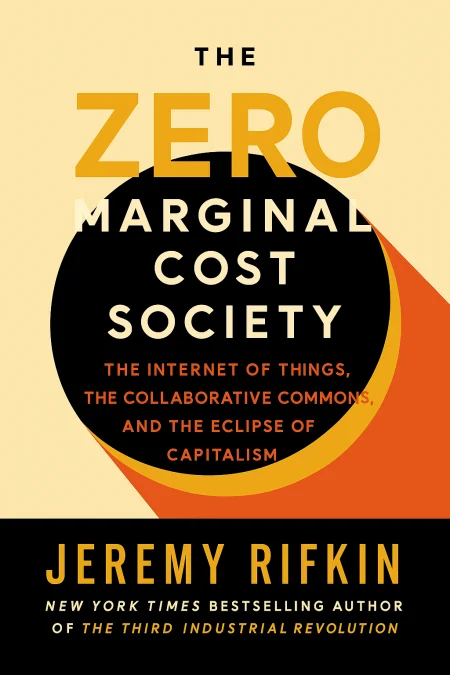
The Zero Marginal Cost Society
The Internet of Things, the Collaborative Commons and the Eclipse of Capitalism
Book Edition Details
Summary
The march of capitalism takes an unexpected twist in Jeremy Rifkin's provocative exploration, "The Zero Marginal Cost Society." As the Internet of Things weaves an intricate tapestry of interconnectedness, a new reality emerges: one where goods and services approach the realm of the nearly free. Rifkin unpacks the curious contradiction that fuels capitalism's triumphs and its potential downfall—hyper-efficiency that erodes marginal costs to the brink of nothingness. Picture a world where the Communication, Energy, and Logistics Internets converge, creating a vast, sentient network that empowers 'prosumers' to blur the lines between consumption and production. In this transformative landscape, the Collaborative Commons rise, reshaping how we perceive value and ownership. As capitalism morphs into a niche player, Rifkin invites us to envision a society where access outshines possession, and cooperation becomes the currency of a new epoch.
Introduction
What happens when the cost of producing additional goods and services approaches zero? This fundamental question challenges our most basic assumptions about economics, work, and human organization. The digital revolution has unleashed forces that are dismantling traditional market mechanisms from within, creating conditions where abundance replaces scarcity as the organizing principle of economic life. The convergence of communication networks, renewable energy systems, and collaborative platforms is giving birth to what theorists call the Collaborative Commons—a new economic paradigm that operates alongside and increasingly challenges market capitalism. This theoretical framework examines how zero marginal cost economics transforms everything from manufacturing and energy production to education and social organization. It explores the rise of prosumers who simultaneously produce and consume, the shift from ownership to access-based models, and the emergence of collaborative networks that create value through sharing rather than selling. The analysis reveals how this transformation affects the nature of work, the meaning of property, and the fundamental relationships between individuals, communities, and resources in an age of technological abundance.
The Third Industrial Revolution and Internet of Things
The Third Industrial Revolution represents a convergence of digital communication, renewable energy, and automated logistics into an integrated Internet of Things infrastructure that fundamentally transforms how economic value is created and distributed. Unlike previous industrial revolutions that relied on centralized, hierarchical systems, this new paradigm operates through distributed networks that connect billions of sensors, devices, and systems in real-time coordination. The theoretical foundation rests on three interconnected layers that function as a unified system. The Communications Internet enables information to flow freely through sensors and software that monitor every aspect of production and consumption. The Energy Internet coordinates renewable power generation and distribution through smart grids that automatically balance supply and demand across vast networks. The Logistics Internet tracks and optimizes the movement of physical goods through automated systems that eliminate waste and inefficiency. These three layers create exponential efficiency gains that compound across the entire economic system. The revolutionary potential becomes clear when we examine how this infrastructure eliminates traditional bottlenecks and coordination costs. A smart factory can automatically adjust production schedules based on real-time energy prices, weather forecasts affecting renewable generation, and transportation availability. Buildings optimize energy consumption while earning credits for feeding excess solar power back to the grid. Predictive maintenance prevents equipment failures before they occur, eliminating downtime and waste. Each additional participant in the network provides more data that improves system intelligence for everyone, creating a virtuous cycle where marginal costs approach zero while value increases exponentially. This technological convergence creates the material foundation for transcending scarcity-based economics. When coordination, communication, and optimization happen automatically at near-zero cost, the fundamental assumptions underlying market pricing mechanisms begin to break down, opening space for new forms of economic organization based on collaboration rather than competition.
From Capitalism to Collaborative Commons Economy
The transition from market capitalism to a Collaborative Commons economy represents a shift from systems based on ownership, competition, and profit maximization to networks organized around access, collaboration, and shared value creation. This transformation emerges not from external revolution but from capitalism's own success in driving productivity gains that ultimately undermine its foundational assumptions about scarcity and pricing. The Collaborative Commons operates on fundamentally different principles than market systems. Instead of competing firms seeking to maximize profits through proprietary control, the Commons enables peer-to-peer collaboration where participants share resources, knowledge, and capabilities to create collective value. Social capital becomes as important as financial capital, with reputation, trust, and reciprocity serving as primary coordination mechanisms. Participants are motivated not by profit maximization but by the desire to contribute to meaningful projects while accessing the collective benefits of the network. Real-world examples demonstrate how collaborative models can outperform traditional market alternatives across multiple sectors. Wikipedia displaced Encyclopedia Britannica not through superior capital investment but through collaborative knowledge creation involving millions of contributors. Open-source software projects like Linux demonstrate how distributed collaboration can produce superior products to proprietary alternatives. Renewable energy cooperatives enable communities to generate and share clean power at costs that undercut traditional utilities. These examples reveal a pattern where collaborative networks eliminate the inefficiencies and redundancies inherent in competitive systems while creating new forms of value that cannot be captured through traditional pricing. The theoretical implications extend beyond economics to encompass new forms of governance, education, and social organization. As more human activities migrate from market transactions to collaborative networks, society develops alternative measures of prosperity based on quality of life, community resilience, and ecological health rather than purely monetary indicators.
The Transformation from Ownership to Access Society
The shift from ownership to access represents one of the most visible manifestations of the transition to a zero marginal cost society, reflecting both changing economic realities and evolving social values that prioritize utilization over accumulation. This transformation challenges fundamental assumptions about property, wealth, and economic security that have dominated human societies for centuries. Traditional ownership models become increasingly inefficient when assets remain idle for most of their useful life. The average automobile sits unused ninety-two percent of the time, representing massive misallocation of resources and capital. Access-based models through car-sharing services can provide equivalent mobility benefits with a fraction of the vehicles, reducing costs for users while minimizing environmental impact. This logic extends across numerous categories where occasional use makes ownership economically irrational: tools, equipment, books, clothing, and spaces that are occupied intermittently. Digital platforms dramatically reduce transaction costs and enable efficient matching between resource providers and users. Smartphone applications can locate available resources in real-time, facilitate seamless payments, and build reputation systems that ensure quality and reliability without traditional institutional intermediaries. These platforms create network effects where additional participants increase value for all users, leading to rapid scaling and market transformation. However, the most profound implications emerge when access models are organized as Commons rather than profit-maximizing platforms. Community-owned tool libraries, nonprofit car-sharing cooperatives, and peer-to-peer home sharing networks demonstrate how access can be provided at cost rather than for profit, further reducing barriers to participation while strengthening social bonds within communities. This transformation suggests a future where accumulation of possessions becomes less important than ability to access resources when needed, fundamentally altering concepts of wealth, status, and economic security toward more sustainable and equitable models.
Biosphere Consciousness and Sustainable Future
Biosphere consciousness represents humanity's emerging recognition that economic systems must align with ecological limits and planetary boundaries, transcending traditional environmentalism by integrating ecological thinking into the fundamental structure of economic relationships. This consciousness shift becomes both possible and necessary as zero marginal cost technologies make sustainable practices economically superior to their conventional alternatives. The convergence of renewable energy, circular manufacturing, and collaborative consumption creates conditions where sustainability becomes profitable rather than costly. Solar and wind power achieve grid parity with fossil fuels, making clean energy the economically rational choice. Three-dimensional printing enables local production from recycled materials, reducing transportation costs and waste streams. Sharing platforms maximize resource utilization while minimizing individual consumption, aligning economic incentives with ecological imperatives. This alignment transforms the relationship between human economic activity and natural systems from extractive to regenerative. When businesses profit from durability rather than planned obsolescence, when energy systems restore rather than degrade ecosystems, and when manufacturing processes eliminate rather than create waste, economic growth becomes compatible with ecological health. The zero marginal cost society enables what economists call "decoupling"—continued improvements in human welfare without corresponding increases in resource consumption or environmental impact. Biosphere consciousness also encompasses a shift in human values from material accumulation toward meaningful relationships, creative expression, and personal development. As basic needs are met through collaborative systems operating at near-zero marginal cost, people can focus on activities that contribute to community wellbeing and ecological restoration rather than endless consumption. This evolution toward post-materialist values creates the cultural foundation for a civilization that operates within planetary boundaries while providing unprecedented opportunities for human flourishing and self-actualization across all populations.
Summary
The convergence of digital technology, renewable energy, and collaborative networks is creating the first economic system in human history capable of delivering material abundance while respecting ecological limits and fostering human cooperation on a planetary scale. As marginal costs approach zero across increasing sectors of the economy, traditional market mechanisms give way to collaborative commons where sharing, cooperation, and sustainability become the primary drivers of value creation, offering humanity the possibility of transcending scarcity-based competition to achieve a prosperous, equitable, and regenerative civilization that honors both human potential and planetary boundaries.
Related Books
Download PDF & EPUB
To save this Black List summary for later, download the free PDF and EPUB. You can print it out, or read offline at your convenience.
By Jeremy Rifkin
