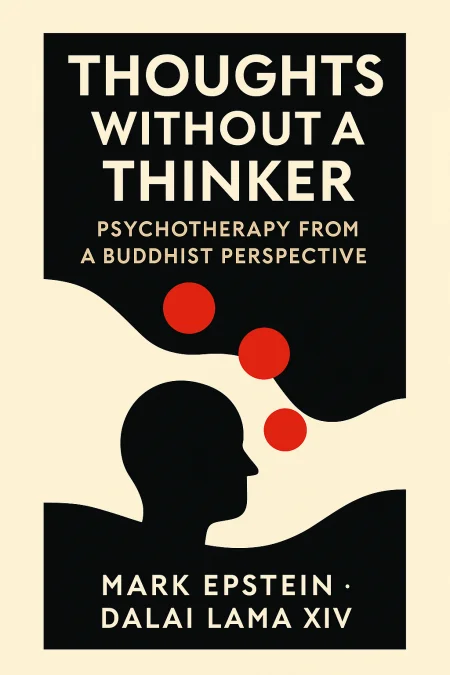
Thoughts Without a Thinker
Psychotherapy from a Buddhist Perspective
byMark Epstein, Dalai Lama XIV
Book Edition Details
Summary
Mind meets spirit in a transformative dialogue that redefines healing. In "Thoughts Without a Thinker," Mark Epstein masterfully merges Eastern spiritual wisdom with Western psychological practice, offering a compelling synthesis for those in search of deeper understanding. At the heart of this enlightening work lies the bold assertion that Buddhist contemplative traditions, particularly meditation and mindfulness, can unlock profound pathways to mental well-being. Epstein's prose is both accessible and profound, casting light on how these ancient practices can fortify the psyche, ease suffering, and foster genuine recovery. This is not just a book—it's an invitation to see therapy through a revolutionary lens, where inner peace and emotional resilience become one.
Introduction
Sarah had been in therapy for years, cycling through different approaches and techniques, each offering glimpses of insight but never quite delivering the lasting peace she sought. Her analytical mind could dissect her patterns, trace them back to childhood experiences, and understand their origins intellectually. Yet somehow, this understanding felt incomplete, like knowing the mechanics of a bicycle without ever learning to ride. The harder she tried to fix herself, the more elusive genuine transformation seemed to become. This struggle reflects a profound gap that many of us experience between knowing about our problems and actually transcending them. While Western psychology excels at helping us understand our minds, it often falls short of providing the tools necessary for genuine liberation from psychological suffering. Meanwhile, ancient Buddhist wisdom offers time-tested methods for working directly with the mind, yet these practices can feel foreign or incomprehensible when divorced from psychological understanding. What emerges from this intersection is a revolutionary approach that honors both traditions. By weaving together the analytical precision of Western psychotherapy with the transformative insights of Buddhist meditation, we discover pathways to healing that neither tradition could achieve alone. This integration doesn't diminish either approach but rather reveals how they can enhance and complete each other, offering hope for those who have found partial answers but seek deeper transformation. The journey ahead explores how ancient wisdom and modern psychology can work hand in hand, creating possibilities for genuine freedom from the patterns that bind us. Through real stories and practical insights, we'll discover that the path to healing may require both understanding our thoughts and learning to hold them with the spacious awareness that meditation cultivates.
The Buddha's Psychology: Understanding Suffering and the Self
When Dr. Chen first encountered the Buddhist concept of the Six Realms during his psychiatric training, he dismissed it as primitive mythology. Years later, treating patients in his private practice, he began to notice something remarkable. His most challenging cases seemed to correspond precisely to these ancient categories. There was Michael, caught in endless cycles of rage and paranoia, embodying what Buddhists called the Hell Realm. Jennifer lived in constant hunger for validation, never satisfied no matter how much attention she received, like the Hungry Ghosts described in ancient texts. David oscillated between grandiose fantasies and crushing despair, perfectly illustrating the human realm's search for a solid sense of self. The more Dr. Chen observed, the more he realized that the Buddha had mapped human psychology with startling accuracy 2,500 years before Freud. The Six Realms weren't descriptions of literal afterlife destinations but rather precise portraits of psychological states that every person experiences. The Hell Realm captured the torment of unprocessed anger and anxiety. The Animal Realm described our instinctual drives and the limitations of seeking happiness through sensual pleasure alone. The Hungry Ghost Realm portrayed the desperate emptiness that no amount of external validation could fill. What struck Dr. Chen most profoundly was how the Buddhist model differed from Western approaches. Instead of pathologizing these states, Buddhism saw them as natural human experiences that become problematic only when we remain unconscious of them. Each realm contained not just suffering but also the seeds of liberation. The key wasn't to escape these psychological territories but to navigate them with awareness, transforming our relationship to the very experiences that had previously trapped us. This ancient psychological map reveals that our modern struggles with identity, meaning, and authentic selfhood are not personal failures but universal human predicaments. The Buddha's genius lay in recognizing that the very sense of solid selfhood we desperately seek to establish or repair is itself the source of our suffering, opening doorways to freedom that Western psychology is only beginning to discover.
Meditation as Mental Development: Bare Attention and Awareness
During her first meditation retreat, Maria was horrified to discover the true nature of her mind. The simple instruction to watch her breath revealed a mental landscape she had never imagined. Thoughts crashed through her awareness like waves in a storm, carrying her away from the present moment into endless stories, judgments, and fantasies. She found herself sitting at breakfast, mechanically eating while her mind plotted her next career move, criticized other retreat participants, and relived conversations from years past. What Maria was encountering was the raw reality of an untrained mind, one that most of us live with daily without ever truly observing. The meditation teacher introduced her to a revolutionary tool called bare attention, the practice of simply noticing whatever arises in consciousness without trying to change, analyze, or judge it. This wasn't about emptying the mind or achieving some blissful state, but rather developing the capacity to be present with whatever is actually occurring in each moment. As Maria continued practicing, something extraordinary began to happen. When difficult emotions arose, instead of being swept away by them or struggling to suppress them, she learned to hold them in the spacious awareness that bare attention creates. A wave of sadness could be present without overwhelming her. Anger could arise and pass through without compelling her to act. She discovered that her emotions and thoughts were not permanent fixtures of her identity but temporary visitors in the vast space of consciousness. The practice of bare attention revealed itself as a form of mental development that goes beyond anything typically offered in Western psychology. It wasn't just about understanding patterns but about fundamentally changing one's relationship to all mental and emotional experiences. Maria learned that freedom doesn't come from having the right thoughts or feelings, but from developing the capacity to meet whatever arises with open, non-judgmental awareness that allows everything to be present without being possessed by any of it.
Therapeutic Integration: Remembering, Repeating, and Working Through
Thomas had been meditating for five years when he entered therapy, convinced that his spiritual practice should have resolved his relationship difficulties by now. His meditation had indeed brought him profound insights and moments of deep peace, but he found himself repeating the same painful patterns in intimate relationships, cycling through attraction, idealization, disappointment, and withdrawal. Each time he thought he had transcended these patterns, they would resurface with renewed intensity, leaving him feeling defeated and spiritually inadequate. His therapist, Dr. Rivera, recognized something that many meditators struggle to understand. Meditation and psychotherapy address different but complementary aspects of healing. While meditation develops the capacity to observe experience without being overwhelmed by it, therapy provides the specific relational context needed to work through the unconscious patterns that meditation alone cannot always reach. Thomas needed both the spacious awareness that meditation cultivates and the focused exploration of his personal history that therapy provides. In their work together, Thomas began to understand how meditation could enhance rather than replace therapeutic healing. When painful memories surfaced in sessions, his meditation training allowed him to stay present with the emotions without being flooded or dissociative. When he found himself repeating old patterns with Dr. Rivera, his awareness practices helped him catch these repetitions in real time rather than remaining unconscious of them. The combination proved transformative in ways that neither approach could achieve alone. The integration of meditation and therapy revealed something crucial about the nature of healing. Thomas learned that spiritual practice doesn't eliminate the need for psychological work, nor does therapy eliminate the need for developing moment-to-moment awareness. Instead, they form a powerful alliance where meditation provides the stability and presence needed for deep therapeutic work, while therapy provides the specific tools needed to work through the personal history and relational patterns that can otherwise sabotage spiritual development.
Summary
The marriage of Buddhist wisdom and Western psychology offers something that neither tradition could provide alone: a complete approach to human suffering that addresses both the universal patterns of mind and the specific psychological wounds that shape individual lives. Through stories like Sarah's struggle with incomplete healing, Dr. Chen's recognition of ancient wisdom in modern patients, Maria's discovery of bare attention, and Thomas's integration of meditation and therapy, we see how these approaches naturally complement each other. The journey reveals that true healing requires both the broad perspective of Buddhist psychology, which maps the universal territories of human experience, and the focused attention of Western therapy, which helps us work through specific patterns and traumas. Neither the detached awareness of meditation nor the analytical understanding of therapy alone suffices; we need both the capacity to step back from our experience and the courage to engage deeply with our personal history. Perhaps most importantly, this integration suggests that the spiritual and psychological dimensions of healing are not separate endeavors but aspects of a single process of awakening to who we truly are beneath our conditioned patterns. The path forward invites us to embrace both ancient wisdom and modern understanding, discovering that the journey to freedom requires both the vast perspective of the Buddha's psychology and the intimate work of healing our individual hearts.
Related Books
Download PDF & EPUB
To save this Black List summary for later, download the free PDF and EPUB. You can print it out, or read offline at your convenience.
By Mark Epstein
