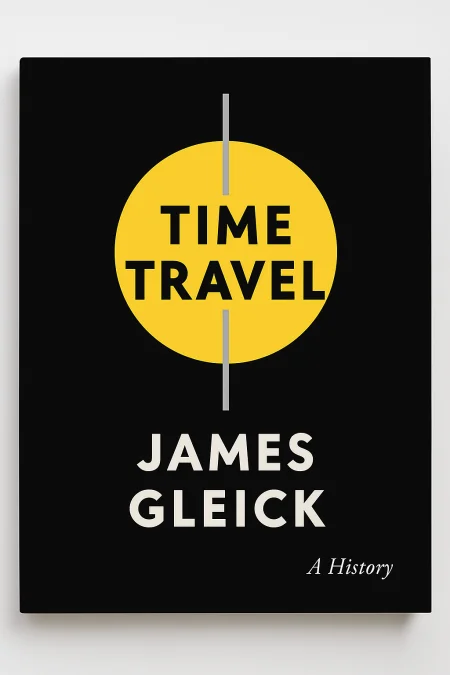
Time Travel
A History
Book Edition Details
Summary
Tick-tock, the clock of imagination takes a bold leap as James Gleick masterfully unravels the enigma of time travel. From the embryonic visions of H. G. Wells' groundbreaking "The Time Machine," Gleick navigates through the shifting sands of temporal exploration, unveiling how this once-revolutionary concept has threaded its way through the fabric of both fiction and science. This narrative dance moves from the philosophical musings of Marcel Proust to the whimsical corridors of Doctor Who, touching the minds of visionaries like Borges and Allen. As Gleick delves into the paradoxes that blur the lines between science fiction and theoretical physics, he also reflects on our present digital age's temporal dissonance. An exhilarating journey awaits those curious about how the echoes of past fantasies continue to shape our understanding of time's elusive nature today.
Introduction
In the flickering light of a late Victorian laboratory, a man tinkers with brass rods and crystal bars, assembling what would become humanity's first fictional time machine. This moment, captured in H.G. Wells's revolutionary 1895 novella, marked the birth of an idea that would fundamentally reshape how we think about time, causality, and our place in the universe. What began as a simple plot device to explore social commentary has evolved into one of our most enduring and complex cultural obsessions. The story of time travel is far more than science fiction entertainment. It reveals how emerging technologies, scientific discoveries, and philosophical breakthroughs converged to create entirely new ways of experiencing temporality. From Einstein's revelations about the nature of spacetime to quantum physics' multiple universes, from cinema's manipulation of narrative time to the internet's collapse of past and present, time travel has served as both mirror and lens for understanding modernity itself. This exploration will captivate anyone curious about how ideas migrate from scientific laboratories to popular culture, how fiction shapes reality, and why certain concepts capture the collective imagination with such enduring power.
The Birth of Time Travel: Wells and the Fourth Dimension (1890s-1920s)
The concept of time travel emerged from a perfect storm of late Victorian anxieties and discoveries. In the 1890s, scientific breakthroughs were accelerating at an unprecedented pace, while new technologies like telegraphy and railways were collapsing traditional notions of distance and simultaneity. Against this backdrop of temporal disruption, Wells crafted his revolutionary tale of a inventor who could navigate through time as easily as others moved through space. Wells drew inspiration from cutting-edge mathematics, particularly the work of Continental geometers exploring dimensions beyond the familiar three. When his Time Traveller explains to skeptical dinner guests that time is simply the fourth dimension, he was translating genuine scientific speculation into accessible fiction. The machine itself, with its brass and crystal construction resembling a fantasticated bicycle, perfectly embodied the era's faith in mechanical solutions to cosmic mysteries. The deeper genius of Wells's invention lay not in its scientific plausibility but in its philosophical implications. By treating time as navigable space, the story forced readers to confront unsettling questions about free will, determinism, and the nature of progress itself. The Time Traveller's journey to humanity's distant future, where he discovers the childlike Eloi and brutal Morlocks, served as a dark commentary on contemporary class divisions and evolutionary theory. This foundational text established many of the paradoxes and possibilities that would define the genre for generations. Wells had created not just a story, but an entirely new mode of thought that would soon spread far beyond the realm of literature into the deepest questions of physics and philosophy.
Pulp Fiction and Paradoxes: Building the Time Travel Canon (1930s-1950s)
The early decades of the twentieth century witnessed time travel's transformation from literary curiosity to popular obsession. Science fiction magazines, led by Hugo Gernsback's Amazing Stories, created a community of writers and readers devoted to exploring the logical consequences of temporal manipulation. These pulp publications may have lacked literary prestige, but they served as laboratories for working out the fundamental rules and paradoxes that still govern time travel narratives today. Writers like Robert Heinlein pushed the concept to new levels of complexity with stories featuring multiple versions of the same character interacting across different timelines. His "By His Bootstraps" introduced readers to the dizzying possibilities of causal loops, where effects precede their causes and individuals become architects of their own destinies. These stories transformed time travel from simple adventure fiction into sophisticated explorations of identity, consciousness, and the nature of existence itself. The period also saw the emergence of time travel's most persistent philosophical problems. The grandfather paradox, first articulated in magazine letter columns, posed the fundamental question: if you could travel to the past, could you change it? Writers experimented with various solutions, from rigid determinism to branching timelines, each approach revealing different assumptions about free will and the structure of reality. By the 1950s, time travel had become a fully developed fictional technology with its own internal logic and growing sophistication. The genre had evolved from Wells's simple mechanical device into a complex framework for examining the deepest questions about time, causality, and human agency, setting the stage for even more ambitious explorations to come.
Physics Meets Philosophy: Relativity, Loops, and Real Science (1960s-1980s)
The middle decades of the twentieth century brought time travel face to face with legitimate physics in ways that surprised both scientists and fiction writers. Einstein's theories of relativity had already suggested that time was more malleable than Newton had imagined, but it was mathematician Kurt Gödel who shocked the scientific community by proving that Einstein's own equations permitted "closed timelike curves" – genuine time travel paths through spacetime. This convergence of science and speculation created a golden age of temporal sophistication. Science fiction writers could now draw on real physics for inspiration, while physicists found themselves seriously discussing paradoxes that had previously been confined to pulp magazines. The result was increasingly complex and philosophically rigorous approaches to time travel, exemplified by works that treated temporal mechanics as seriously as any other branch of engineering. Television shows like Doctor Who brought time travel to mass audiences with unprecedented regularity, while literary authors like Ursula K. Le Guin explored the psychological and social implications of temporal manipulation. The concept had evolved beyond mere plot device to become a fundamental tool for examining consciousness, memory, and the construction of reality itself. Stories began to question not just whether time travel was possible, but what it might mean for human identity and experience. The period culminated in an explosion of theoretical work on temporal paradoxes, with philosophers and physicists seriously debating questions that had once seemed purely fictional. Time travel had achieved a curious double existence, equally at home in university physics departments and popular culture, serving as a bridge between the most abstract mathematical concepts and the most human concerns about mortality, regret, and possibility.
Digital Age Time Wars: Virtual Worlds and Infinite Possibilities (1990s-Present)
The advent of digital technology has revolutionized both the experience and understanding of time travel, creating new forms of temporal manipulation that Wells could never have imagined. Video games allow players to save and reload their progress, effectively creating personal time machines that permit endless experimentation with alternative outcomes. The internet has collapsed traditional distinctions between past and present, creating a perpetual now where historical documents exist alongside real-time communications. Contemporary time travel stories reflect this technological sophistication while grappling with increasingly complex philosophical questions. Films like Groundhog Day and Source Code explore temporal loops as metaphors for consciousness and moral development, while television shows create intricate multi-season story arcs that weave together multiple timelines and alternate realities. The concept has evolved from simple wish fulfillment into a sophisticated tool for examining the nature of choice, consequence, and possibility. Meanwhile, advances in physics have kept pace with fictional imagination. Theoretical physicists seriously study wormholes, quantum entanglement, and the many-worlds interpretation of quantum mechanics, all of which offer potential pathways for temporal manipulation. The boundary between science and science fiction has become increasingly porous, with each realm informing and inspiring the other in ways that would have seemed impossible to earlier generations. Perhaps most significantly, digital culture has created new forms of temporal experience that blur the distinction between time travel and everyday life. Social media platforms create persistent timelines that mix past posts with present updates, while streaming services allow viewers to experience decades of programming as an eternal present. We have become, in effect, time travelers in our own digital lives, constantly navigating between different temporal contexts and constructing narratives that span multiple timeframes simultaneously.
Summary
The evolution of time travel reveals a fascinating interplay between scientific discovery, technological innovation, and cultural imagination. What began as Wells's simple thought experiment has grown into one of our most powerful tools for exploring fundamental questions about reality, consciousness, and human possibility. The concept has served as both mirror and engine for our changing understanding of time itself, reflecting and shaping how we experience temporality in an increasingly complex world. The enduring appeal of time travel lies not in its scientific plausibility but in its emotional resonance. It speaks to universal human desires to correct past mistakes, glimpse future possibilities, and transcend the limitations of linear existence. As we navigate an era where digital technologies have created new forms of temporal experience, time travel narratives continue to evolve, offering frameworks for understanding our relationship with memory, anticipation, and the eternal human struggle to make sense of our place in the flow of time. The story of time travel is ultimately the story of how imagination and intellect combine to expand the boundaries of what seems possible, reminding us that the future, like the past, remains a country limited only by the scope of human creativity.
Related Books
Download PDF & EPUB
To save this Black List summary for later, download the free PDF and EPUB. You can print it out, or read offline at your convenience.
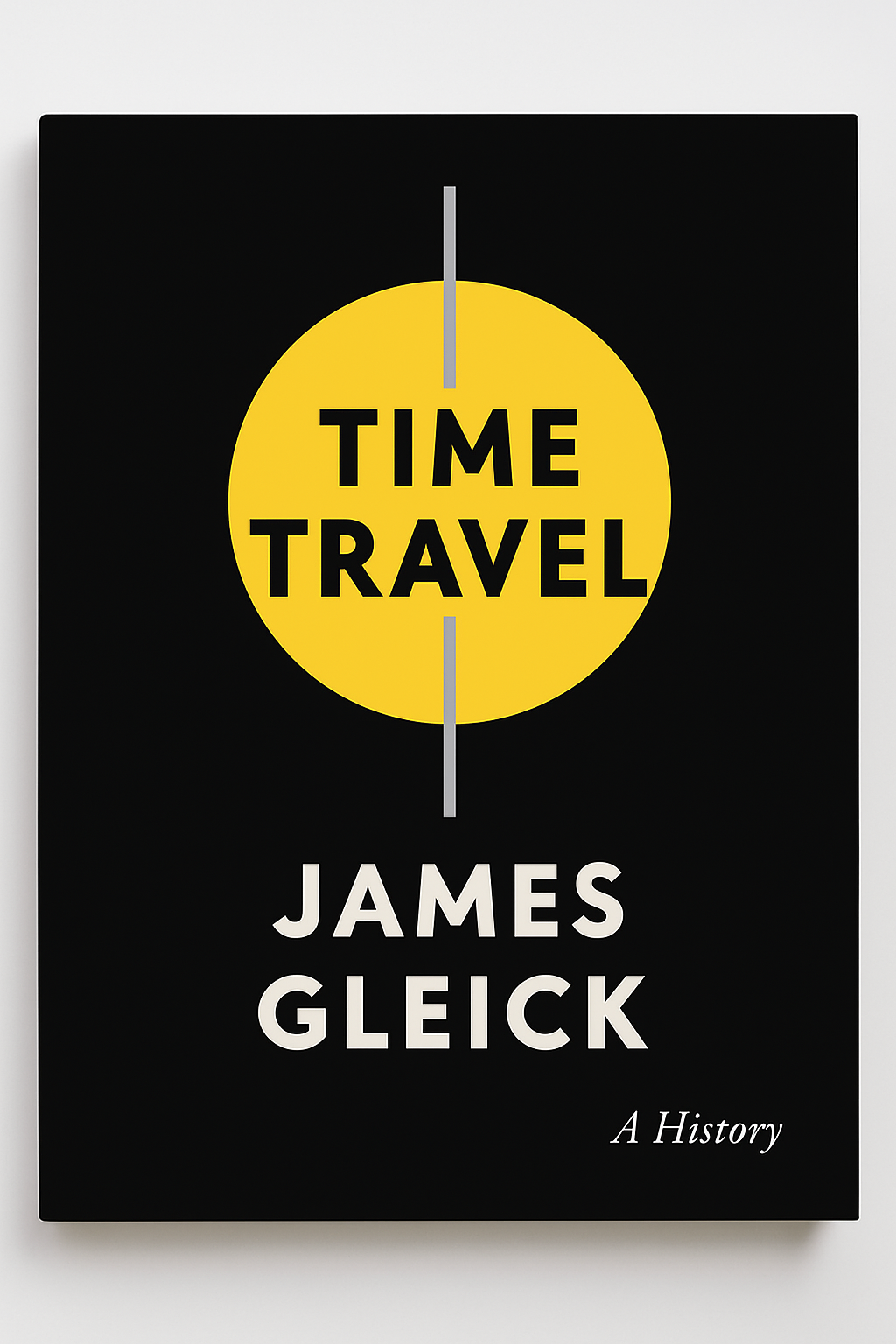
By James Gleick
