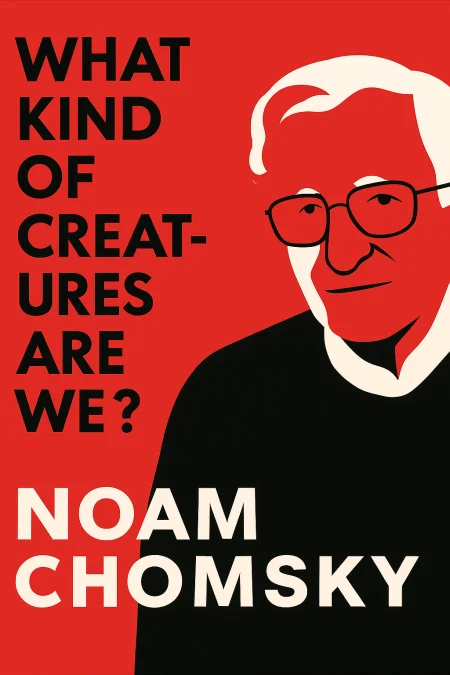
What Kind of Creatures Are We?
A deep exploration of human nature, language, and consciousness
Book Edition Details
Summary
Step into the mind of Noam Chomsky, a luminary whose intellectual odyssey reshapes our understanding of language, thought, and society. "What Kind of Creatures Are We?" serves as a vibrant tapestry woven with decades of Chomsky's groundbreaking insights into linguistics and cognitive science. This work transcends the ordinary by examining how our unique linguistic capabilities illuminate the very essence of human consciousness. With an astute yet accessible narrative, Chomsky critiques prevailing theories, challenging the boundaries of what we assume about language's origins and its ties to thought. Venturing beyond the realms of science, he passionately defends a vision of "libertarian socialism," linking it to historical and modern philosophical thought. This masterful exploration invites readers to reconsider the power of language in shaping our minds and society, offering an exhilarating glimpse into the boundless potential of human inquiry.
Introduction
Human beings have long wondered about their own nature, yet conventional wisdom about language, mind, and society often rests on questionable foundations. This inquiry challenges three fundamental assumptions that shape contemporary thought: that language exists primarily for communication, that human understanding has no inherent limits, and that democratic ideals can flourish within existing power structures. Through rigorous logical analysis spanning linguistics, philosophy, and political theory, a radical reexamination emerges of what defines human cognitive capacity and social organization. The investigation employs a distinctive methodology that treats apparent contradictions not as obstacles but as windows into deeper truths about biological constraints, evolutionary development, and the tension between individual creativity and collective welfare. Rather than accepting surface phenomena at face value, this exploration probes the hidden principles governing language acquisition, the boundaries of scientific inquiry, and the mechanisms by which genuine democratic participation gets systematically undermined. Each domain of investigation reveals how seemingly obvious conclusions often mask more profound realities about human nature.
Language as the Defining Human Faculty
Language represents the most distinctive characteristic of human beings, yet its fundamental nature remains poorly understood. The prevailing view treats language primarily as a communication system, but this assumption collapses under careful scrutiny. Language emerges instead as an instrument of thought, with communication serving merely as a secondary function. This distinction proves crucial because most language use never gets externalized at all, existing purely as internal dialogue and conceptual manipulation. The computational system underlying language operates through surprisingly simple principles, particularly a basic operation called Merge that combines linguistic elements without regard to linear order. This process generates hierarchically structured expressions that map onto two interfaces: one connecting to thought processes and another to the sensorimotor system for externalization. The primacy of structural over linear relationships explains why children automatically know that in sentences like "instinctively, eagles that fly swim," the adverb relates to the distant verb "swim" rather than the adjacent "fly," despite never receiving explicit instruction about this principle. Language design consistently favors computational efficiency over communicative ease, creating structures optimal for semantic interpretation but problematic for processing and perception. Features like displacement, where phrases appear in one location but get understood elsewhere, emerge naturally from the simplest computational assumptions rather than representing design flaws. This optimization suggests language evolved not gradually through communication pressures but through a sudden rewiring of the brain that yielded the basic computational capacity, providing humans with unbounded creative thought. The implications extend far beyond linguistics, revealing that what makes humans unique lies not in superior general intelligence but in possessing this specific computational system that generates infinite expressions from finite means. This capacity appears unrelated to anything found in animal communication, where signals maintain direct causal connections to external stimuli, unlike human linguistic elements that lack such referential properties.
The Scope and Limits of Human Understanding
Human cognitive abilities achieve remarkable scope precisely because they operate within specific limitations imposed by our biological nature. This relationship between scope and limits, evident throughout organic systems, challenges the widespread assumption that human intelligence can ultimately comprehend all aspects of reality. The digestive system illustrates this principle clearly: its specialized structure enables processing food efficiently while simultaneously constraining what substances it can handle, and nobody questions this as natural design. The same logic applies to cognitive faculties, suggesting that problems and mysteries represent different categories relative to our mental architecture. Problems fall within our cognitive reach through the conceptual frameworks and analytical methods our minds can generate, while mysteries exceed these capacities entirely. Newton's discovery of gravitational attraction exemplifies this distinction: it solved astronomical problems while simultaneously revealing fundamental mysteries about action at a distance that remain unresolved centuries later. Scientific inquiry itself reflects these cognitive constraints through the historical pattern of abandoning questions deemed unanswerable rather than solving them completely. The mechanical philosophy that guided early modern science collapsed when Newton demonstrated that matter and motion operate through principles inconceivable within that framework, forcing science to lower its aspirations from understanding how the world works to constructing intelligible theories about observable phenomena. Contemporary consciousness studies repeat this pattern, treating subjective experience as uniquely problematic while ignoring that similar explanatory gaps exist throughout science. Chemistry developed independently from physics for generations until quantum theory radically redefined physical concepts, suggesting that current difficulties in relating mind to brain may reflect inadequate understanding of both domains rather than fundamental impossibility. The history of science demonstrates repeatedly that apparent mysteries sometimes yield to new theoretical frameworks while others may represent permanent cognitive limitations, and wisdom lies in pursuing investigation without demanding guarantees about ultimate comprehensibility.
Democracy, Freedom, and the Common Good
Political arrangements that genuinely serve human development require dismantling unjustified hierarchies and redistributing power to those whose lives such systems govern. This principle, though seemingly obvious, faces systematic violation across existing institutions that claim democratic legitimacy while concentrating authority in elite hands. The tension between authentic democratic participation and elite management shapes contemporary politics through mechanisms designed to limit popular influence while maintaining formal electoral processes. Classical liberal thought, from Adam Smith through Wilhelm von Humboldt, recognized that meaningful freedom requires not merely absence of direct coercion but active cultivation of human creative capacities. Smith's critique of industrial division of labor emphasized how repetitive work destroys intellectual development, making the majority of people "as stupid and ignorant as it is possible for a human creature to be" unless educational and social institutions counteract these effects. This analysis connects individual flourishing directly to economic organization, revealing how workplace hierarchies undermine the human development that democratic theory promises to foster. Anarchist traditions extend this logic by questioning all forms of domination, not merely state power, while recognizing that dismantling unjustified authority requires building alternative institutions capable of coordinating complex social activities. The principle demands that coercive institutions justify themselves or face dissolution, but this process must occur alongside constructive efforts to create worker-controlled enterprises, federated communities, and educational systems that encourage critical thinking rather than passive compliance. Historical examples from revolutionary Spain to contemporary cooperative movements demonstrate practical possibilities for organizing society around human development rather than profit maximization. The challenge intensifies because existing democratic systems often serve primarily to legitimate elite rule rather than enable popular participation. Public opinion polls consistently show majority support for policies that never reach political agendas, while corporate interests shape legislation through lobbying and campaign contributions that dwarf citizen influence. This systematic disenfranchisement operates through formally democratic procedures, creating what amounts to competitive elections between candidates selected by wealth concentrations, making genuine democratic participation the exception rather than the norm.
The Mysteries of Nature: Mind, Matter, and Method
The apparent problem of relating mind to physical processes dissolves when examined through the historical development of scientific concepts, particularly the collapse of mechanistic materialism that once provided clear definitions of "physical" and "material." Newton's gravitational theory demolished the contact-mechanical philosophy that made mind-body dualism coherent by showing that matter itself operates through principles no less mysterious than consciousness, leaving science without defensible criteria for distinguishing mental from physical phenomena. Eighteenth-century thinkers like Joseph Priestley recognized that post-Newtonian science eliminated any principled objection to thinking matter, since the properties attributed to matter no longer conformed to commonsense mechanical intuitions. If bodies can attract each other across empty space through forces that remain fundamentally incomprehensible, then consciousness emerging from neural organization poses no greater conceptual difficulty than gravitational attraction between masses. Both phenomena require accepting that natural processes operate through principles that exceed human intuitive understanding. Modern neuroscience rediscovers these insights while often presenting them as revolutionary breakthroughs, but the basic argument traces back three centuries to the recognition that mind and matter problems disappear once the mechanical philosophy no longer constrains theoretical possibilities. Contemporary debates about consciousness, emergence, and reduction recapitulate earlier discussions that concluded our ignorance of physical processes renders premature any claims about their compatibility or incompatibility with mental phenomena. The methodological implications suggest treating consciousness studies like early chemistry, which developed sophisticated theoretical frameworks independently of physics until quantum mechanics eventually enabled unification through radically revised concepts of physical processes. Rather than demanding immediate reduction to current neuroscience, investigation of mental phenomena should proceed pragmatically by discovering regular principles and systematic relationships, recognizing that unification attempts may require transforming our understanding of both cognitive and neural processes. This approach acknowledges that some aspects of mind, like free action and creative thought, may represent permanent mysteries for beings constituted as we are, without abandoning empirical investigation of those mental phenomena that do yield to systematic study.
Summary
The convergence of linguistic, cognitive, and political analysis reveals human nature as fundamentally shaped by biological endowments that simultaneously enable remarkable creative capacities while imposing systematic limitations on understanding and social organization. Language emerges as the defining human faculty not through its communicative function but as the computational system underlying unbounded thought, consciousness studies dissolve traditional mind-body problems while revealing the permanent mysteriousness of subjective experience, and authentic democracy requires dismantling hierarchical institutions that constrain human development regardless of their formal legitimacy. This framework offers profound insights for readers seeking rigorous analysis of fundamental questions about human nature, particularly those interested in how biological constraints shape both intellectual possibilities and social transformation, though it demands willingness to question deeply held assumptions about language, mind, and political organization.
Related Books
Download PDF & EPUB
To save this Black List summary for later, download the free PDF and EPUB. You can print it out, or read offline at your convenience.
By Noam Chomsky
