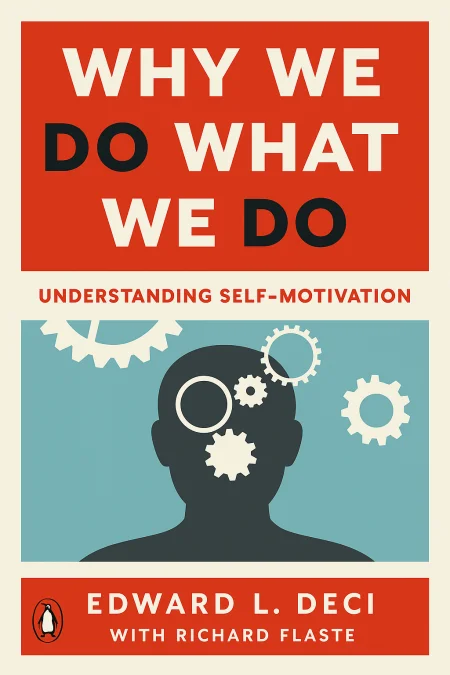
Why We Do What We Do
Understanding Self-Motivation
byEdward L. Deci, Richard Flaste
Book Edition Details
Summary
Imagine the spark of genuine interest lighting up inside a child's eyes, a student's heart, or an employee's mind. Psychologist Edward L. Deci uncovers a revolutionary truth in "Why We Do What We Do": autonomy, not rewards, is the true catalyst for motivation. Through engaging narratives and insightful analysis, Deci dismantles the age-old carrot-and-stick mentality, revealing a profound new approach to inspiring action. This book is an essential guide for anyone—be it a parent, educator, or leader—eager to foster environments where intrinsic motivation thrives. Dive into the science of self-driven success, where understanding and freedom replace coercion and control. Witness how cultivating an atmosphere of trust and explanation can transform mere compliance into passionate engagement, unlocking the secret to authentic achievement in every sphere of life.
Introduction
Why do some children lose their natural curiosity about learning as they grow older? Why do employees become disengaged despite reward systems designed to motivate them? Why do people struggle to maintain healthy behaviors even when they understand the benefits? These questions point to a fundamental misunderstanding about human motivation that pervades our educational systems, workplaces, and personal relationships. At the heart of these challenges lies Self-Determination Theory, a comprehensive framework for understanding what truly drives human behavior and well-being. This theory reveals that people have three basic psychological needs that, when satisfied, lead to optimal motivation, performance, and psychological health. The theory challenges conventional wisdom about rewards and punishments, showing how traditional motivational strategies often backfire by undermining the very behaviors they aim to encourage. The implications extend far beyond academic theory. Understanding authentic motivation can transform how parents raise children, how teachers engage students, how managers lead teams, and how individuals pursue personal change. The research reveals why some people thrive while others merely comply or rebel, and how social environments can either nourish or diminish human potential. This framework offers practical insights for creating conditions where people naturally want to do their best work, learn effectively, and maintain positive behaviors over time.
Self-Determination Theory and Human Motivation
Self-Determination Theory represents a fundamental shift in understanding human motivation, moving beyond simplistic reward-punishment models to examine what actually drives sustained engagement and well-being. The theory identifies three basic psychological needs that are essential for optimal human functioning: autonomy, competence, and relatedness. These needs are not learned desires but universal requirements that, when satisfied, promote intrinsic motivation and psychological health across all cultures and life stages. Autonomy refers to the need to feel volitional and self-directed in one's actions, experiencing a sense of personal choice rather than external pressure. Competence involves the need to feel effective and capable of achieving desired outcomes and mastering challenges. Relatedness encompasses the need for connection, belonging, and meaningful relationships with others. These three needs work synergistically, and environments that support all three tend to foster the highest levels of motivation and well-being. The theory distinguishes between different types of motivation based on their underlying regulatory processes. Intrinsic motivation represents engagement in activities for their inherent satisfaction and enjoyment. Extrinsic motivation varies in quality, ranging from external regulation through rewards and punishments to integrated regulation where external goals become personally meaningful. This nuanced understanding explains why two people performing the same behavior can have vastly different experiences and outcomes. Consider a musician who practices daily. If driven by intrinsic motivation, she experiences joy in the process, maintains engagement over time, and demonstrates creativity and excellence. If externally motivated by competition or parental pressure, she may perform adequately but experience stress, lose interest when rewards cease, and show less creative expression. The behavior appears identical, but the underlying motivation determines both the experience and long-term outcomes.
Autonomy Support vs Controlling Environments
The distinction between autonomy-supportive and controlling environments represents one of the most crucial insights for anyone in a position of influence. Controlling environments rely on pressure, surveillance, evaluation, and contingent rewards to shape behavior. While these approaches may produce short-term compliance, they often undermine intrinsic motivation and can lead to decreased performance, reduced creativity, and psychological costs including anxiety and resentment. Autonomy-supportive environments, by contrast, acknowledge the other person's perspective, provide meaningful choices, offer rationales for requests, and minimize controlling language. These environments don't abandon structure or standards but implement them in ways that respect individual agency. Autonomy support involves taking the other person's frame of reference, understanding their needs and concerns, and working collaboratively toward shared goals. The effects of these different approaches are profound and measurable. Students with autonomy-supportive teachers show greater creativity, deeper learning, higher self-esteem, and better psychological adjustment. Employees under autonomy-supportive managers demonstrate increased job satisfaction, organizational commitment, and innovative thinking. Patients with autonomy-supportive healthcare providers show better treatment adherence and health outcomes. A parent helping with homework exemplifies this distinction. The controlling approach involves setting rigid schedules, offering rewards for completion, and emphasizing external consequences like grades. The autonomy-supportive approach might involve discussing the child's learning goals, exploring together how homework connects to their interests, providing choice in when and how to complete tasks, and acknowledging that homework can sometimes feel burdensome while explaining its purpose. Both approaches seek the same outcome, but one preserves and enhances the child's natural motivation to learn while the other risks undermining it.
Intrinsic vs Extrinsic Motivation Effects
The research reveals striking differences between intrinsic and extrinsic motivation in terms of both immediate experience and long-term outcomes. When people are intrinsically motivated, they demonstrate superior conceptual understanding, greater creativity, more flexible problem-solving, and enhanced well-being. Extrinsically motivated individuals may work hard and achieve acceptable results, but they typically show more rigid thinking, anxiety about performance, and dependence on continued external reinforcement. These differences become particularly evident in complex tasks requiring creativity or deep processing. Studies consistently show that people working for external rewards perform worse on tasks requiring artistic creativity, innovative problem-solving, or conceptual insight. The external focus seems to narrow attention and reduce the exploratory thinking necessary for breakthrough solutions. Conversely, intrinsic motivation promotes the open, playful mindset that facilitates creative discovery. The sustainability of motivation also differs dramatically. Intrinsic motivation tends to be self-perpetuating, as engagement brings its own rewards and often leads to increasing competence and deeper interest. Extrinsic motivation requires ongoing reinforcement and can actually decrease when rewards are withdrawn. This creates a problematic dependence where external motivators must be continuously escalated to maintain performance levels. The implications extend to how rewards are structured and implemented. A sales team motivated primarily by commissions may achieve short-term targets but could engage in unethical practices, show little concern for customer relationships, or lose motivation during slower periods. A team that finds meaning in their work, enjoys collegial relationships, and feels trusted to make decisions will likely maintain higher performance across varying conditions while upholding company values and customer service standards.
Building Autonomous Motivation in Practice
Creating conditions that foster autonomous motivation requires specific strategies and a fundamental shift in how we think about influence and leadership. Rather than asking how to motivate others, the key question becomes how to create environments where people motivate themselves. This involves providing choice whenever possible, explaining rationales for necessary constraints, acknowledging feelings of resistance or difficulty, and using non-controlling language that emphasizes collaboration rather than compliance. Effective choice provision goes beyond simple options to include meaningful participation in goal-setting, method selection, and problem-solving. When children help decide family rules, students participate in designing learning activities, or employees contribute to policy development, they develop ownership and commitment that external mandates cannot achieve. Even in situations with significant constraints, creative leaders find ways to expand the realm of choice and personal agency. Rationale-giving proves equally important, as people need to understand the purpose and value of what they're asked to do. Simply explaining why a task matters, how it connects to larger goals, or what benefits it provides helps people integrate external requirements with their personal values. This understanding transforms obligation into choice and compliance into commitment. The language and tone of communication profoundly influence whether people feel controlled or supported. Phrases like "you should" or "you must" trigger psychological reactance, while language like "you might consider" or "what do you think about" invites collaboration. Acknowledging negative feelings rather than dismissing them helps people process resistance and move toward genuine acceptance rather than grudging compliance. Consider a manager implementing a new safety protocol. The controlling approach emphasizes rules, consequences, and monitoring compliance. The autonomy-supportive approach might involve the team in identifying safety concerns, collaboratively developing procedures, providing training that builds genuine competence, and creating systems for ongoing input and refinement. Both aim for safety, but one builds lasting commitment while the other may generate resistance or mere surface compliance.
Summary
The essence of human motivation lies not in external rewards and punishments but in the satisfaction of our fundamental psychological needs for autonomy, competence, and relatedness. When social environments support these needs, people naturally engage in behaviors that benefit both themselves and their communities, experiencing vitality, creativity, and well-being in the process. Understanding this principle transforms how we approach relationships, leadership, education, and personal change, replacing coercive strategies with collaborative approaches that honor human agency while achieving meaningful outcomes. This framework offers hope for creating more humane and effective institutions while helping individuals discover their authentic motivations and develop their full potential.
Related Books
Download PDF & EPUB
To save this Black List summary for later, download the free PDF and EPUB. You can print it out, or read offline at your convenience.
By Edward L. Deci
