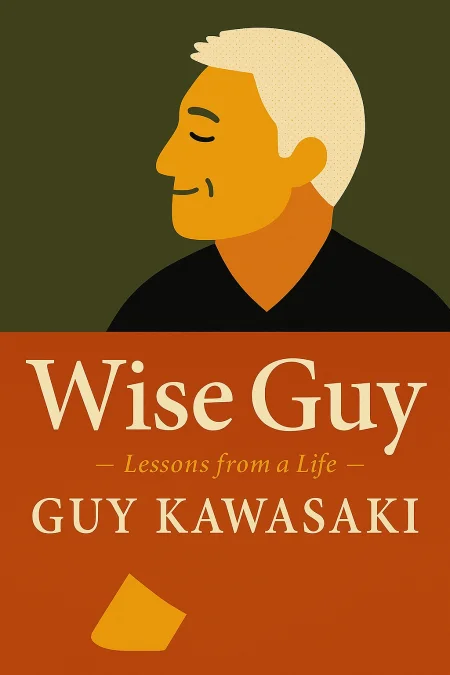
Wise Guy
Lessons from a Life
Book Edition Details
Summary
Once a young dreamer in Hawaii, Guy Kawasaki's journey from a football-loving kid to a Silicon Valley luminary reads like a mosaic of life's most unexpected turns. In "Wise Guy," Kawasaki paints a vibrant tapestry of vignettes, offering glimpses into his world where tech innovation meets human wisdom. His candid reflections, from being a dropout who defied convention to a pivotal force at Apple, invite readers into a realm where business acumen intertwines with personal growth. With warmth and wit, Kawasaki crafts not a mere memoir, but a guide to living with purpose and joy. Dive into tales of triumph and folly, where each story is a stepping stone towards a more meaningful existence. "Wise Guy" is a celebration of life's unpredictable lessons, an inspiring testament to the art of embracing one's unique path.
Introduction
In the pantheon of Silicon Valley legends, few figures embody the entrepreneurial spirit quite like Guy Kawasaki. Born to immigrant grandparents who fled Japan for the sugar plantations of Hawaii, Kawasaki would grow up to become one of tech's most influential evangelists, transforming how we think about marketing, innovation, and the pursuit of meaningful work. His journey from the working-class neighborhoods of Honolulu to the boardrooms of Apple represents more than just personal success—it captures the essence of the American dream reimagined for the digital age. Kawasaki's story unfolds against the backdrop of the personal computer revolution, where his gift for storytelling and genuine passion for great products would make him Apple's chief evangelist during the Macintosh era. Yet his influence extends far beyond any single company or product. Through fifteen books, countless speeches, and his work with startups around the globe, he has become a master of what he calls "the art of evangelism"—the ability to inspire others to embrace transformative ideas. From this remarkable life, readers will discover the power of authentic enthusiasm in building movements, the importance of embracing failure as a pathway to wisdom, and the profound satisfaction that comes from dedicating one's career to empowering others. Kawasaki's journey reveals how immigrant values, educational opportunity, and relentless curiosity can combine to create not just professional success, but a life of genuine impact and meaning.
Foundations: From Immigrant Roots to Stanford Dreams
Guy Kawasaki's story begins not with Silicon Valley ambition, but with the courage of his great-grandparents who left everything behind in Meiji-era Japan. Fleeing military conscription and economic uncertainty, they chose the grueling life of sugar plantation workers in Hawaii over the familiar struggles of their homeland. This decision, made in desperation, would ripple through generations to create opportunities none of them could have imagined. Growing up in Kalihi Valley, one of Honolulu's poorest neighborhoods, young Guy experienced the melting pot of working-class Hawaii. His family's small house sat near public housing projects, surrounded by a community of Hawaiians, Filipinos, Samoans, and Japanese Americans who shared the common bond of making do with very little. His father, Duke Kawasaki, worked multiple jobs—stevedore, fireman, and eventually state senator—while his mother Lucy dedicated herself entirely to her children's futures, instilling in Guy both fierce independence and the mandate to "always leave a place neater than you found it." The pivotal moment came in sixth grade when teacher Trudy Akau recognized potential that others had missed. Despite his family's modest circumstances, she convinced Guy's parents to sacrifice financially to send him to the elite Iolani prep school. This single act of advocacy changed everything. At Iolani, Guy encountered rigorous academic standards and teachers like Harold Keables, whose demanding approach to English composition taught him that excellence required not just effort, but precision and relentless revision. The transformation continued at Stanford University, where a kid from Hawaii's housing projects found himself surrounded by wealth and possibility he had never imagined. Here, among the children of doctors and executives, Guy discovered that intellect and determination could level any playing field. His friendship with future Apple evangelist Mike Boich began over a shared love of cars, but it would evolve into something far more significant—a partnership that would eventually bring Guy into the orbit of Steve Jobs and the personal computer revolution that was about to transform the world.
Apple Years: The Making of a Tech Evangelist
When Guy Kawasaki walked into Apple's Macintosh Division in 1983, he possessed neither a computer science degree nor relevant work experience. His background selling jewelry seemed laughably inappropriate for Silicon Valley's cutting edge. Yet within months, this former diamond counter would become one of tech's most effective evangelists, helping to launch a computer that would revolutionize how humans interact with technology. The role of software evangelist was itself revolutionary—part salesman, part missionary, part startup advisor. Armed with Macintosh prototypes and boundless enthusiasm, Kawasaki crisscrossed America convincing software developers to bet on an unproven computer with no installed base. His secret weapon wasn't technical expertise but genuine passion for the product and an intuitive understanding that people buy experiences, not specifications. When he demonstrated MacPaint and MacWrite to skeptical programmers, he wasn't selling technology—he was selling possibility. Working under Steve Jobs proved both exhilarating and terrifying. Jobs demanded excellence with an intensity that could crush egos and end careers, but he also inspired people to achieve more than they thought possible. Kawasaki learned that honesty, even brutal honesty, was not just preferred but essential. When Jobs unexpectedly introduced him to the CEO of a mediocre software company, Guy's unvarnished assessment of their products impressed rather than offended. In the Macintosh Division, truth-telling was a test of both competence and character. The experience taught Kawasaki lessons that would shape his entire career. He discovered that evangelism works only when you genuinely believe in what you're promoting—that "Guy's Golden Touch" wasn't about turning everything to gold, but about recognizing and championing truly golden opportunities. He learned that great products create their own momentum, that passionate early adopters are worth more than lukewarm masses, and that changing the world requires more than clever marketing—it demands products that actually make people's lives better. Perhaps most importantly, his Apple years revealed the power of positioning work as a cause rather than a job. The Macintosh wasn't just another computer; it was a tool for democratizing creativity and productivity. This lesson would become central to Kawasaki's later philosophy: the best evangelism doesn't feel like selling because it's really about empowering others to achieve their dreams.
Beyond Cupertino: Entrepreneur, Author, and Family Man
Leaving Apple in 1987 marked the beginning of Guy Kawasaki's most creatively fertile period. Co-founding ACIUS to publish database software taught him that entrepreneurship requires not just good ideas but the grinding determination to execute them. Yet it was an unexpected conversation with his startup partner, Marylene Delbourg-Delphis, that would unlock his most enduring contribution. When she suggested he write about his Apple experiences, Kawasaki discovered a calling he never knew existed. "The Macintosh Way," written in a closet-sized office on a Mac Plus, launched a writing career that would span fifteen books and establish Kawasaki as one of business literature's most accessible voices. His breakthrough came from embracing Brenda Ueland's radical advice in "If You Want to Write"—that everyone has something important to say and needs no permission to say it. This philosophy liberated him from the paralysis of perfectionism and launched a decades-long mission to democratize entrepreneurial wisdom. The evolution from tech evangelist to author and speaker revealed Kawasaki's greatest gift: the ability to translate complex business concepts into stories that inspire action. Whether explaining why "the customer is always right" is wrong, or demonstrating how to pitch ideas effectively, his approach remained consistent—combine practical advice with memorable anecdotes, delivered with self-deprecating humor and genuine enthusiasm for helping others succeed. Parallel to his professional evolution ran an even more important transformation—his growth as a husband and father. His marriage to Beth grounded him in values beyond career achievement, while raising four children, including two adopted from Guatemala, taught him that the most meaningful evangelism happens within families. His decision to take up hockey at age forty-eight, purely to share his sons' passion, exemplified his philosophy that authentic relationships require genuine investment, not just good intentions. This period also saw Kawasaki grappling with questions of legacy and purpose. Multiple returns to Apple, successful but unfulfilling ventures in venture capital, and his eventual role as chief evangelist for design platform Canva all reflected his ongoing search for work that mattered. The common thread remained his commitment to empowering others—whether entrepreneurs seeking funding, authors learning to self-publish, or individuals discovering their creative potential through accessible design tools.
Wisdom Gained: Lessons from a Life Well-Lived
As Guy Kawasaki entered his sixties, his perspective shifted from achieving success to understanding its deeper meaning. The boy who once measured progress by the car his father drove had evolved into a man who found profound satisfaction in surfing mediocre waves with his teenage daughter. This transformation reveals perhaps his most important insight—that true wealth lies not in accumulating achievements but in cultivating relationships and experiences that bring genuine joy. Kawasaki's later writings and speeches increasingly emphasized what he calls "getting high and to the right"—developing skills that are both unique and valuable. His own career exemplified this principle, combining technical knowledge with storytelling ability and moral courage with marketing savvy. Yet he consistently warned against the trap of believing that success follows any predictable formula. His most costly mistake—declining to interview for the CEO position at Yahoo when it was just a collection of favorite websites—taught him that you can never fully predict which opportunities will matter most. The adoption of his two youngest children crystallized another core belief—that love creates families, not biology. His fierce defense of adoption as "beautiful for parents and children alike" reflected a broader philosophy about embracing people and ideas that others might overlook. This openness to the unexpected became a hallmark of his approach to both business and life, from hiring unproven talent based on demonstrated competence rather than credentials to championing startup ideas that conventional wisdom dismissed as impossible. Perhaps most significantly, his battle with Ménière's disease and the deaths of close friends forced him to confront mortality and redefine priorities. The executive who once answered every email learned to delete entire inboxes when life reminded him of what truly mattered. His practice of spending more time with family whenever friends passed away became a physical manifestation of his deepest conviction—that relationships and experiences, not accomplishments and possessions, determine whether a life has been well-lived. In his role as mentor and advisor to countless entrepreneurs, Kawasaki discovered that his greatest satisfaction came not from his own successes but from enabling others to achieve theirs. The immigrant's great-grandson had found his ultimate calling—not just reaching the American dream himself, but helping others believe such dreams were possible for them too.
Summary
Guy Kawasaki's journey from the sugar plantations of his great-grandparents to the heights of Silicon Valley success embodies the profound truth that meaningful achievement comes not from accumulating wealth or status, but from dedicating one's talents to empowering others. His life demonstrates that the most effective evangelism springs not from manipulative techniques but from authentic passion for products, ideas, and people that genuinely deserve support. The lessons embedded in Kawasaki's story offer timeless guidance for anyone seeking to build a career of significance. His embrace of continuous learning, willingness to take risks on unproven opportunities, and commitment to honest communication provide a blueprint for professional success that transcends any single industry or era. Perhaps most importantly, his evolution from ambitious young executive to wise mentor illustrates that true fulfillment comes from using whatever platform we achieve to lift others up rather than simply elevating ourselves. For aspiring entrepreneurs, creative professionals, and anyone seeking to transform passion into purpose, Kawasaki's example suggests that the key lies not in perfecting a master plan but in remaining open to unexpected opportunities while staying true to core values of honesty, generosity, and genuine care for others' success. His story ultimately proves that the American dream remains alive and achievable—not just for those born into privilege, but for anyone willing to work hard, think differently, and never stop believing that tomorrow can be better than today.
Related Books
Download PDF & EPUB
To save this Black List summary for later, download the free PDF and EPUB. You can print it out, or read offline at your convenience.

By Guy Kawasaki
