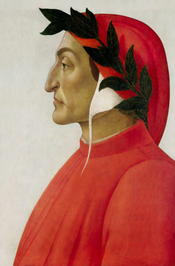
Dante Alighieri
Dante Alighieri, an illustrious figure in the realm of Italian poetry, emerged from the vibrant city-state of Florence in 1265. His life, marked by profound personal and political tumult, served as fertile ground for his literary genius. At the tender age of nine, Dante encountered Beatrice Portinari, the muse who would profoundly influence his work, particularly in his exploration of divine love and virtue. Despite their limited real-world interactions, Beatrice's ethereal presence permeated his writings, inspiring the transcendent allegories of his opus. Dante's life unfolded against the backdrop of Florence's fractious political landscape, where the struggle between the Guelfs and the Ghibellines, and later the internal rift between the White and Black Guelfs, shaped his career and eventual exile. Among Dante's literary contributions, "The Divine Comedy" stands as a monumental achievement, cementing his status as a master of the Italian vernacular. This epic poem, divided into three parts—Inferno, Purgatorio, and Paradiso—chronicles a symbolic journey through the realms of the afterlife, offering an intricate tapestry of medieval theology and cosmology. Each canto pulsates with vivid imagery and profound philosophical inquiry, reflecting Dante's deep engagement with the spiritual and moral issues of his time. His work has garnered enduring critical acclaim, hailed as a pillar of Western literature for its innovative narrative structure and its profound exploration of the human condition. Dante's literary style is distinguished by its intricate use of allegory and its fusion of classical and Christian motifs, presenting a rich tapestry of moral and theological exploration. His profound insights into the human soul and his skillful weaving of complex themes have left an indelible mark on literature, influencing countless writers and thinkers across generations. Though exiled from his beloved Florence, Dante's legacy transcends time and place, his work continuing to resonate with readers seeking to understand the intricacies of faith, redemption, and the eternal human quest for meaning.


by Paul J. Zak
by Rory Vaden
by Robert C. Solomon, Fernando Flores
by Brett Gardner
by Dennis S. Reina
by Julian Baggini
by Larry Downes, Omar Abbosh, Paul Nunes
by Jacqueline Woodson
by Kevin Oakes
by Lindsey Pollak, Kimberly B. Cummings, Kimberly Brown
