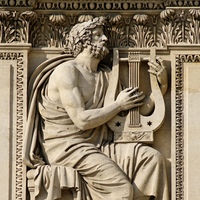
Homer
Homer, the enigmatic bard of ancient Greece, is traditionally credited with composing "The Iliad" and "The Odyssey," two epic masterpieces that have profoundly influenced the literary canon of Western civilization. Flourishing around the 8th century BC, Homer is often enveloped in the mists of legend, with scant biographical details shrouding his existence. Most narratives depict him as a blind poet from Ionia, a coastal region of Anatolia, yet these accounts remain as much a part of myth as his own tales of gods and heroes. Despite this ambiguity, his impact on Greek culture was monumental, shaping the ideals of heroism, glory, and honor that permeate not only Greek but also subsequent Western thought. "The Iliad" and "The Odyssey," Homer's magnum opuses, stand as pillars of epic poetry. "The Iliad" unfolds the tragic saga of the Trojan War, focusing on the wrathful clash between King Agamemnon and the formidable warrior Achilles. In contrast, "The Odyssey" recounts the arduous, decade-long voyage of Odysseus, King of Ithaca, as he strives to return home following Troy's downfall. Written in the unique Homeric Greek—a blend of Ionic and Aeolic dialects—these works were originally transmitted through the oral tradition, a testament to their enduring resonance. While primarily hailed for their tragic and heroic themes, Homer’s epics are interspersed with moments of levity and wit, offering a rich tapestry of the human condition. The timeless nature of these narratives has sparked inspiration across diverse artistic fields, from Dante's reverent allusion to Homer as the "Poet sovereign" in "The Divine Comedy" to Alexander Pope's recognition of Homer as the "greatest of poets." Homer’s narrative style, characterized by its grandeur and meticulous attention to detail, has left an indelible mark on the literary landscape. His exploration of universal themes, such as the complexities of human emotion, the capriciousness of fate, and the pursuit of honor, continues to captivate audiences. Through his compelling storytelling, Homer has transcended the confines of time, offering not only a window into the ancient world but also a mirror reflecting timeless truths about humanity. His epics, with their intricate blend of myth and history, have established Homer as a cornerstone of literary tradition, and his influence persists as a beacon for generations of poets and scholars alike.


by Paul J. Zak
by Rory Vaden
by Robert C. Solomon, Fernando Flores
by Brett Gardner
by Dennis S. Reina
by Julian Baggini
by Larry Downes, Omar Abbosh, Paul Nunes
by Jacqueline Woodson
by Kevin Oakes
by Lindsey Pollak, Kimberly B. Cummings, Kimberly Brown
