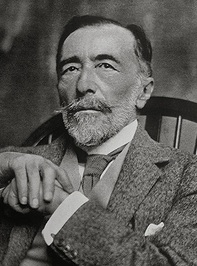
Joseph Conrad
Joseph Conrad, born Józef Teodor Konrad Korzeniowski in 1857 in what is now Ukraine, emerged as a luminary in English literature despite his Polish origins and the considerable linguistic challenges he faced. Emigrating to the United Kingdom in his twenties after extensive travels with the French and British merchant navies, he infused his works with a distinctive blend of continental sensibility and maritime experience. Conrad's narratives often reflect the complexities of human existence against the backdrop of an unfeeling and enigmatic world, a perspective shaped by his early life under the partitioned Polish lands and later by his seafaring adventures. His profound insights into the human psyche and the moral quandaries posed by imperialism continue to resonate with readers and scholars alike. Among Conrad's oeuvre, "Heart of Darkness" stands as a pivotal work, dissecting the dark undercurrents of colonial exploitation and the inner turmoil of its protagonist, Marlow. This novella, along with "Lord Jim," exemplifies Conrad's ability to weave tales that navigate the treacherous waters of human conscience and the ambiguities of heroism. While his books did not always achieve widespread commercial success during his lifetime, they garnered critical acclaim, cementing his reputation as a pioneering voice in modernist literature. His narratives, frequently set in the expansive and unpredictable maritime world, challenge readers to confront the inscrutable nature of humanity and the ethical dilemmas inherent in colonial ventures. Conrad's literary style is marked by its impressionistic approach, often employing a complex narrative structure and a rich, evocative prose that delves into the depths of human consciousness. His masterful use of language, despite it being his third language, coupled with his thematic exploration of isolation, existential doubt, and moral ambiguity, has profoundly influenced subsequent generations of writers. Through his introspective characters and intricate storytelling, Conrad has contributed significantly to the evolution of the novel, bridging 19th-century realism and the burgeoning modernist movement, and leaving an indelible mark on the landscape of English literature.


by Paul J. Zak
by Rory Vaden
by Robert C. Solomon, Fernando Flores
by Brett Gardner
by Dennis S. Reina
by Julian Baggini
by Larry Downes, Omar Abbosh, Paul Nunes
by Jacqueline Woodson
by Kevin Oakes
by Lindsey Pollak, Kimberly B. Cummings, Kimberly Brown
