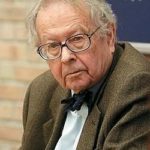
Kenneth N. Waltz
Kenneth N. Waltz, an eminent figure in the realm of international relations theory, was an American political scientist whose profound insights into the nature of global politics left an indelible mark on the academic community. Born on June 8, 1924, in Ann Arbor, Michigan, Waltz's journey into the intricacies of political theory was shaped by his experiences during World War II and his subsequent academic pursuits. A graduate of Oberlin College, he further honed his intellectual acumen at Columbia University, where he earned his Ph.D. in political science. Waltz's career was characterized by his tenure at several prestigious institutions, including Columbia University and the University of California, Berkeley, where he imparted his knowledge to generations of students, solidifying his status as a venerated scholar in the field. The cornerstone of Waltz's scholarly legacy is his seminal work, "Man, the State, and War: A Theoretical Analysis," published in 1959. This groundbreaking text dissected the perennial causes of war through a tripartite framework, examining the individual, the state, and the international system. The book, lauded for its analytical rigor and depth, established Waltz as a leading voice in international relations. His subsequent publication, "Theory of International Politics" (1979), further cemented his reputation by introducing the concept of neorealism or structural realism, which posited that the anarchic structure of the international system is the primary determinant of state behavior. This theoretical innovation not only provoked scholarly debate but also reshaped the paradigms through which international politics were understood. Waltz's contribution to political science is not confined to his theoretical innovations but extends to his articulate prose and methodical approach to complex global issues. His writing is distinguished by a clarity that elucidates intricate ideas without sacrificing intellectual sophistication. Through his works, Waltz espoused a worldview that emphasized the constraints imposed by the international system on state actions, challenging more optimistic notions of international cooperation and peace. His profound impact on the field of international relations endures, as scholars and policymakers continue to grapple with the implications of his theories in understanding contemporary global dynamics.


by Paul J. Zak
by Rory Vaden
by Robert C. Solomon, Fernando Flores
by Brett Gardner
by Dennis S. Reina
by Julian Baggini
by Larry Downes, Omar Abbosh, Paul Nunes
by Jacqueline Woodson
by Kevin Oakes
by Lindsey Pollak, Kimberly B. Cummings, Kimberly Brown
