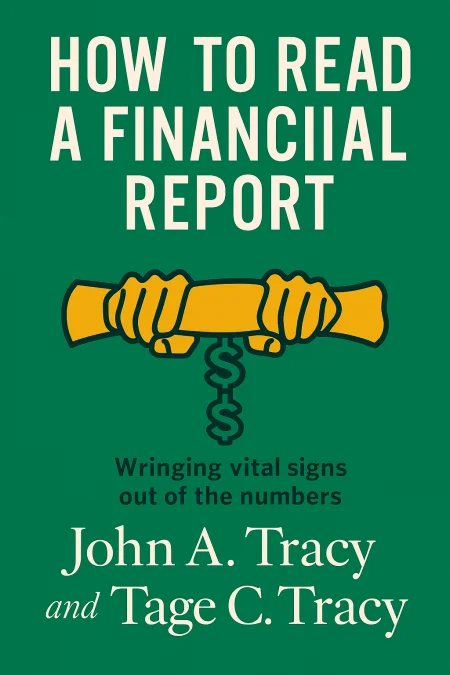
How to Read a Financial Report
Essential Information for Entrepreneurs, Lenders, Investors, Analysts, and Management
byJohn A. Tracy, Tage C. Tracy
Book Edition Details
Summary
When financial statements seem like cryptic puzzles only accountants can solve, this fresh edition of *How to Read a Financial Report* arrives as your indispensable translator. Perfect for investors, managers, and curious minds alike, this book unravels the intricate language of balance sheets and income reports with clarity and flair. With over five decades of collective expertise, the authors illuminate the latest shifts in financial standards and regulations, from the nuances of XBRL tagging to the evolving landscape of auditor's reports. This guide doesn't just explain—it empowers you to decode and leverage financial insights, offering a rare window into the true fiscal health of any business. Prepare to navigate the financial world with newfound confidence and precision.
Introduction
Picture yourself sitting across from a potential business partner, investor, or lender. They slide a stack of financial documents across the table and ask, "What do you think?" Your response in that moment could determine the trajectory of your business relationships, investment opportunities, and financial future. Yet for many bright, capable professionals, financial statements remain as mysterious as ancient hieroglyphics. The numbers seem to dance on the page without revealing their secrets about a company's true health, performance, and potential. This disconnect between financial literacy and business success creates unnecessary barriers to wealth building and informed decision-making. Whether you're an entrepreneur seeking funding, an investor evaluating opportunities, or a professional wanting to understand your company's performance, the ability to decode financial reports transforms you from a passive observer into an active, confident participant in the business world. The journey from financial confusion to clarity begins with understanding that every number tells a story, every ratio reveals a relationship, and every statement unveils a different dimension of business performance.
Understanding Financial Statement Fundamentals
At its core, financial statement analysis resembles detective work, where each document provides crucial evidence about a company's financial story. The three primary financial statements work together like chapters in a book, each revealing different aspects of the same business narrative. The income statement captures the company's performance over time, showing how successfully it generates revenue and controls expenses. The balance sheet freezes a moment in time, revealing what the company owns, what it owes, and what belongs to the owners. The cash flow statement tracks the actual movement of money, bridging the gap between accounting profits and real cash generation. Consider the case of a manufacturing company that appeared highly profitable on paper but struggled to pay its bills on time. Their income statement showed strong sales growth and healthy profit margins, painting a picture of success that attracted potential investors. However, a deeper examination of their financial statements revealed a more complex reality. The balance sheet showed rapidly growing inventory levels and accounts receivable, indicating that much of their reported profit was tied up in unsold products and uncollected customer payments. The company's cash flow statement told the most revealing part of the story. Despite reporting significant profits, their operating cash flow was actually negative, meaning they were consuming more cash than they generated from their core business activities. This disconnect between profits and cash flow created a dangerous situation where the company appeared successful while actually burning through their cash reserves. The management team had to make difficult decisions about inventory management, credit policies, and payment terms to align their cash generation with their reported profitability. To master financial statement fundamentals, start by reading all three statements together rather than in isolation. First, identify the time periods covered and ensure you're comparing consistent timeframes. Next, trace key numbers between statements to understand their interconnections. For instance, net income from the income statement should appear as an increase in retained earnings on the balance sheet, while changes in balance sheet accounts should reconcile with the cash flow statement. Pay particular attention to the relationship between revenue growth, asset growth, and cash flow patterns, as these reveal the sustainability of the company's business model. Remember that financial statements follow standardized formats and accounting principles, but companies within the same industry may present information differently. Develop the habit of reading the footnotes, as they often contain crucial information about accounting methods, significant events, and potential risks that could dramatically affect your interpretation of the numbers.
Analyzing Profit Performance and Cash Flow
The relationship between profit and cash flow represents one of the most critical yet misunderstood aspects of financial analysis. Many business owners and investors make the dangerous assumption that profit automatically translates into cash, leading to poor decisions and financial difficulties. Understanding this distinction requires examining how accounting principles create timing differences between when revenue is recorded and when cash is actually received, and when expenses are recognized versus when cash is paid out. The authors present the compelling example of a company that earned $2.6 million in net income but generated $3.1 million in cash flow from operations during the same period. This $500,000 difference wasn't an accounting error but rather the natural result of how the company's working capital accounts changed throughout the year. Their accounts receivable increased as sales grew, temporarily reducing cash flow as more money became tied up in customer credit. Simultaneously, their accounts payable increased as they took longer to pay suppliers, effectively providing free financing that boosted cash flow above reported profits. This company's experience illustrates why successful businesses monitor both profit margins and cash conversion cycles. The cash conversion cycle measures how long it takes to convert inventory investments into cash receipts from customers. Companies with shorter cycles generate cash more quickly and require less working capital to support growth. Those with longer cycles must carefully manage their financing to avoid cash shortages, even during profitable periods. The manufacturing company implemented new policies to accelerate customer collections, optimize inventory levels, and strategically time supplier payments, ultimately improving their cash conversion cycle from 13 weeks to 10 weeks and freeing up nearly $2 million in cash. To analyze profit performance and cash flow effectively, calculate key ratios including gross profit margin, operating profit margin, and cash flow margin. Compare these ratios over multiple periods to identify trends and benchmark them against industry standards. Next, examine the components of working capital including accounts receivable, inventory, and accounts payable to understand how efficiently the company converts sales into cash. Pay close attention to any significant changes in these accounts, as rapid growth in receivables or inventory often signals collection problems or overproduction. Focus on the quality of earnings by comparing net income to operating cash flow over several years. Companies with consistently higher cash flow than net income often have conservative accounting practices and strong cash management. Conversely, companies where profits consistently exceed cash flow may be experiencing operational difficulties or using aggressive accounting methods that warrant further investigation.
Reading Between the Lines of Financial Reports
Financial reports contain layers of information beyond the basic numbers, requiring readers to develop skills in detecting subtle signals about management quality, business risks, and future prospects. The footnotes, management discussions, and supplementary information often reveal more about a company's true condition than the headline figures. Experienced analysts know that the most important insights frequently emerge from unexpected places, such as changes in accounting methods, unusual one-time charges, or shifts in management language about business conditions. The authors highlight a crucial example involving a company's depreciation policies and their impact on reported earnings. This company had adopted conservative depreciation methods that made their assets appear less valuable on the balance sheet while creating higher annual depreciation expenses that reduced reported profits. However, this conservative approach actually strengthened their financial position by creating hidden value and ensuring that their reported earnings were highly sustainable. When competitors using more aggressive depreciation methods faced write-downs and restructuring charges, this company's conservative practices protected them from similar problems. The same company's management demonstrated transparency by clearly explaining their accounting choices and their long-term implications in the footnotes to their financial statements. They discussed how their depreciation methods aligned with their actual asset replacement cycles and how their revenue recognition policies ensured that reported sales reflected genuine business activity. This level of disclosure built credibility with lenders and investors, who could make informed decisions based on complete information rather than having to guess about the company's accounting practices. To read between the lines effectively, always examine footnotes carefully, looking for changes in accounting methods, significant estimates, or contingent liabilities that could affect future performance. Pay attention to management's tone and consistency in their narrative discussions, noting any changes in language or emphasis that might signal shifting business conditions. Compare key ratios not just against industry averages but also against the company's own historical performance to identify meaningful trends or deterioration. Look for patterns in extraordinary or one-time charges, as companies that frequently report such items may be experiencing systematic operational problems rather than truly unusual events. Examine the composition of revenue growth to distinguish between organic growth and growth from acquisitions, pricing changes, or accounting adjustments. Finally, assess the sustainability of profit margins by understanding the underlying business drivers and competitive dynamics rather than simply projecting past performance into the future.
Summary
Financial literacy transforms from a technical skill into a powerful tool for building wealth and making confident business decisions. Throughout this exploration, we've seen how the seemingly complex world of financial statements becomes accessible when approached systematically, with each statement revealing different aspects of the same business story. The key insight that emerges is that numbers alone tell only part of the story, while the relationships between different financial elements, the timing of cash flows, and the quality of management decisions determine long-term success. As the authors emphasize, "The main point is that capital has a cost, and excess assets mean that excess debt or excess owners' equity capital is being used by the business." Your journey toward financial mastery begins with a simple but transformative action: select three companies in an industry you understand and commit to reading their complete annual reports, including footnotes, within the next month. Focus not just on the numbers but on understanding the story they tell about each company's strategy, efficiency, and prospects. This practical exercise will build your confidence and reveal patterns that textbooks cannot teach, transforming you from someone who avoids financial discussions into someone who can engage confidently with investors, lenders, and business partners about the financial dimensions of success.
Related Books
Download PDF & EPUB
To save this Black List summary for later, download the free PDF and EPUB. You can print it out, or read offline at your convenience.
By John A. Tracy
