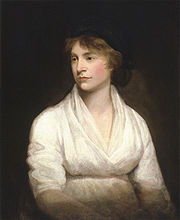
Mary Wollstonecraft
Mary Wollstonecraft, an eminent figure of the eighteenth century, stood at the confluence of British intellectual and cultural spheres as a writer, philosopher, and pioneering feminist. Her life, marked by personal trials and revolutionary ideas, often overshadowed her literary contributions during her era. Born into a society that relegated women to the shadows of domestic life, Wollstonecraft defied convention through her poignant explorations of gender equality and educational reform. Her personal narrative, intertwined with romantic entanglements with Henry Fuseli and Gilbert Imlay, eventually led to her marriage to the philosopher William Godwin. This union bore a daughter, Mary Shelley, who would later carve her own legacy as the author of "Frankenstein." Tragically, Wollstonecraft's life was cut short at thirty-eight, a casualty of childbirth complications, yet she left behind a legacy of unfinished manuscripts and a profound impact on the feminist discourse. Wollstonecraft's literary prowess is most vividly encapsulated in her seminal work, "A Vindication of the Rights of Woman," published in 1792. In this groundbreaking treatise, she ardently argued against the perceived inferiority of women, attributing it to a lack of access to education rather than any inherent deficiency. By advocating for women to be treated as rational beings on par with men, Wollstonecraft envisioned a society rooted in reason and equality. Her body of work, though diverse, consistently reflected her unwavering commitment to social justice, encompassing novels, treatises, and even a history of the French Revolution. Despite her contemporary society's reluctance to embrace her radical ideas, her writings gradually achieved recognition, particularly as the feminist movement gained momentum in the twentieth century. The literary style of Mary Wollstonecraft is characterized by its incisive clarity and impassioned rhetoric, serving as a clarion call for reform and intellectual emancipation. Her writings, steeped in social criticism, challenged the status quo and laid the groundwork for future feminist thought. Although initially her unorthodox lifestyle, as revealed in William Godwin's posthumous "Memoirs," tarnished her reputation, Wollstonecraft's intellectual contributions have since been vindicated. Today, she is revered as a foundational philosopher in feminist ideology, her life and work continuing to inspire and resonate with those advocating for gender equality and human rights.


by Paul J. Zak
by Rory Vaden
by Robert C. Solomon, Fernando Flores
by Brett Gardner
by Dennis S. Reina
by Julian Baggini
by Larry Downes, Omar Abbosh, Paul Nunes
by Jacqueline Woodson
by Kevin Oakes
by Lindsey Pollak, Kimberly B. Cummings, Kimberly Brown
