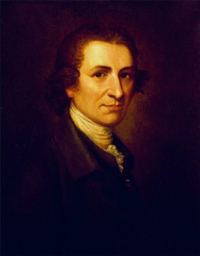
Thomas Paine
Emerging from the modest town of Thetford, England, Thomas Paine carved a path that would see him become a pivotal figure in the revolutionary fervor that swept through America and France in the late 18th century. Born in Norfolk in 1737, Paine's early life was marked by a series of vocations, from corset-making to tax collection, before he found his true calling as a writer and political activist. In 1774, with the endorsement of the illustrious Benjamin Franklin, Paine set sail for the American colonies, arriving just in time to lend his voice to the burgeoning movement for independence. His writings, suffused with Enlightenment ideals, would galvanize the American populace and echo across the Atlantic, cementing his legacy as a formidable advocate for liberty and human rights. Among Paine's most influential contributions are his incendiary pamphlets, notably "Common Sense" and "The Age of Reason." "Common Sense," published in 1776, stands as a cornerstone of revolutionary literature, its lucid arguments for independence capturing the imagination of a colonial society on the brink of transformation. This pamphlet, a runaway bestseller, is often credited with crystallizing the colonial resolve to break from British rule, earning praise from figures such as John Adams. Meanwhile, "The Age of Reason," penned during his tumultuous years in France, challenged the accepted dogmas of institutional religion, advocating instead for a deistic perspective grounded in reason and skepticism. His other notable work, "Rights of Man," defended the principles of the French Revolution and critiqued the conservative stance of Edmund Burke, further solidifying his reputation as a radical thinker. Paine's writing is characterized by its clarity, vigor, and unapologetic boldness. His prose, direct yet eloquent, is imbued with a fervent passion for justice and egalitarianism, themes that resonate throughout his oeuvre. Despite facing imprisonment in France and ostracism upon his return to America, Paine's contributions to political thought and discourse are undeniable. His enduring influence is reflected in the progressive ideals that continue to shape modern democratic societies. Paine's legacy as a provocateur of thought and champion of human rights remains a testament to his indomitable spirit and unwavering commitment to the cause of liberty.
New From Thomas Paine
More Books by Thomas Paine


by Martha S. Jones
by Jeff Stibel
by Tessa White
by Meghan Keane, LA Johnson
by Monica Guzmán
by Dan Barber
by La Leche League International
by Simon Napier-Bell
by Frances Frei, Anne Morriss
by Bill Gates Sr., Mary Ann Mackin
