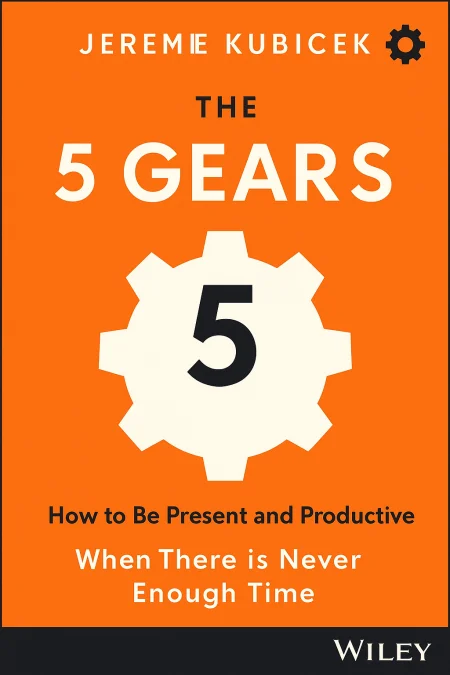
5 Gears
How to Be Present and Productive When There's Never Enough Time
Book Edition Details
Summary
In a world where every tick of the clock seems to slip through your fingers, "5 How to Be Present and Productive When There Is Never Enough Time" offers a transformative roadmap to reclaiming your day. Imagine harnessing five distinct gears—mindsets tailored to seamlessly navigate the chaos of modern life. This revolutionary guide equips you to shift effortlessly, aligning your energy with the moment's demands, whether you're at home or at the helm of a team. By embracing these gears, unlock a new realm of relational intelligence and influence, transcending mere time management. Step into a life where productivity and profound connections coexist, reshaping your influence in every sphere. Experience the joy of truly being present, and turn fleeting interactions into lasting impacts.
Introduction
Picture this: you're sitting at the dinner table with your family, but your mind is racing through tomorrow's meeting agenda. Your spouse is sharing something important, but you're mentally composing that urgent email. Your children are laughing and playing nearby, yet you feel disconnected, as if watching their lives through a foggy window. This scenario plays out in millions of homes and workplaces every day. We live in a world where being busy has become a badge of honor, where multitasking is praised, and where the lines between work and personal life have blurred beyond recognition. The challenge isn't that we lack time or energy—it's that we've forgotten how to be truly present in the moments that matter most. The cost of this disconnection is profound: strained relationships, missed opportunities for genuine connection, and a persistent feeling that life is happening to us rather than being lived by us. But what if there was a simple, practical way to shift gears intentionally, to be fully present when it matters most, and to master the art of connecting deeply while remaining productively engaged?
Know Yourself: Understanding Your Personal Gear Order
The foundation of being present lies in understanding your natural operating patterns—what we call your personal gear order. Just as every vehicle has a designed sequence from first through fifth gear, each person has a natural tendency to spend time in certain "gears" more than others. This isn't about good or bad patterns; it's about awareness and intentional choice. Consider Dan Frey's experience with his sixteen-year-old son Sam. Sam was an exceptional student who had never earned anything less than an A, achieved a second-degree black belt in karate, excelled in cross-country running, and was on track to become an Eagle Scout. Yet one morning, Dan noticed something troubling—his son seemed intensely focused but also under significant pressure. Rather than lecturing or probing with questions, Dan simply placed a visual representation of the five gears next to Sam at breakfast and asked him to look it over. When Dan returned from getting dressed, Sam looked him in the eye and said, "Dad, I'm stuck in fourth and fifth gear. I can't remember the last time I was in first gear." This moment of recognition transformed their relationship. Sam realized he had mastered high-performance gears but had completely neglected recharge and rest. For the first time, he had language to express his struggle without feeling weak or admitting failure. Dan could respond not with criticism but with understanding and guidance about the necessity of rest and renewal. To discover your own gear order, start by tracking your natural patterns throughout a typical week. Notice when you feel most energized, when you're most productive, and when you feel drained or disconnected. Write down what activities dominate your time and which ones you tend to avoid or rush through. The goal isn't to change everything immediately, but to develop the self-awareness that makes intentional shifting possible. Remember, awareness is the first step to transformation, and even highly successful people often discover they're operating in limited patterns that, while effective in some areas, may be creating disconnection in others.
Master the Gears: From Focus to Connection
Each gear serves a specific purpose in creating a balanced, connected life. Fifth gear represents focus mode—those times when you need to enter "the zone" and work with deep concentration. This is where strategic thinking happens, where complex problems get solved, and where your most important work gets accomplished. Fourth gear is the multitasking gear, where you handle multiple responsibilities, respond to communications, and manage the day-to-day flow of work and life. Ryan Underwood discovered the power of understanding these different modes when conflict arose in his marriage over technology use. As a creative introvert, Ryan recharged by engaging with apps and digital content—over 700 apps on his phone that energized rather than drained him. However, his extroverted wife saw his iPhone not as a recharge tool but as a disruptor that stole her husband's attention from family time. She had renamed his device "the Damn Phone" because of its power to make him disappear mentally even when physically present. The breakthrough came when they learned the language of gears. Instead of his wife threatening to break the phone or feeling hurt by what seemed like rejection, she could simply ask, "What gear are we in?" Ryan received this question much better than accusations or demands. When she asked this, he would recognize the need to shift and put the phone away, responding with "second gear" and becoming fully present with her. Third gear represents social connection—the casual conversations, the relationship building, and the lighter interactions that create trust and rapport. Second gear is deep connection mode, where meaningful conversations happen, where you're fully present with someone important to you, and where relationships are strengthened. First gear is recharge mode, where you restore your energy and clarity through rest, reflection, or whatever activities truly renew you. The magic happens when you learn to shift intentionally between these gears rather than getting stuck in one pattern. Start practicing by identifying which gear each situation calls for, then making the mental shift before engaging. This conscious choice transforms both your effectiveness and your relationships.
Shift Intentionally: Right Time, Right Place, Right Gear
Mastering the art of intentional shifting requires understanding that there are appropriate times and places for each gear. The morning rush to check emails immediately upon waking throws you into fourth gear when your mind and relationships need the gentler start of first gear. The dinner table conversation that gets hijacked by work discussions represents being in the wrong gear for the setting and the people present. Brian Hood from Naples, Florida, discovered this when he noticed a heartbreaking pattern: his baby daughter would get excited seeing his car pull into the driveway, but over time became less enthusiastic when she realized he would sit in the car for another twenty minutes finishing work calls and emails. The very person he was working to provide for was learning that work came first. Brian made a pivotal decision to leave his phone in the car and focus completely on his family when he walked through the door. Similarly, Tim from Wisconsin created a geographical marker that transformed his transitions. He identified a specific location on his drive home that reminded him to start downshifting from work gear to family gear. By the time he arrived home, he was mentally and emotionally prepared to be fully present with his family. This simple practice eliminated the jarring transition that often left his family feeling like they were competing with his work for attention. Creating your own shifting system involves three key elements: recognition markers that remind you to check what gear you're in, clear boundaries that protect important relationships and times, and practice in making smooth transitions rather than abrupt gear changes. Consider establishing technology-free zones or times, using physical locations as mental shift points, and communicating with those around you about when you're in different modes. The goal isn't perfection but intentionality. When you start choosing your gear based on what the moment requires rather than operating on autopilot, you discover that being present becomes natural rather than forced. Your relationships deepen, your work becomes more focused, and life begins to feel more balanced and fulfilling.
Summary
True presence isn't about finding more time or working harder—it's about being intentional with the time and energy you have. When you learn to shift gears consciously, choosing the right mode for each moment and relationship, you discover what one practitioner observed: "Being present makes you more productive, more creative, and happier, so those around you understand that if they want you to bring your best, then you need that time to recharge and connect." Start today by simply noticing what gear you're in throughout the day, and ask yourself whether it's the right gear for the moment you're in and the people you're with.
Related Books
Download PDF & EPUB
To save this Black List summary for later, download the free PDF and EPUB. You can print it out, or read offline at your convenience.
By Jeremie Kubicek
