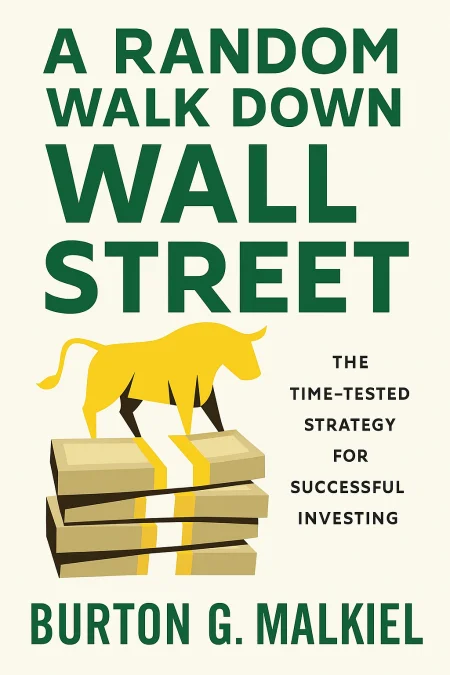
A Random Walk Down Wall Street
The Time-Tested Strategy for Successful Investing
Book Edition Details
Summary
Financial storms come and go, but one beacon of wisdom remains unwavering. Burton G. Malkiel’s timeless classic, "A Random Walk Down Wall Street," serves as the ultimate compass for navigating the choppy waters of today’s markets. In this newly updated edition, Malkiel dives into the art of tax-loss harvesting, the meteoric rise and risks of cryptocurrencies, and the growing influence of automated investment advisers. Each page brims with Malkiel's signature insights on everything from stocks to tangible assets like gold, all rooted in the fundamental idea that market movements are as unpredictable as a random walk. Whether you're a seasoned investor or just dipping your toes into the financial sea, this guide offers the clarity and calm needed to sail confidently through economic uncertainty.
Introduction
Have you ever wondered why some people seem to effortlessly build wealth while others struggle despite earning good incomes? The answer isn't luck, timing, or secret insider knowledge. It's about understanding fundamental principles that have worked for decades and applying them with unwavering discipline. The financial markets can seem intimidating, filled with complex jargon and conflicting advice from countless experts. Yet beneath this complexity lies a simple truth: successful investing doesn't require you to be a genius or have access to exclusive information. What it requires is patience, consistency, and the wisdom to ignore the noise while focusing on what truly matters. This journey toward financial independence begins with understanding three core principles that can transform your relationship with money and set you on a path toward lasting prosperity.
Master the Fundamentals of Smart Investing
Smart investing begins with understanding that markets are remarkably efficient at incorporating information into prices, making consistent outperformance extremely difficult even for professionals. This concept challenges everything we see in financial media, where daily market movements are analyzed as if they contain profound meaning. The reality is far different and far more encouraging for ordinary investors. Consider the legendary chartist John Magee, who operated from a windowless office in Springfield, Massachusetts, deliberately cutting himself off from outside influences. Magee believed that chart patterns held universal truths, spending hours studying price movements and drawing trend lines. He treated these patterns like sacred geometry, convinced that past price movements could predict future directions. His followers invested fortunes based on "inverted bowl" formations and resistance levels. Meanwhile, fundamental analysts following companies like Enron were busy calculating earnings projections and growth rates. Armed with detailed financial models and industry expertise, they issued glowing buy recommendations right up until the company's spectacular collapse. Their sophisticated analysis missed the creative accounting that was inflating reported profits, proving that even the most thorough research can miss critical risks. The uncomfortable truth revealed by decades of academic research is that neither technical nor fundamental analysis consistently beats a simple buy-and-hold strategy. After accounting for transaction costs and taxes, professional stock picking rarely justifies its fees. Start by shifting your perspective from trying to outsmart the market to capturing its long-term wealth-creating power. Focus on broad diversification, low costs, and maintaining discipline during both market euphoria and panic. Remember that sustainable wealth building requires patience, not speculation, and that time in the market beats timing the market.
Harness Index Funds for Long-Term Success
Index funds represent one of the most powerful yet underappreciated tools in investing, offering a revolutionary approach that doesn't try to beat the market but simply captures whatever returns it provides while keeping costs extraordinarily low. These funds own a broad slice of the entire market, delivering consistent results without the drama of active management. The story of how this approach gained acceptance reveals its power. When the first index fund launched, Wall Street ridiculed it as a guarantee of mediocrity, arguing that investors should aim higher than average returns. Critics couldn't understand why anyone would settle for market performance when skilled managers promised to beat it. Yet the mathematical truth was inescapable: since all investors collectively own the entire market, their average return must equal the market return before costs. Over the decades that followed, this simple index fund consistently outperformed the majority of actively managed funds. The fund that was dismissed as boring actually delivered superior results by avoiding the high costs and poor timing decisions that plagued its more ambitious competitors. Investors who chose this approach accumulated significantly more wealth than those who chased hot performance and paid high fees for the privilege. The beauty of index fund investing lies in its simplicity and effectiveness. You don't need to research fund managers or worry about style drift. Start by investing in a broad market index fund covering the entire stock market, then add international exposure for global diversification. Keep costs below 0.2 percent annually and set up automatic investments to take advantage of dollar-cost averaging. This isn't about settling for average returns but capturing the market's wealth-creating power while avoiding costly mistakes that reduce long-term performance.
Create Your Life-Cycle Investment Strategy
Your investment approach should evolve as you move through different stages of life, reflecting changes in your earning capacity, time horizon, and financial responsibilities. This life-cycle approach recognizes that different ages face fundamentally different investment challenges and opportunities that require tailored strategies. Take the example of a young professional like Tiffany, an ambitious MBA graduate in her twenties. With decades of earning potential ahead and no immediate need for her investment funds, she could afford significant risks in pursuit of higher returns. Her portfolio could be heavily weighted toward stocks, including aggressive growth investments and international markets. Even if the market crashed and her portfolio lost substantial value, she had time to recover through continued salary and investments. Contrast this with someone like Mildred, a widow in her sixties who had to stop working due to health issues. Her investment needs were completely different, requiring current income to pay bills and capital preservation for expenses she couldn't afford to lose. The aggressive growth strategy perfect for Tiffany would be disastrous for Mildred, who needed steady income from bonds and dividend-paying stocks. This approach extends beyond age to consider your entire financial situation. A middle-aged worker whose job and investments were both tied to the same company faced dangerous concentration risk. When that company eventually went bankrupt, he lost both employment income and investment portfolio simultaneously, demonstrating why diversification must consider all aspects of your financial life. Create your life-cycle strategy by honestly assessing your time horizon and risk capacity. In your twenties and thirties, embrace higher-risk investments for growth potential. Gradually shift toward more conservative investments as you approach retirement while maintaining some stock exposure for inflation protection. Consider target-date funds that automatically adjust allocation as you age, and regularly rebalance to maintain your desired risk level throughout your investment journey.
Summary
The path to building lasting wealth isn't about finding the next hot stock or timing the market perfectly, but about understanding and applying timeless principles that have worked for generations of successful investors. Through disciplined investing in low-cost index funds, maintaining a long-term perspective, and adjusting your strategy as circumstances change, you can harness the market's wealth-creating power while avoiding costly mistakes. As the evidence clearly demonstrates, "I doubt whether such extensive efforts will generate sufficiently superior selections to justify their cost," reminding us that simplicity often trumps complexity in investing. Start today by setting up automatic investments in a diversified portfolio of index funds, embrace the boring approach that actually works, and let time and compound growth build the financial future you deserve. Your journey toward financial independence begins with this first disciplined step away from speculation and toward proven wealth-building principles.
Related Books
Download PDF & EPUB
To save this Black List summary for later, download the free PDF and EPUB. You can print it out, or read offline at your convenience.
By Burton G. Malkiel
