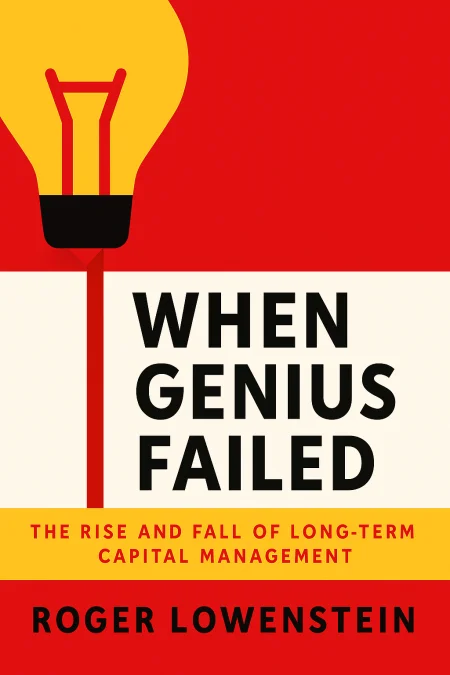
When Genius Failed
The Rise and Fall of Long-Term Capital Management
Book Edition Details
Summary
In the tumultuous world of high finance, where brilliance meets blunder, Roger Lowenstein's "When Genius Failed" unveils the riveting saga of Long-Term Capital Management. This hedge fund, once hailed as a paragon of market prowess, soared to dazzling heights before plummeting into a crisis that threatened the very bedrock of Wall Street. With access to confidential memos and insider interviews, Lowenstein dissects the personalities and hubris that fueled both meteoric success and catastrophic failure. This gripping narrative not only chronicles a financial roller-coaster but also serves as a haunting forewarning of future market collapses. A must-read for anyone intrigued by the delicate dance between risk and reward, where genius sometimes leads to downfall.
Introduction
In the gleaming offices overlooking Long Island Sound during the summer of 1998, the most brilliant minds in finance believed they had solved the ancient puzzle of market risk. These weren't ordinary traders relying on gut instinct, but Nobel Prize winners and former Federal Reserve officials who had transformed mathematical equations into what seemed like a perpetual money machine. Their hedge fund, Long-Term Capital Management, had achieved returns that appeared to defy the fundamental laws of risk and reward, generating extraordinary profits while their computer models promised near-zero probability of significant losses. Yet within weeks of their apparent triumph, this temple of financial genius would nearly collapse the entire global banking system. The story reveals three profound questions about the intersection of human ambition and market reality. How do the most sophisticated mathematical tools designed to eliminate risk become instruments of unprecedented destruction? What happens when intellectual brilliance becomes divorced from market humility? And how do the private decisions of a small group of traders threaten the stability of the world's financial system? This chronicle speaks to anyone seeking to understand the recurring patterns of boom and bust, the psychology of overconfidence, and the eternal tension between our desire to control uncertainty and the inherent unpredictability of complex systems. The lessons extend far beyond Wall Street, illuminating how the pursuit of mathematical perfection can blind even the smartest minds to fundamental human realities.
The Birth of Scientific Finance (1994-1996)
The early 1990s marked a revolutionary moment in financial history when academic theory began its fateful marriage with Wall Street ambition. John Meriwether, the legendary bond trader fresh from his exile following the Salomon Brothers scandal, recognized that the financial world was ripe for transformation. Traditional trading relied heavily on intuition and relationships, but advances in computing power and mathematical modeling promised to bring scientific precision to the seemingly chaotic world of markets. Meriwether assembled what many considered the most formidable intellectual team ever gathered in finance. Robert Merton and Myron Scholes, architects of modern options theory, joined forces with David Mullins, former vice chairman of the Federal Reserve, and a cadre of MIT-trained mathematicians. This wasn't merely another hedge fund launch but the birth of a new financial species that believed markets could be decoded through differential equations and statistical analysis rather than trader folklore and gut instinct. The fund's core philosophy rested on identifying tiny pricing discrepancies across global markets, then exploiting these inefficiencies through massive leverage and sophisticated hedging. Their models promised to spot opportunities invisible to less sophisticated competitors—Italian bonds yielding more than German bonds, off-the-run Treasury securities trading at discounts to newer issues, mortgage securities mispriced relative to their underlying risks. Everywhere the professors looked, their computers identified convergence trades that seemed to offer consistent profits with minimal risk. The early results appeared to validate their revolutionary approach spectacularly. In 1994, while most bond investors suffered brutal losses during an unexpected interest rate spike, Long-Term Capital thrived on market chaos, earning 28 percent returns by positioning itself as a liquidity provider when others fled. This success attracted an elite roster of investors from university endowments to foreign central banks, all eager to participate in what seemed like the dawn of truly scientific investing. By 1996, the fund had grown into a financial colossus managing over $100 billion in assets, seemingly proving that academic theory could generate extraordinary profits when applied with sufficient scale and mathematical sophistication.
Peak Confidence and Nobel Prize Validation (1997-Early 1998)
By 1997, Long-Term Capital Management had achieved something unprecedented in financial history, transforming from a hedge fund into a market-moving force capable of influencing global bond prices. The fund's assets swelled to over $125 billion, making it larger than many Wall Street investment banks despite employing fewer than 200 people. The partners had become financial royalty, their personal fortunes growing from millions to hundreds of millions as they reinvested their management fees with unwavering confidence in their mathematical models. The ultimate validation arrived in October 1997 when Merton and Scholes won the Nobel Prize in Economics for their groundbreaking work on derivatives pricing. Their Black-Scholes model had revolutionized options trading, and now their real-world laboratory was generating returns that seemed to prove the superiority of mathematical finance over traditional methods. Wall Street banks competed fiercely to finance Long-Term's trades, offering unprecedented terms including zero margin requirements—a testament to the fund's perceived invincibility and the universal belief in their risk management capabilities. Yet beneath this triumph, dangerous contradictions were emerging that would prove fatal. As Long-Term's success attracted imitators, the very arbitrage opportunities that had made the fund profitable began disappearing. Spreads narrowed as more capital chased the same trades, forcing the partners to venture into riskier territory including equity markets, merger arbitrage, and emerging market bonds—areas where their mathematical models offered less certain guidance. Most ominously, they began making larger and larger bets to maintain their extraordinary returns, pushing their leverage to dangerous extremes. The partners' response to shrinking opportunities revealed a crucial flaw in their thinking. Rather than accepting lower returns or returning capital to investors, they chose to maintain their lifestyle and status by concentrating risk. In late 1997, they forced outside investors to withdraw $2.7 billion while keeping the fund's massive asset base intact, dramatically increasing their personal leverage just as market conditions were becoming more treacherous. This decision transformed mathematical confidence into dangerous hubris, setting the stage for a spectacular collision between theoretical models and market reality.
Russian Crisis and the Mathematics of Collapse (August-September 1998)
The first warning signs emerged in early 1998 as traditional arbitrage opportunities continued vanishing, forcing Long-Term Capital into increasingly desperate territory. The partners plunged heavily into equity volatility trades, essentially selling insurance against stock market turbulence while collecting premiums their models suggested were overpriced. They expanded positions in Russian government bonds, convinced that a nuclear power backed by International Monetary Fund support could never default on its debts. The fund's leverage had reached astronomical levels—over thirty times its capital when including derivatives positions that didn't appear on traditional balance sheets. This meant even small market movements could generate massive losses, but the partners remained prisoners of their own intellectual framework. Their computers calculated that the probability of significant losses was virtually zero, based on historical patterns that assumed markets would behave rationally and predictably during stress periods. On August 17, 1998, Russia shattered the financial world's assumptions by defaulting on government bonds and devaluing the ruble. This wasn't supposed to happen according to any mathematical model, yet it triggered something far more devastating than a localized emerging market crisis. Russia's collapse exposed the dangerous interconnectedness of global financial markets and revealed how mathematical precision could become a fatal weakness when human panic replaced rational behavior. Long-Term Capital found itself at the epicenter of a perfect storm as every single carefully constructed trade moved against the fund simultaneously—a statistical impossibility according to their models, yet brutal reality in panicked markets. The fund lost $553 million in a single day, more than fifteen times what their risk models calculated as the maximum possible daily loss. Credit spreads that had been narrowing for years suddenly exploded wider as investors fled to Treasury bond safety, while the fund's leverage accelerated their destruction with terrifying speed. Within weeks, Long-Term's capital fell from $4.7 billion to less than $1 billion, threatening complete extinction and exposing how the very tools designed to eliminate risk had become instruments of unprecedented destruction.
Federal Rescue and Systemic Implications (September 1998-2000)
As Long-Term Capital Management teetered on bankruptcy's edge, financial regulators confronted an unprecedented dilemma that would reshape understanding of systemic risk. The fund's collapse would not merely wipe out sophisticated investors but could trigger a cascade of failures throughout the global financial system. Long-Term's trading partners included every major Wall Street bank, and its derivative contracts covered over $1 trillion in notional value, creating a web of interconnected obligations that threatened to freeze credit markets worldwide. Federal Reserve officials, led by New York Fed President William McDonough, made the controversial decision to orchestrate an extraordinary private sector rescue. In a historic meeting at the Federal Reserve building on September 23, 1998, the heads of Wall Street's most powerful institutions were essentially compelled to contribute $3.6 billion to keep Long-Term Capital operating while its positions were gradually unwound. This intervention marked a watershed moment in financial history, establishing the precedent that some private institutions could indeed be "too big to fail." The rescue succeeded in preventing immediate systemic collapse, but it came at significant cost to free market principles and revealed disturbing truths about modern finance. Critics argued that bailing out sophisticated investors who had willingly taken enormous risks created moral hazard that would encourage even greater risk-taking in the future. More troubling, the episode exposed how supposedly independent financial institutions had become interconnected through complex derivative relationships, creating systemic vulnerabilities that regulators had barely begun to understand. The Long-Term Capital saga ultimately served as a harbinger of larger crises to come, demonstrating patterns that would resurface repeatedly in subsequent decades. The same combination of mathematical overconfidence, excessive leverage, and interconnected risk that destroyed the hedge fund would culminate in the 2008 financial crisis and beyond. The fund's collapse proved that no amount of intellectual sophistication could eliminate the fundamental uncertainty and human psychology that drive financial markets—a lesson the financial world would need to relearn again and again, often at enormous cost to global economic stability.
Summary
The Long-Term Capital Management saga illuminates a fundamental paradox of modern finance: the more sophisticated our tools for measuring risk become, the more dangerous our illusions of control grow. This story reveals how the pursuit of mathematical precision in an inherently uncertain world can transform brilliant minds into architects of their own destruction, turning theoretical models into weapons of mass financial destruction when combined with excessive leverage and institutional arrogance. Three crucial lessons emerge from this historical catastrophe for anyone navigating uncertainty in complex systems. First, beware of models that promise to eliminate uncertainty rather than simply helping to understand it better—the most dangerous moment comes when we mistake our measurements of risk for risk itself, forgetting that the future remains fundamentally unknowable regardless of computational power. Second, recognize that success often contains the seeds of failure, particularly when it breeds the arrogance to abandon the very caution and humility that made initial success possible. Finally, understand that in interconnected systems, individual failures can cascade unpredictably, making seemingly private risks into existential public dangers. The deeper wisdom transcends finance entirely, speaking to the eternal human struggle between ambition and prudence. Whether in investing, business, or life itself, the greatest risks often emerge not from what we don't know, but from what we believe we know with absolute certainty. True wisdom lies in maintaining intellectual humility before uncertainty, building robust systems that can survive inevitable miscalculations, and remembering that human judgment, for all its flaws, remains irreplaceable when navigating an unpredictable world where mathematical models meet the messy reality of human behavior under extreme stress.
Related Books
Download PDF & EPUB
To save this Black List summary for later, download the free PDF and EPUB. You can print it out, or read offline at your convenience.
By Roger Lowenstein
