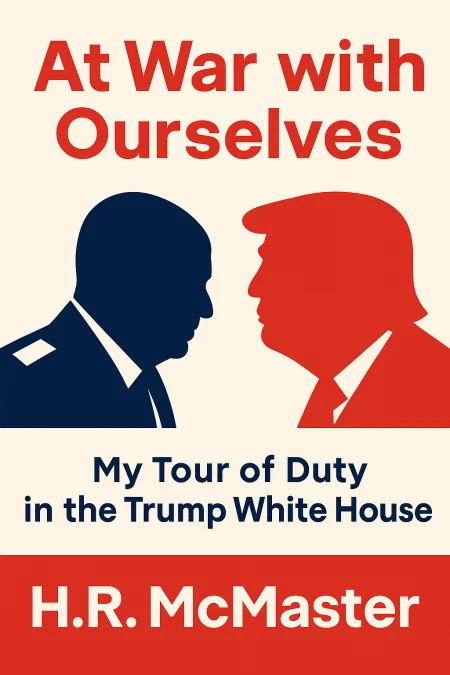
At War with Ourselves
My Tour of Duty in the Trump White House
Book Edition Details
Summary
Power struggles and high-stakes diplomacy color the tumultuous landscape of H.R. McMaster's tenure as National Security Advisor in "At War with Ourselves." Step into a world where political intrigue and strategic maneuvering intersect with the raw unpredictability of the Trump White House. McMaster, with the precision of a military strategist and the insight of a seasoned historian, navigates the volatile corridors of power, revealing the intense battles waged not only on the global stage but within the very administration itself. Through candid reflections, he illuminates the delicate balance of maintaining national security while grappling with internal discord and backroom agendas. As the 2024 election looms, this compelling narrative underscores the critical need for astute leadership and unwavering integrity in guiding the United States through an era of global uncertainty.
Introduction
The phone call came on a quiet Philadelphia street corner, interrupting what should have been a routine briefing on Russian hybrid warfare. Within hours, Lieutenant General H.R. McMaster would find himself sitting across from President Trump at Mar-a-Lago, discussing everything from Afghanistan to Iran in what would become one of the most consequential job interviews in modern American politics. It was February 2017, and the Trump administration was reeling from National Security Advisor Michael Flynn's abrupt resignation after just twenty-four days in office. McMaster entered that meeting as a soldier-scholar whose reputation had been forged both on Iraqi battlefields and in academic halls. His tank battle at 73 Easting had become the stuff of military legend, while his book on Vietnam had warned against the dangers of advisors who told presidents what they wanted to hear rather than what they needed to know. Now he would face the ultimate test of that principle, serving a commander-in-chief whose unconventional style and deep suspicions of the foreign policy establishment would challenge every assumption about how American power should be wielded. Through McMaster's thirteen-month journey in the West Wing, readers will witness the collision between military discipline and political chaos, between institutional expertise and disruptive innovation. His story reveals the complex dynamics of serving a president who valued loyalty above all else while maintaining the intellectual honesty that had defined his career. This is not merely the tale of one man's service, but a window into how foreign policy is truly made when personal relationships, competing agendas, and global crises converge in the most powerful office on earth.
From Battlefield Commander to Presidential Advisor
McMaster's transformation from battlefield commander to presidential advisor began with an unlikely chemistry between two men who couldn't have been more different. Trump, the real estate mogul turned politician, was drawn to McMaster's willingness to challenge conventional wisdom and his promise to provide multiple options rather than predetermined recommendations. When the president asked about his salary, McMaster's honest admission that he didn't know because his paycheck went directly to his wife seemed to convince Trump that here was someone motivated purely by service rather than personal gain. The general's military bearing and academic credentials appealed to a president who respected strength and expertise, even as Trump remained deeply suspicious of the foreign policy establishment. McMaster's reputation for intellectual rigor, built through years of studying military history and strategy, offered something Trump's inner circle lacked: the ability to think systematically about America's role in an increasingly complex world. His book on Vietnam had established him as someone unafraid to criticize senior leaders when they failed in their duty to provide honest counsel. Yet the transition from military command to presidential advisor would prove more challenging than any battlefield McMaster had faced. In the Army, chains of command were clear, objectives were defined, and loyalty flowed upward and downward with institutional precision. The Trump White House operated by entirely different rules, where competing power centers vied for influence, personal relationships often trumped formal authority, and the president's own mercurial nature meant that today's decision could become tomorrow's reversal. Within hours of his appointment, McMaster discovered that his new battlefield was unlike anything his military experience had prepared him for. The Russia investigation cast a shadow over everything, while competing factions led by figures like Steve Bannon and Jared Kushner fought for control over a president who seemed to thrive on chaos. For a career officer accustomed to unified command and clear mission objectives, it was a jarring introduction to the reality that in Trump's Washington, the most dangerous enemies were often within.
Navigating Chaos: Policy Battles and Internal Warfare
The Trump White House that McMaster entered was consumed by internal warfare that made coherent policy-making nearly impossible. From his first days in the West Wing, he found himself caught between Steve Bannon's nationalist agenda, which viewed traditional alliances with suspicion, and establishment figures who sought to contain Trump's more disruptive impulses. The normal interagency process that had guided American foreign policy for decades was under constant assault from advisors who saw disruption as an end in itself. McMaster's efforts to impose order on this chaos often put him at odds with other senior officials who maintained their own direct channels to the president. Secretary of State Rex Tillerson and Defense Secretary James Mattis, viewing themselves as the adults in the room, frequently operated independently of the National Security Council process, creating parallel power structures that undermined unified strategy. These weren't merely bureaucratic turf wars; they reflected fundamental disagreements about America's role in the world and how presidential authority should be exercised in foreign affairs. The challenge was compounded by Trump's unconventional decision-making style, which relied heavily on personal relationships, media coverage, and instinctive reactions to unfolding events. McMaster found himself constantly working to channel the president's disruptive energy toward constructive ends while preventing impulsive decisions that could damage American interests. This required walking a delicate tightrope between respecting Trump's authority as commander-in-chief and providing the kind of honest, sometimes unwelcome counsel that effective leadership demanded. Perhaps most frustrating was the constant warfare between different administration factions, each claiming to represent the authentic Trump agenda. McMaster's commitment to traditional policy processes put him in direct conflict with those who viewed such structures as obstacles to revolutionary change. The result was a daily battle fought not just over policy substance but over fundamental questions of how decisions should be made and who had the right to influence them. Every policy victory came at the cost of political capital, and every honest assessment risked being seen as disloyalty to a president who prized personal allegiance above institutional expertise.
Strategic Achievements Amid Administrative Turbulence
Despite the internal chaos that defined much of his tenure, McMaster managed to achieve significant shifts in American foreign policy that would outlast his time in office. His work on the National Security Strategy represented a fundamental departure from post-Cold War assumptions, explicitly acknowledging that the United States was once again engaged in strategic competition with great powers like China and Russia. This intellectual breakthrough, which seemed obvious in hindsight, required overcoming decades of wishful thinking about the end of history and the inevitable spread of democratic values. The development of a new Afghanistan strategy showcased McMaster's ability to apply rigorous analysis to America's most intractable foreign policy challenge. Drawing on his extensive combat experience and deep understanding of counterinsurgency warfare, he helped craft an approach that moved away from arbitrary timelines toward conditions-based decision-making. The strategy acknowledged that American interests required sustained engagement while focusing on achievable objectives rather than nation-building fantasies that had consumed previous administrations. McMaster's influence was equally evident in the administration's maximum pressure campaign against North Korea, which abandoned the failed cycle of negotiations followed by violations that had characterized previous approaches. This strategy required careful coordination with allies in South Korea and Japan while managing the complex relationship with China, whose cooperation was essential but whose interests didn't always align with American objectives. The campaign succeeded in imposing unprecedented economic pressure on the Kim regime while maintaining alliance unity. The administration's harder line toward Iran also bore McMaster's fingerprints, moving beyond the narrow focus on nuclear issues to address Iran's destabilizing activities across the Middle East. This comprehensive approach recognized that Tehran's support for terrorism and efforts to dominate the region through proxy forces couldn't be separated from the nuclear question. While controversial, this strategy forced allies and adversaries alike to confront the full scope of Iranian malign behavior rather than compartmentalizing different aspects of the challenge.
The Cost of Principled Leadership in Political Combat
By early 2018, the political forces that had been building against McMaster throughout his tenure finally reached a breaking point. The constant battles with other senior officials, combined with Trump's growing frustration with traditional foreign policy approaches, had eroded the relationship between the president and his National Security Advisor. McMaster's commitment to speaking truth to power, the very quality that had distinguished his military career, had become a liability in an administration that increasingly valued loyalty over candor. The attacks on McMaster came from multiple directions, orchestrated by political operatives who viewed his influence as an obstacle to their own agendas. The hashtag FireMcMaster campaign, amplified by alt-right media and even Russian bots, represented a new form of political warfare that combined domestic grievance politics with foreign disinformation. These assaults were deeply personal, targeting not just his policies but his character, his loyalty to allies, and his commitment to Trump's vision for America. The end came not with dramatic confrontation but with the gradual recognition that McMaster had become more of a political liability than a strategic asset. His replacement by John Bolton, a figure with very different views about American power and diplomacy, signaled Trump's desire for advisors who would embrace rather than moderate his most aggressive instincts. The phone call announcing his departure was cordial, even respectful, but it marked the end of an experiment in bringing traditional military expertise into an unconventional administration. For McMaster, the departure represented both personal disappointment and professional relief. The constant stress of managing competing agendas while trying to serve the national interest had taken its toll, requiring him to fight battles on multiple fronts simultaneously. His experience revealed the profound challenges facing American democracy when partisan warfare and personal animosity override institutional norms, creating opportunities for foreign adversaries while undermining the foundations of effective governance.
Summary
H.R. McMaster's journey through the Trump White House stands as a powerful reminder that principled leadership often comes at significant personal cost, especially in an era when political loyalty is valued above institutional expertise. His experience reveals the eternal tension between telling leaders what they want to hear and what they need to know, a challenge that remains as relevant today as it was during the Vietnam War he had studied as a military historian. Despite the internal chaos and political warfare that defined much of his tenure, McMaster succeeded in reshaping American foreign policy for a new era of great power competition, establishing intellectual frameworks that would guide strategy long after his departure. His commitment to rigorous analysis and honest counsel, even when it put him at odds with powerful political forces, exemplifies the kind of leadership that democratic institutions require to function effectively. For anyone seeking to understand the intersection of military expertise and civilian authority, or the challenges of maintaining professional integrity in highly politicized environments, McMaster's story offers invaluable lessons about the price of speaking truth to power and the enduring importance of putting national interest above personal advancement.
Related Books
Download PDF & EPUB
To save this Black List summary for later, download the free PDF and EPUB. You can print it out, or read offline at your convenience.
By H.R. McMaster
