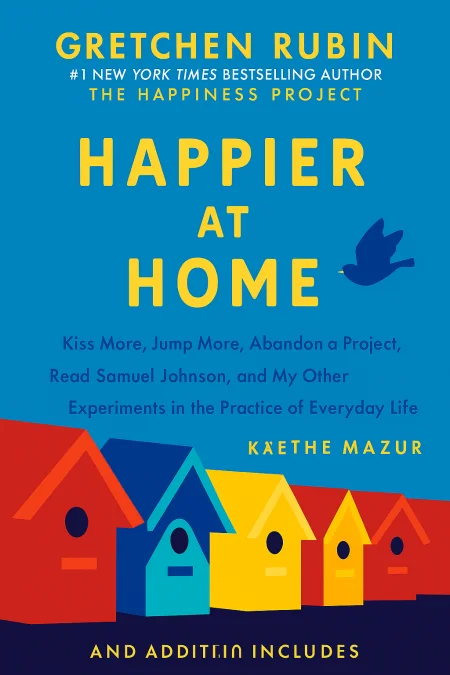
Happier at Home
Kiss More, Jump More, Abandon Self-Control, and My Other Experiments in Everyday Life
Book Edition Details
Summary
Picture this: a Sunday afternoon, a sink full of clean dishes, and a sudden, inexplicable wave of longing. Not for a distant place, but for home itself. This poignant moment propelled Gretchen Rubin, renowned author of "The Happiness Project," on a heartfelt journey to infuse her dwelling with deeper joy and comfort. In "Happier at Home," Rubin transforms her living space into a canvas for happiness, exploring the intimate ties between our surroundings and our spirits. With a curious blend of memoir, science, and practical wisdom, she navigates the intricacies of marriage, parenthood, and personal growth, encouraging her family to embrace change alongside her. Each chapter unfolds like a thoughtful meditation, prompting readers to consider how their own homes can become sanctuaries of simplicity and love. Rubin's narrative, brimming with passion and insight, invites us all to rethink the spaces we inhabit and discover the serenity and inspiration waiting within our own walls.
Introduction
In an age where self-help books promise instant transformation, Gretchen Rubin offers something different: the quiet wisdom that happiness isn't found in dramatic changes but in the small, deliberate choices we make every day. A former lawyer turned bestselling author and happiness researcher, Rubin has dedicated her career to understanding what makes ordinary people flourish in their everyday lives. Her approach eschews grand gestures in favor of methodical, practical strategies that anyone can implement. What sets Rubin apart is her deeply personal methodology—she doesn't just research happiness, she experiments with it in her own life, turning herself into both scientist and subject. Through meticulous self-observation and countless small experiments, she has uncovered profound truths about how we can reshape our daily experiences to cultivate greater contentment. Her work reveals that the path to a happier life lies not in chasing peak moments, but in creating sustainable systems that support our well-being day after day. From her exploration of what makes a house feel like home to her groundbreaking insights into habit formation, Rubin's journey offers readers three invaluable gifts: a framework for understanding their own unique happiness patterns, practical tools for making lasting positive changes, and the reassuring knowledge that transformation happens not through perfection, but through persistent, gentle progress toward becoming more authentically ourselves.
Finding Home: From Law to Happiness Writing
Rubin's transformation from accomplished lawyer to happiness guru began with a moment of profound recognition during an ordinary day. While riding a city bus in the rain, she experienced what she would later describe as an epiphany—a sudden awareness that she wanted to be happier, coupled with the realization that she was responsible for making that happen. This wasn't the crisis-driven awakening common to many life changes, but rather a quiet acknowledgment that her successful external life wasn't fully aligned with her inner contentment. Her legal background, far from being irrelevant to her new path, provided crucial skills that would define her approach to happiness research. The analytical thinking, systematic methodology, and evidence-based reasoning she had developed as a lawyer became the foundation of her unique contribution to the happiness field. Rather than relying solely on academic research or spiritual platitudes, Rubin brought a lawyer's precision to the task of dissecting what actually works in the pursuit of contentment. The transition wasn't immediate or easy. Leaving a prestigious legal career required confronting fundamental questions about identity, security, and purpose. Yet this very struggle equipped her with empathy for others facing similar crossroads. Her writing resonates precisely because she understands the gap between knowing what might make us happier and actually implementing those changes in real life. Most importantly, this career shift taught Rubin that authenticity—being true to one's own nature rather than pursuing someone else's definition of success—is fundamental to genuine happiness. This insight would become a cornerstone of all her subsequent work, reminding readers that the most profound changes often begin with the courage to honor who we truly are.
Building Better Habits: The Architecture of Daily Life
Rubin's exploration of habit formation reveals her greatest intellectual contribution: the understanding that lasting change happens not through willpower but through the careful construction of automatic behaviors. She discovered that habits function as the invisible architecture of daily life, shaping our experiences far more powerfully than our occasional bursts of motivation or good intentions. Her research uncovered a crucial paradox about human behavior: people often fail to maintain habits they enjoy while successfully maintaining habits they dislike. This led to her breakthrough insight about the role of decision-making in habit formation. The most sustainable habits are those that eliminate the need for daily decisions, creating what she calls "decision-less" behaviors that free up mental energy for more important choices. Through systematic self-experimentation, Rubin identified distinct personality types that respond differently to habit formation strategies. Her "Four Tendencies" framework—dividing people into Upholders, Questioners, Obligers, and Rebels—provided a revolutionary tool for understanding why the same habit-building advice works brilliantly for some people while failing completely for others. This personalized approach acknowledged that there is no one-size-fits-all solution to behavioral change. Perhaps most practically, Rubin demonstrated that small habits compound into significant life changes. Her methodical approach to testing everything from sleep schedules to exercise routines to daily rituals showed that consistency matters more than intensity. The person who walks for fifteen minutes every day will ultimately be more successful than someone who occasionally runs for an hour. This insight offers hope to anyone who has felt defeated by their inability to make dramatic changes, showing instead that tiny, persistent actions create the foundation for lasting transformation.
Creating Connection: Family, Marriage, and Relationships at Home
Rubin's most intimate research focused on the relationships that form the heart of home life, revealing how happiness strategies must be adapted to the complex dynamics of family living. Her exploration of marriage and parenthood demonstrated that personal happiness isn't selfish but rather essential for creating the kind of household atmosphere that nurtures everyone who lives there. Her approach to improving family relationships was characteristically systematic yet gentle. Rather than trying to change others directly, she focused on how her own behavior and attitudes could create positive ripple effects throughout her household. She discovered that small gestures—like implementing "warm greetings and farewells" or establishing simple daily rituals—had disproportionate power to strengthen family bonds and create a sense of security and love. The challenge of balancing personal happiness with family responsibilities led Rubin to some of her most nuanced insights. She learned to distinguish between accommodation and martyrdom, understanding that constantly sacrificing her own well-being didn't actually serve her family's best interests. Instead, she found ways to honor her own needs while remaining deeply committed to her relationships. Her experiments with creating meaningful family traditions, managing daily routines, and handling conflicts revealed that happiness within relationships requires both structure and spontaneity. The most successful families, she observed, combine reliable patterns that provide security with enough flexibility to accommodate individual differences and changing circumstances. This balance creates homes where each family member can flourish while remaining connected to the larger unit.
Summary
Gretchen Rubin's life work demonstrates that true happiness isn't about achieving perfection or following someone else's blueprint for the good life, but about developing a deep understanding of your own nature and then creating systems that support your authentic self. Her journey from successful lawyer to happiness researcher illustrates that the most meaningful transformations often require not dramatic upheaval but patient, methodical attention to the details of daily living. Two key insights emerge from her experience: first, that sustainable change happens through habit formation rather than willpower, and second, that there is no universal path to happiness—each person must discover what works for their unique personality and circumstances. Her rigorous yet compassionate approach offers a middle way between harsh self-discipline and passive acceptance, showing how gentle persistence can lead to profound transformation. Rubin's work is particularly valuable for busy adults juggling multiple responsibilities, parents seeking to create happier family dynamics, and anyone who has grown skeptical of quick-fix solutions to life's challenges. Her emphasis on self-knowledge, practical experimentation, and incremental progress provides a realistic framework for anyone serious about creating lasting positive change in their daily experience.
Related Books
Download PDF & EPUB
To save this Black List summary for later, download the free PDF and EPUB. You can print it out, or read offline at your convenience.
By Gretchen Rubin
