
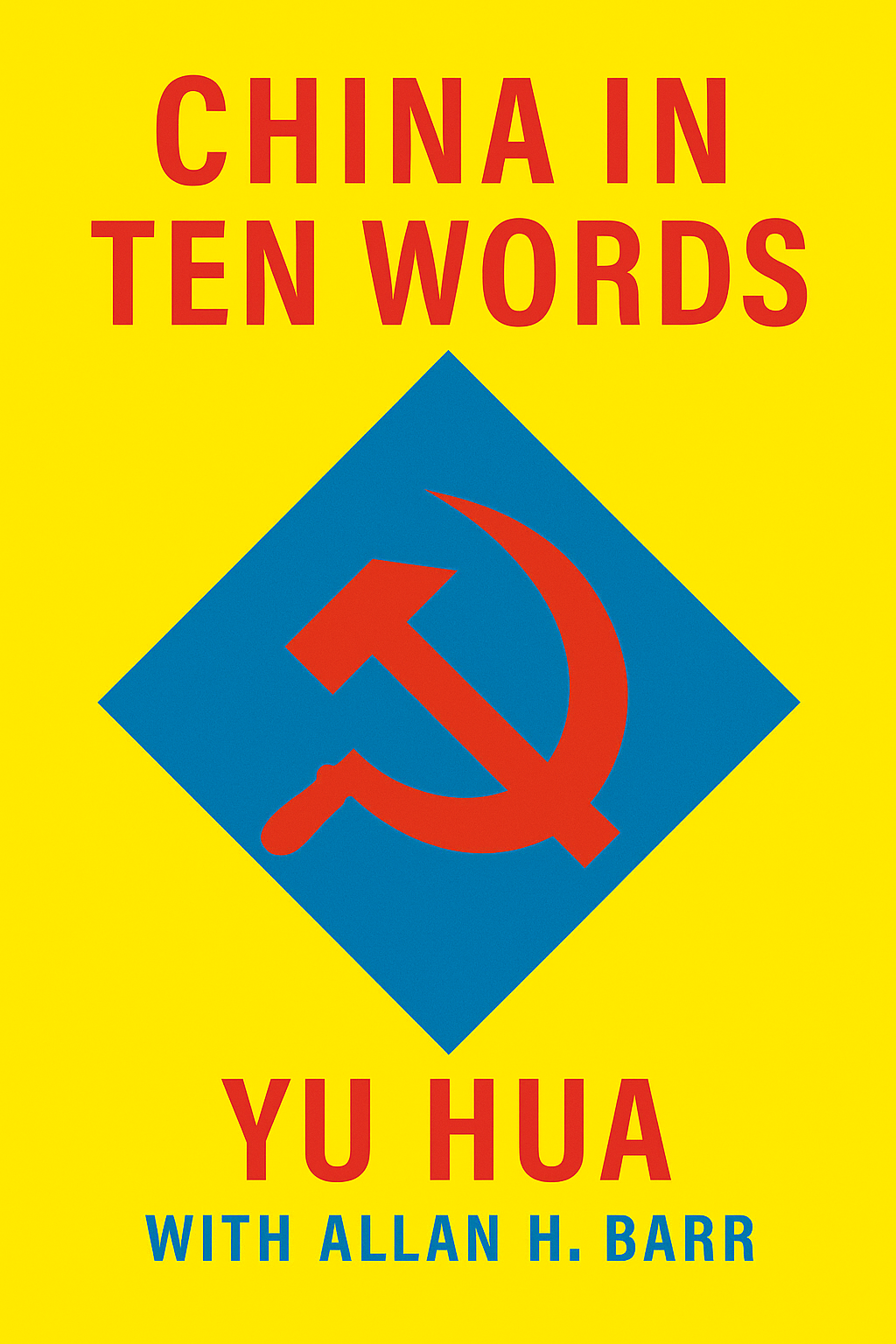
China In Ten Words
The ten key concepts underlying China’s transformation
Book Edition Details
Summary
To navigate the labyrinthine evolution of modern China, Yu Hua crafts a vivid mosaic from ten resonant expressions that echo through its bustling streets and quiet courtyards. "China in Ten Words" distills the country's whirlwind transformation through a lens both personal and profound. With a storyteller's eye and a historian's insight, Yu Hua unveils the seismic shifts that have shaped a nation still tethered to its revolutionary roots. His keen wit uncovers a society teetering between economic marvel and moral maze, where "Disparity" captures the stark chasms of wealth, and "Copycat" chronicles a culture of mimicry as rebellion. Bold, candid, and infused with the pulse of everyday life, this work stands as a fearless testament to China's relentless metamorphosis—a must-read for those seeking to understand the enigmatic heart of a global powerhouse.
Introduction
Imagine growing up in a world where your father's name appearing on a wall poster could destroy your family overnight, where children learned to navigate political storms before they could properly read, and where a simple phrase like "the sun went down" could brand a three-year-old as counterrevolutionary. This is the China that emerges from these intimate chronicles, a nation caught between revolutionary fervor and reform ambitions, where personal survival intertwined with political upheaval in ways both tragic and absurd. Through the lens of one person's journey from the Cultural Revolution's final years to China's economic transformation, we witness how ordinary Chinese navigated extraordinary times. The author's experiences as a small-town dentist turned writer illuminate broader questions about how societies change, how people adapt, and what costs accompany rapid transformation. These stories reveal the human dimension behind China's headlines, showing how political movements shaped daily life, family relationships, and individual dreams. This account offers valuable insights for anyone seeking to understand modern China's complexities, the lasting effects of political upheaval on society, and the universal human experience of living through historical change. It speaks particularly to those curious about how ordinary people survive and thrive amid social transformation, and how personal memory can illuminate broader historical truths.
Mao's Era: Revolution, Cultural Turmoil and Political Authority (1949-1976)
The final decade of Mao's rule created a society where children learned politics before arithmetic, where families turned against neighbors overnight, and where revolutionary purity was measured by one's willingness to destroy the past. During these years, from 1966 to 1976, the Cultural Revolution transformed China into a nation of amateur politicians, where factory workers became government leaders and students wielded power over their teachers. In this atmosphere, the word "revolution" carried almost magical properties. Students who once feared their instructors now watched teachers wash their feet and clean their classrooms. The author witnessed classmates who had been timid rule-followers suddenly transformed into bold rebels, discovering that violence and political rhetoric could remake the social order overnight. Revolutionary committees sprouted everywhere, each claiming legitimate authority through the seizure of official seals, those small wooden stamps that represented real power in Chinese bureaucracy. The era's defining characteristic was its ability to turn social relationships upside down instantaneously. A Communist Party official could wake up as a respected leader and end the day as a despised "capitalist roader," subject to public humiliation and physical violence. Children learned to scrutinize their parents' words for signs of counterrevolutionary thinking, while adults walked on eggshells, knowing that a casual remark could trigger denunciation sessions that might destroy entire families. Yet beneath the surface chaos, deeper patterns emerged. Mao's revolution succeeded because it tapped into genuine frustrations with authority and hierarchy, giving voice to those who had been powerless. However, this democratization of power often devolved into factional warfare, as different rebel groups fought violently for control. The period revealed both the explosive potential of mass mobilization and its inherent instability, setting the stage for the more pragmatic reforms that would follow.
Opening Up: Economic Transformation and Social Upheaval (1978-1989)
The death of Mao in 1976 marked the end of revolutionary romanticism and the beginning of China's great economic experiment. Under Deng Xiaoping's leadership, the nation embarked on reforms that would fundamentally reshape Chinese society, though few anticipated the magnitude of changes to come. The shift from revolutionary slogans to economic pragmatism created new opportunities and tensions that would define the following decade. Initially, the reforms brought welcome relief from political campaigns and ideological strictures. Writers could publish previously banned books, entrepreneurs could start small businesses, and ordinary citizens enjoyed freedoms unimaginable during the Cultural Revolution's peak years. The author's transition from dentist to writer symbolized this new mobility, as rigid job assignments gave way to career choices based on talent and ambition rather than political considerations. However, economic liberalization created unexpected social frictions. While some prospered from new opportunities, others watched helplessly as familiar certainties dissolved. The gap between rich and poor began widening, corruption emerged as officials exploited their positions for personal gain, and traditional values clashed with market-driven priorities. These tensions culminated in the spring of 1989, when students gathered in Tiananmen Square demanding democratic reforms and denouncing official corruption. The Tiananmen protests represented a watershed moment, as economic reforms had created expectations for political change that the government was unwilling to meet. The violent suppression of the demonstrations ended hopes for democratic transformation but paradoxically cleared the path for more aggressive economic liberalization. After June 4th, political passions seemed to exhaust themselves completely, replaced by an overwhelming focus on making money and improving material conditions.
Market Economy: Rapid Growth and Widening Disparities (1990s-2000s)
Following the Tiananmen crisis, China plunged headlong into market capitalism with revolutionary fervor, pursuing economic growth with the same single-minded intensity that had once characterized political campaigns. The results were spectacular and troubling in equal measure, creating unprecedented wealth alongside growing inequality and social disruption. This period revealed how quickly a society could transform its values, priorities, and daily rhythms. The speed of change defied comprehension. Cities that had remained unchanged for centuries sprouted forests of skyscrapers seemingly overnight. Entrepreneurs who had been street vendors one year became millionaires the next. Rural peasants abandoned their ancestral villages to work in factories producing goods for global markets. The author observed how his hometown transformed from a sleepy coastal community where bicycles were rare to a bustling commercial center connected to the world economy. Yet this economic miracle came with profound social costs. Traditional communities fragmented as people migrated in search of opportunities. Environmental degradation accelerated as factories prioritized production over sustainability. Most significantly, the gap between rich and poor widened dramatically, creating a society where luxury car dealerships flourished alongside persistent rural poverty. These disparities generated new forms of social tension that officials struggled to manage. The period also witnessed the emergence of distinctly Chinese approaches to capitalism, characterized by pragmatic flexibility rather than ideological consistency. Local officials became entrepreneurs, state enterprises learned market competition, and ordinary citizens demonstrated remarkable adaptability in seizing economic opportunities. This grassroots creativity drove much of China's growth, though it also fostered corruption, counterfeiting, and various forms of social gaming that challenged traditional notions of business ethics and government authority.
Summary
The three decades chronicled here reveal a fundamental pattern in Chinese development: the tendency to pursue goals with revolutionary intensity, whether political or economic. From Mao's campaign to remake human nature to Deng's drive for prosperity, China repeatedly demonstrated its capacity for dramatic transformation, though always at considerable human cost. This intensity reflects deeper cultural traits that value collective mobilization and rapid, comprehensive change over gradual, incremental progress. The historical trajectory illuminated in these personal stories offers several crucial insights for understanding contemporary challenges. First, political and economic freedoms do not necessarily advance together; China's experience shows how economic liberalization can proceed alongside political restrictions, creating unique tensions and contradictions. Second, rapid development inevitably generates social disruption that requires careful management to prevent instability. Third, the human capacity for adaptation is remarkable, but this adaptability can also enable systems and behaviors that undermine long-term social cohesion. For those seeking to understand China today, these experiences suggest the importance of appreciating how quickly circumstances can change, how personal and political intersect in unexpected ways, and how historical memory shapes present-day attitudes and expectations. The stories remind us that behind every statistic and policy lies a complex web of individual choices, family dynamics, and community relationships that ultimately determine whether reforms succeed or fail.
Related Books
Download PDF & EPUB
To save this Black List summary for later, download the free PDF and EPUB. You can print it out, or read offline at your convenience.
By Yu Hua
