
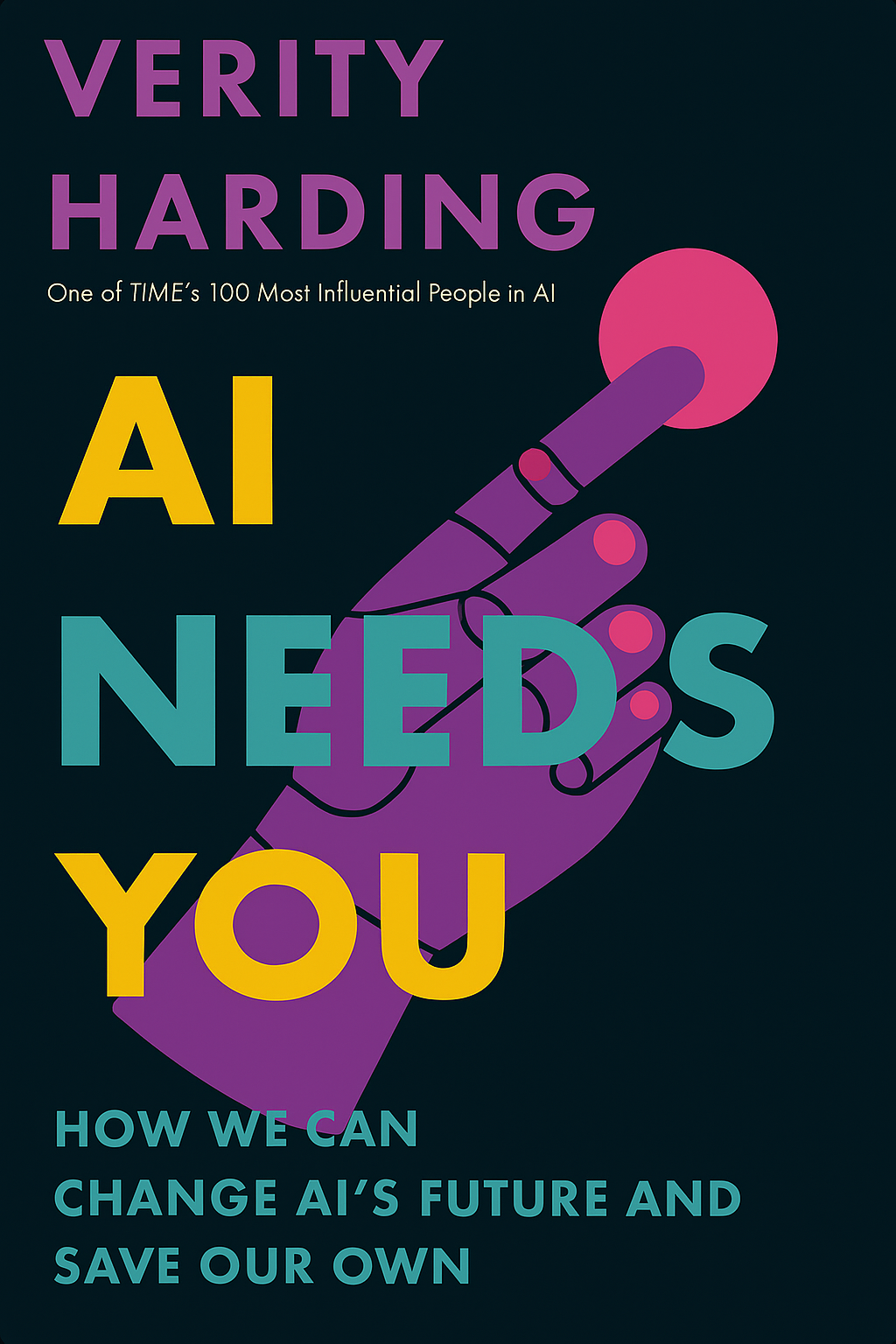
AI Needs You
How We Can Change AI's Future and Save Our Own
Book Edition Details
Summary
As artificial intelligence surges forward, who will determine its direction? "AI Needs You" is not just a book; it's a clarion call for everyday heroes to step into the spotlight. Verity Harding, a seasoned insider in tech and politics, dismantles the bombastic narratives surrounding AI, instead drawing on pivotal moments from our past—like the space race and the dawn of the internet—to craft a vision of technology guided by shared human values. This manifesto ignites hope, urging citizens to steer AI away from dystopian futures and towards a world where technology serves humanity, not just profit. The future of AI is ours to shape, and Harding invites us all to be its architects.
Introduction
Artificial intelligence stands at a crossroads. While tech leaders promise revolutionary benefits, AI systems already demonstrate troubling biases, surveillance capabilities, and potential for dehumanization. The prevailing narrative treats AI development as an exclusively technical domain, leaving crucial decisions about our technological future to a narrow circle of Silicon Valley executives and computer scientists. This approach fundamentally misunderstands both the nature of technology and the requirements of democratic governance. Technology is never neutral. Every algorithmic decision, every system design, every deployment choice reflects the values, assumptions, and priorities of its creators. When facial recognition systems fail on darker skin tones or hiring algorithms perpetuate workplace discrimination, these aren't mere technical glitches but manifestations of the social and political contexts in which they were developed. The concentration of AI development within a homogeneous industry culture virtually guarantees that these systems will embed and amplify existing inequalities unless deliberate action is taken to prevent it. Historical precedent reveals both the dangers of unchecked technological development and the possibilities for democratic oversight. Past transformative technologies, from space exploration to reproductive medicine to the internet itself, achieved their greatest successes when broader society engaged meaningfully in shaping their development and governance. The challenge lies not in the technical complexity of AI, but in mustering the political will to ensure that this powerful technology serves human flourishing rather than narrow commercial interests.
The Political Nature of Technological Development
Science and technology emerge from specific social, economic, and political contexts that fundamentally shape their character and applications. The myth of neutral, objective technological progress obscures how thoroughly human values, cultural assumptions, and power structures become embedded within seemingly technical systems. Understanding this relationship proves essential for anyone seeking to influence the trajectory of artificial intelligence. The space program exemplifies how political motivations drive technological innovation. While celebrated today as humanity's greatest scientific achievement, the Apollo missions originated from Cold War competition and military imperatives rather than pure scientific curiosity. President Kennedy's decision to pursue lunar exploration stemmed directly from geopolitical embarrassment following Soviet successes with Sputnik and Yuri Gagarin's orbital flight. The massive resources devoted to reaching the moon reflected not humanity's inherent drive to explore, but America's need to demonstrate technological superiority over its ideological rivals. Similarly, the internet began as ARPANET, a military project designed to maintain communication networks during potential nuclear warfare. The Pentagon's Advanced Research Projects Agency funded early networking research not to foster global communication, but to preserve command structures in catastrophic scenarios. The collaborative, open architecture that later characterized the internet reflected the academic culture of its early developers rather than any inherent properties of digital communication. Contemporary AI development follows similar patterns. The massive computational resources required for training large language models concentrate development within a handful of technology companies, predominantly located in Silicon Valley and staffed by demographically homogeneous teams. These companies' business models, rooted in data collection and targeted advertising, inevitably influence the types of AI systems they create and the problems they prioritize solving. When these systems exhibit biases or privacy violations, such outcomes represent logical extensions of their developmental context rather than unfortunate accidents.
Historical Precedents for Democratic Technology Governance
Democratic societies possess proven mechanisms for shaping technological development in accordance with broader social values and priorities. Historical examples demonstrate that citizen participation in technology governance not only prevents harmful applications but actively enhances innovation by expanding the range of problems addressed and solutions considered. These precedents offer concrete models for contemporary AI governance challenges. The British approach to regulating in vitro fertilization illustrates how democratic deliberation can navigate complex ethical terrain while fostering scientific progress. When IVF technology first emerged in the 1970s, public concern about "playing God" with human reproduction threatened to halt research entirely. Rather than leaving decisions to scientists alone or imposing blanket prohibitions, the British government established the Warnock Commission, bringing together philosophers, theologians, lawyers, and citizens alongside medical experts. The Commission's fourteen-day rule for embryo research exemplified democratic compromise at its finest. While biologically somewhat arbitrary, the rule provided clear, understandable boundaries that reassured the public while permitting valuable research to continue. This regulatory framework enabled Britain to become a global leader in reproductive medicine while maintaining broad social consensus about acceptable limits. The contrast with the United States, where political gridlock prevented similar deliberative processes, demonstrates the practical benefits of inclusive governance. The internet's governance structure through ICANN represents another successful model of multistakeholder participation. When the internet transitioned from government to commercial control in the 1990s, the Internet Corporation for Assigned Names and Numbers brought together technical experts, business representatives, civil society groups, and government officials to manage critical infrastructure decisions. Despite occasional tensions and limitations, this collaborative approach has maintained the internet's global, interoperable character across diverse national and commercial interests. These historical precedents reveal common elements essential for successful technology governance: inclusive participation that extends beyond technical experts, transparent deliberative processes that build public understanding and trust, and flexible institutional structures capable of adapting to technological change while maintaining core democratic values and oversight mechanisms.
Lessons from Space, IVF, and Internet Regulation
Three transformative technologies of the twentieth century offer distinct yet complementary lessons for governing artificial intelligence in the twenty-first. Each faced similar challenges of balancing innovation with social responsibility, managing competing interests, and establishing governance frameworks for unprecedented capabilities. Their varied approaches and outcomes illuminate both successful strategies and cautionary examples for AI governance. Space exploration achieved perhaps the most remarkable transformation from military origins to peaceful purposes through deliberate diplomatic leadership. The 1967 Outer Space Treaty emerged from sustained international negotiations that prioritized cooperation over competition, establishing space as "the province of all mankind" rather than an arena for superpower rivalry. This diplomatic achievement required political leaders willing to sacrifice short-term national advantages for long-term global stability, demonstrating how technological development can serve broader human values when guided by visionary governance. In vitro fertilization regulation succeeded through patient democratic deliberation that respected both scientific potential and public concerns. The Warnock Commission's work exemplified how complex ethical questions can be resolved through inclusive dialogue rather than expert diktat or popular prejudice. By establishing clear, enforceable boundaries while permitting continued research, British regulation fostered both innovation and public trust. The resulting regulatory framework proved sufficiently robust to accommodate decades of technological advancement while maintaining social consensus. Internet governance evolved through pragmatic experimentation with multistakeholder institutions that balanced diverse interests without sacrificing core principles. ICANN's creation represented institutional innovation that preserved the internet's open architecture while providing necessary coordination mechanisms. The transition from U.S. government control to international oversight demonstrated how technological governance can adapt to changing global circumstances while maintaining essential functions. Each case reveals that successful technology governance requires proactive leadership rather than reactive regulation. Waiting until harmful applications emerge proves far more difficult than establishing preventive frameworks that guide development from the outset. Moreover, inclusive governance processes typically produce more robust and durable solutions than expert-driven or market-based approaches alone.
Applying Historical Insights to AI Governance Today
Contemporary artificial intelligence development exhibits troubling parallels to past technologies that initially proceeded without adequate democratic oversight, resulting in significant social harms that proved difficult to remedy after the fact. The concentration of AI development within a narrow commercial ecosystem, combined with the technology's potential for surveillance and social control, creates urgent need for governance frameworks informed by historical precedent. The space program's evolution from military competition to international cooperation offers a template for redirecting AI development toward peaceful purposes. Just as the Outer Space Treaty established principles for space exploration that transcended national rivalries, international agreements on AI governance could establish boundaries around the most dangerous applications while fostering beneficial uses. Prohibitions on lethal autonomous weapons systems, for instance, could follow the model of chemical and biological weapons treaties, stigmatizing certain applications while permitting others. Democratic deliberation processes modeled on the Warnock Commission could address AI's most challenging ethical dimensions. Citizens' assemblies or expert commissions including diverse perspectives beyond computer science could establish clear boundaries around AI applications in criminal justice, employment, healthcare, and education. Such processes would build public understanding and trust while providing developers with clear guidance about acceptable uses. Multistakeholder governance institutions similar to ICANN could coordinate international cooperation on AI safety standards, data sharing protocols, and algorithmic transparency requirements. These bodies would bring together technologists, civil society representatives, government officials, and affected communities to establish norms for AI development that transcend narrow commercial interests or national rivalries. The key insight from historical precedent lies in recognizing that technology governance requires proactive democratic engagement rather than reactive regulation. AI systems are being deployed across society with insufficient consideration of their broader impacts or democratic oversight of their development. Learning from past successes and failures in technology governance offers hope that artificial intelligence can be directed toward enhancing human welfare rather than undermining democratic values.
Summary
The future of artificial intelligence will be determined not by technological imperatives but by human choices about how to develop, deploy, and govern these powerful systems. Historical analysis reveals that transformative technologies achieve their greatest benefits when democratic societies actively shape their development rather than leaving such decisions to technical experts or commercial interests alone. The space program, reproductive medicine, and internet governance each demonstrate different models for inclusive technology governance that respect both innovation and democratic values. The concentration of AI development within Silicon Valley's narrow cultural and economic ecosystem virtually guarantees that these systems will reflect and amplify existing inequalities unless deliberate action redirects their development toward broader social purposes. Democratic societies possess both the right and the responsibility to establish boundaries around AI applications while fostering beneficial uses that serve human flourishing rather than commercial extraction or state surveillance. Human agency, not technological determinism, will ultimately determine whether artificial intelligence enhances or undermines democratic values, social equity, and human dignity. The tools and precedents for exercising this agency exist within democratic institutions and practices, but only if citizens, leaders, and institutions commit to the difficult work of technology governance rather than abandoning these crucial decisions to others.
Related Books
Download PDF & EPUB
To save this Black List summary for later, download the free PDF and EPUB. You can print it out, or read offline at your convenience.
By Verity Harding
