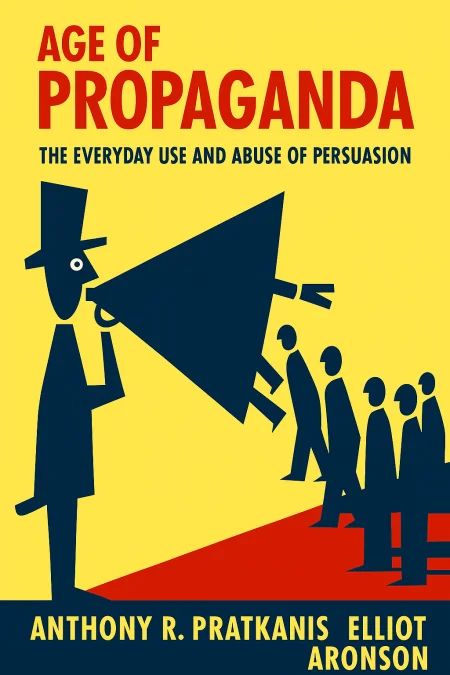
Age of Propaganda
The Everyday Use and Abuse of Persuasion
byAnthony R. Pratkanis, Elliot Aronson
Book Edition Details
Summary
In a world drowning in a sea of messages, where fact and fiction blur with every headline, "Age of Propaganda" uncovers the hidden strings pulling at our perceptions. This eye-opening exploration delves into the sinister art of persuasion wielded by power-hungry politicians, cunning advertisers, and charismatic televangelists. With a keen eye on history and the science of social psychology, this updated edition tackles modern scandals and media spectacles—from the Clinton/Lewinsky affair to the chilling echoes of the Columbine tragedy. It's a compelling revelation of how our deepest fears and wildest hopes are manipulated, crafting a skewed reality that we unwittingly accept. Prepare to see the world anew, questioning not just what you believe, but why you believe it.
Introduction
Democratic societies face an unprecedented challenge in the modern information age, where citizens navigate thousands of persuasive messages daily while lacking adequate tools to distinguish legitimate discourse from manipulative propaganda. This fundamental problem strikes at the heart of democratic governance itself, as informed citizen participation becomes increasingly difficult when sophisticated influence techniques dominate public communication. The psychological mechanisms underlying human decision-making operate through two distinct pathways: one involving careful consideration of evidence and arguments, another relying on mental shortcuts and emotional responses that bypass critical analysis entirely. The distinction between ethical persuasion and propaganda lies not merely in content or intent, but in the relationship these communications establish with human reasoning capacity. While traditional democratic discourse seeks to engage citizens' analytical faculties through reasoned argument and evidence presentation, contemporary propaganda systematically exploits cognitive vulnerabilities to achieve compliance without genuine understanding. This transformation represents a profound shift in how societies process information and make collective decisions, with implications extending far beyond individual susceptibility to manipulation. Understanding these influence mechanisms becomes essential for preserving democratic institutions and individual autonomy in an environment where the line between information and manipulation has become increasingly blurred. The analysis reveals how even intelligent, educated individuals can fall prey to sophisticated tactics when their cognitive resources are overwhelmed or when issues seem peripheral to their immediate concerns, creating systematic vulnerabilities that threaten the foundation of informed democratic participation.
Dual-Route Processing: Why Citizens Fall Prey to Manipulation
Human beings process persuasive information through two fundamentally different cognitive pathways, each with distinct characteristics that determine susceptibility to influence attempts. The central route involves systematic, effortful evaluation where individuals actively scrutinize argument quality, seek additional information, and consider alternative perspectives before reaching conclusions. This deliberative process requires both sufficient motivation to think carefully and adequate cognitive resources to engage in complex analysis, conditions that prove increasingly rare in modern information environments characterized by overwhelming message volume and competing attention demands. The peripheral route operates through an entirely different mechanism, allowing rapid decision-making based on simple cues and mental shortcuts rather than substantive content evaluation. When processing peripherally, individuals rely on surface features like source attractiveness, message length, social consensus indicators, or emotional resonance to guide their responses. While these cognitive shortcuts serve essential functions in managing information overload and enabling efficient daily decisions, they create systematic vulnerabilities that skilled propagandists can exploit with remarkable precision. The choice between these processing routes depends on several critical factors that propagandists understand and manipulate strategically. Personal relevance of the issue, available cognitive capacity, individual motivation for accuracy, and time pressure all influence whether audiences engage in careful analysis or default to automatic responses. When people feel overwhelmed, distracted, or perceive issues as peripheral to their concerns, they become significantly more susceptible to influence techniques that exploit peripheral processing rather than providing genuine insight or evidence. This dual-process framework explains why identical persuasive messages can produce dramatically different effects depending on the recipient's mental state and circumstances. Political advertisements might receive careful scrutiny from highly engaged voters while being processed automatically by those with competing demands on their attention, leading to vastly different persuasive outcomes from the same content. Recognition of these processing differences provides the foundation for understanding how propaganda succeeds and how democratic discourse can be protected through conscious engagement of analytical thinking.
Strategic Influence Tactics: Manufacturing Credibility and Exploiting Emotions
Source credibility operates as one of the most powerful influence factors in human decision-making, yet modern propaganda has transformed credibility from an earned attribute reflecting genuine expertise into a manufactured commodity created through strategic image management. The traditional components of credibility—expertise and trustworthiness—can now be systematically constructed through careful positioning, selective credential highlighting, and media manipulation that creates impressions of authority without requiring actual competence. Celebrity endorsements exemplify this process, where fame in entertainment or sports translates into perceived expertise in politics, health, or social issues through psychological mechanisms that respond to appearances of knowledge rather than demonstrated understanding. Trustworthiness manufacturing relies on sophisticated understanding of psychological cues that signal honesty and reliability to audiences. Appearing to argue against one's own interests dramatically increases perceived credibility, even when this appearance is deliberately orchestrated for persuasive effect. Creating impressions of reluctant disclosure, spontaneous revelation, or unguarded moments exploits the human tendency to trust communications that seem unintentional or unfiltered. These manufactured authenticity techniques prove particularly effective because they trigger automatic trust responses while bypassing the skepticism that audiences might apply to obviously promotional content. Emotional manipulation represents perhaps the most potent propaganda tool, as intense emotions can overwhelm rational analysis and create lasting attitude changes that persist even after the emotional arousal subsides. Fear appeals combine vivid threat presentations with specific behavioral recommendations, exploiting anxiety to motivate compliance while often exaggerating dangers or oversimplifying complex solutions. The emotional arousal created by fear narrows attention, reduces capacity for critical thinking, and makes audiences more likely to accept proposed remedies without questioning their logic or effectiveness. The systematic combination of manufactured credibility with emotional manipulation creates overwhelming persuasive pressure that can bypass even sophisticated analytical defenses. When audiences encounter messages from seemingly trustworthy sources that trigger strong emotional responses, their normal skepticism and critical evaluation processes become compromised. This combination proves particularly dangerous in democratic contexts, where citizens need access to reliable information and the cognitive capacity to evaluate complex policy alternatives rather than responding automatically to emotional appeals from manufactured authorities.
Media as Propaganda Infrastructure: News, Entertainment and Information Warfare
Contemporary mass media functions as a sophisticated propaganda delivery system that shapes public understanding through seemingly neutral editorial decisions about newsworthiness, framing, and emphasis. This agenda-setting power operates through the selection of which stories receive attention, how they are presented, and which perspectives are included or excluded from coverage. The emphasis on entertainment value over informational content leads to systematic coverage patterns that prioritize dramatic, visual, and emotionally engaging stories while neglecting complex but important issues that resist simple narrative treatment or lack compelling visual elements. Entertainment media serves as a particularly effective propaganda vehicle because audiences consume it for pleasure rather than information, reducing skepticism and analytical processing that might otherwise provide protection against influence attempts. Persuasive messages embedded within engaging narratives exploit emotional identification with characters and storylines to shape attitudes toward social issues, political positions, or cultural values. This approach proves remarkably effective because the entertainment context provides cover for ideological content, allowing propagandists to influence audiences who might resist the same messages in explicitly political formats. The fragmentation of media audiences into separate information ecosystems creates unprecedented opportunities for targeted propaganda campaigns that present fundamentally different versions of reality to different groups. This segmentation allows propagandists to craft specialized messages that reinforce existing beliefs within each audience while avoiding the scrutiny that might arise from broader public debate. The result is a society where different groups operate with incompatible understandings of basic facts about their shared world, undermining the common factual foundation necessary for democratic deliberation. The speed and volume of modern information flows create additional vulnerabilities that sophisticated propagandists systematically exploit. When new information arrives faster than it can be properly evaluated, people rely more heavily on source credibility and emotional resonance rather than careful fact-checking or logical analysis. This environment systematically favors those who can produce compelling content quickly over those who prioritize accuracy and nuance, creating structural advantages for propaganda over legitimate journalism and informed commentary.
Democratic Defense: Detection Skills and Institutional Safeguards Against Manipulation
Effective defense against propaganda requires developing metacognitive awareness of one's own decision-making processes and the circumstances that increase vulnerability to manipulation. This involves recognizing emotional states that compromise analytical thinking, identifying situations that promote automatic rather than deliberative processing, and consciously engaging critical faculties when encountering important persuasive messages. Detection skills include examining source motivations and qualifications, seeking alternative perspectives and contrary evidence, questioning underlying assumptions and framing effects, and distinguishing between correlation and causation in presented evidence. Individual resistance strategies must be complemented by institutional safeguards that protect democratic discourse from systematic manipulation. Media literacy education becomes essential, teaching citizens to recognize influence techniques, understand how media systems operate economically and politically, and develop practical skills for evaluating information quality and source reliability. Educational approaches should emphasize the psychology of influence, provide practice in identifying propaganda tactics across different formats, and foster appreciation for the complexity of important issues that resist simple solutions or emotional appeals. Democratic societies require structural protections against propaganda through policies that ensure diverse viewpoints in media markets, transparency in funding sources for political communication, and meaningful accountability for deliberately deceptive practices in public forums. This includes supporting independent journalism through funding mechanisms that reduce dependence on advertising or political sponsors, limiting media concentration that enables coordinated messaging campaigns, and requiring clear disclosure of sponsors for political advertising across all platforms. The ultimate defense against propaganda lies in cultivating cultural values that prioritize critical thinking, intellectual honesty, and good-faith dialogue over winning arguments or confirming existing beliefs. This cultural transformation requires recognizing that democracy depends fundamentally on citizens' ability to engage thoughtfully with complex issues rather than succumbing to emotional manipulation or tribal loyalties. Building this capacity involves practicing intellectual humility about one's own beliefs, maintaining openness to changing positions when presented with compelling evidence, and developing tolerance for uncertainty and complexity that resists the false certainties that propaganda typically offers.
Summary
The fundamental insight emerging from this analysis reveals that propaganda succeeds not through superior arguments or evidence, but by systematically exploiting the psychological mechanisms that govern human decision-making, particularly the natural tendency to rely on emotional reactions and mental shortcuts rather than effortful analysis when processing information. The distinction between legitimate democratic persuasion and manipulative propaganda lies primarily in whether communicators seek to engage or bypass their audience's critical thinking capabilities, with effective propaganda deliberately designed to circumvent rational evaluation through manufactured credibility, emotional manipulation, and social pressure tactics that exploit cognitive vulnerabilities. Democratic discourse depends critically on citizens developing both individual detection skills and collective institutional defenses against sophisticated influence attempts that threaten the informed deliberation essential to self-governance, making this understanding essential for anyone seeking to maintain intellectual autonomy and participate meaningfully in democratic society within our increasingly complex and manipulative information environment.
Related Books
Download PDF & EPUB
To save this Black List summary for later, download the free PDF and EPUB. You can print it out, or read offline at your convenience.
By Anthony R. Pratkanis
