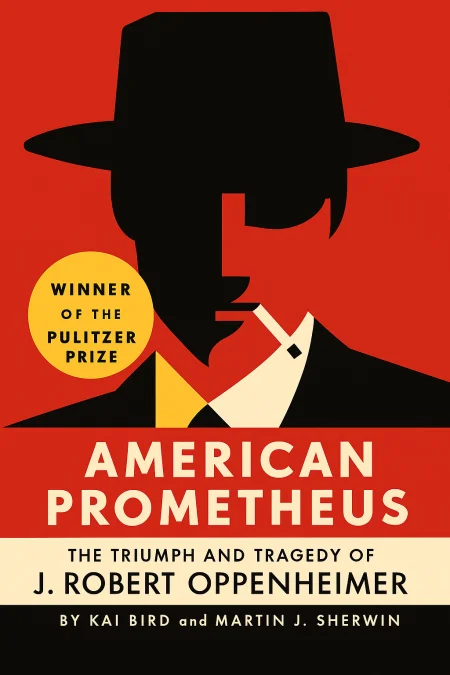
American Prometheus
The Triumph and Tragedy of J. Robert Oppenheimer
Book Edition Details
Summary
In the crucible of the atomic age, where scientific triumph met moral quandary, stood J. Robert Oppenheimer—a man of profound intellect and deeper introspection. This riveting biography, a quarter-century in the making and crowned with a Pulitzer Prize, delves into the life of the enigmatic physicist who forged the path to nuclear power. Yet, in an era gripped by Cold War paranoia, Oppenheimer’s visionary calls for peace and restraint rendered him a target of suspicion and betrayal. His story unfolds like a modern myth, echoing Prometheus’s defiance in wielding fire, and casting a spotlight on the timeless clash between innovation and ethics. Here lies the extraordinary tale of a man who dared to challenge the very forces he helped unleash.
Introduction
In the summer of 1945, as the first atomic bomb exploded over the New Mexico desert, a thin, intense physicist watched from twenty miles away and whispered words from the ancient Hindu scripture: "Now I am become Death, destroyer of worlds." That man was J. Robert Oppenheimer, and in that moment of terrible triumph, he embodied both the promise and the peril of the atomic age. Known to history as the "father of the atomic bomb," Oppenheimer was far more than a brilliant scientist—he was a Renaissance man whose life traced the arc of American intellectual ambition and political tragedy in the twentieth century. Born into privilege and educated in the finest institutions, Oppenheimer possessed a mind that ranged effortlessly from Sanskrit poetry to quantum mechanics, from leftist politics to the highest circles of government power. His story reveals the complex relationship between science and politics, the price of moral awakening, and the dangerous intersection of genius with the machinery of state. Through Oppenheimer's extraordinary journey, we witness the transformation of a young idealist into the architect of humanity's most destructive weapon, and ultimately into a symbol of scientific conscience in an age of Cold War paranoia. His life illuminates the eternal tension between scientific discovery and moral responsibility, between individual conscience and national duty, and between the pursuit of knowledge and the weight of its consequences.
The Making of a Scientific Visionary
Robert Oppenheimer's intellectual awakening began in the rarefied atmosphere of early twentieth-century New York, where his German-Jewish immigrant father had built a successful textile empire. Born in 1904, young Robert displayed an almost supernatural appetite for learning that extended far beyond conventional academic boundaries. While his peers focused on traditional subjects, he immersed himself in literature, philosophy, and ancient languages, developing a lifelong fascination with Sanskrit poetry and Hindu philosophy that would later provide him with the metaphors to understand his own destiny. His formative years at Harvard revealed a mind that refused categorization. Oppenheimer devoured courses in chemistry, physics, literature, and philosophy with equal enthusiasm, graduating summa cum laude in just three years. Yet beneath this academic brilliance lay a sensitive, sometimes tormented soul who struggled with depression and feelings of inadequacy. A transformative summer spent in New Mexico introduced him to the stark beauty of the American Southwest, where he would later establish a ranch that became his spiritual refuge. The young scholar's path to physics was neither direct nor inevitable. Initially drawn to chemistry, he discovered his true calling only after encountering the revolutionary new field of quantum mechanics in Europe. At Cambridge and later at Göttingen, he studied under the pioneers of modern physics, absorbing not just their scientific methods but their philosophical approaches to understanding the fundamental nature of reality. This European sojourn transformed him from a dilettante intellectual into a focused scientist, yet he never abandoned his broader humanistic interests. By the time he returned to America to begin his academic career at Berkeley, Oppenheimer had synthesized his diverse intellectual pursuits into a unique worldview. He approached physics not merely as a technical discipline but as a form of natural philosophy, seeing in quantum mechanics profound questions about the nature of knowledge and reality. This philosophical bent, combined with his gift for elegant expression and his ability to inspire students, would make him one of America's most influential theoretical physicists and, ultimately, the natural choice to lead the most ambitious scientific project in human history.
Father of the Atomic Bomb: Los Alamos Leadership
When General Leslie Groves selected Oppenheimer to lead the Manhattan Project's scientific efforts in 1942, many questioned the choice of a theoretical physicist with no experience managing large-scale projects and a questionable political past. Yet Oppenheimer possessed a rare combination of scientific brilliance, administrative acumen, and inspirational leadership that proved perfectly suited to the unprecedented challenge of building an atomic bomb. At Los Alamos, a secret laboratory carved from the New Mexico wilderness, he assembled and directed a community of the world's most brilliant scientists in a race against time and Nazi Germany. The transformation of Los Alamos from an isolated boys' school into a bustling scientific city revealed Oppenheimer's extraordinary organizational abilities. He understood that the project's success depended not merely on solving technical problems but on creating a collaborative environment where physicists, chemists, engineers, and mathematicians could work together effectively. His open scientific colloquia, where researchers shared their findings across disciplinary boundaries, fostered the kind of intellectual cross-pollination essential for breakthrough discoveries. Despite military security requirements, he insisted on maintaining the free exchange of ideas that was the lifeblood of scientific progress. Under intense pressure and impossible deadlines, Oppenheimer displayed a leadership style that combined scientific rigor with human understanding. He could grasp the technical details of complex problems while simultaneously managing the egos and anxieties of Nobel Prize winners and young graduate students alike. His ability to synthesize diverse viewpoints and guide discussions toward practical solutions earned him the respect and devotion of his colleagues. They saw in him not just an administrator but a fellow scientist who understood their work and shared their commitment to defeating fascism. The successful Trinity test in July 1945 represented the culmination of Oppenheimer's leadership during the war years. As the fireball rose over the desert, illuminating the pre-dawn darkness with the light of a thousand suns, he experienced both the satisfaction of scientific achievement and the first stirrings of moral doubt. The weapon they had created was far more powerful than even the scientists had anticipated, and Oppenheimer began to understand that they had crossed a threshold from which there could be no return. The success at Los Alamos had proven his capabilities as a leader, but it had also burdened him with knowledge of humanity's newfound capacity for self-destruction.
The Security Trial and Fall from Grace
The very qualities that had made Oppenheimer an effective wartime leader—his broad intellectual interests, his left-leaning political sympathies, and his complex personal relationships—became liabilities in the paranoid atmosphere of the early Cold War. His opposition to the development of the hydrogen bomb, based on both strategic and moral grounds, put him at odds with powerful figures in the military-industrial complex who viewed his influence as an obstacle to American nuclear supremacy. The security hearing that began in April 1954 was ostensibly about his loyalty, but it was fundamentally a struggle over the direction of American nuclear policy and the role of scientists in shaping national security decisions. The charges against Oppenheimer revealed the extent to which Cold War hysteria had infected American institutions. His past associations with Communist Party members, his financial contributions to left-wing causes during the 1930s, and his relationship with Jean Tatlock, a psychiatrist with communist sympathies, were all dredged up as evidence of potential disloyalty. The hearing board scrutinized every aspect of his personal and political life, transforming private relationships and youthful political enthusiasms into evidence of security risks. The process revealed how the national security apparatus could weaponize an individual's complexity and intellectual honesty against them. Perhaps most damaging was the testimony of Edward Teller, Oppenheimer's former colleague and the driving force behind the hydrogen bomb project. Teller's carefully worded statement that he would feel more secure with the country's nuclear program in other hands delivered a devastating blow to Oppenheimer's reputation. The betrayal by a fellow scientist highlighted the personal costs of the political divisions that had fractured the scientific community. Other colleagues rallied to his defense, but the damage was done, and the hearing board ultimately voted to revoke his security clearance. The outcome of the hearing transformed Oppenheimer from a celebrated war hero into a symbol of the dangers of political persecution. While he retained his position at the Institute for Advanced Study and continued his scientific work, his influence on nuclear policy was effectively ended. The scientific community largely viewed the proceedings as a travesty of justice, recognizing that Oppenheimer had been punished not for disloyalty but for his moral courage in questioning the wisdom of an unlimited nuclear arms race. His fall from grace served as a warning to other scientists about the costs of challenging official policy, contributing to a climate of intellectual conformity that would persist for years.
Legacy of a Complex American Hero
Following his public humiliation, Oppenheimer retreated from the political arena but found unexpected solace in returning to his first love: pure science and philosophical reflection. At Princeton's Institute for Advanced Study, he focused on fundamental questions in physics while also exploring broader questions about the relationship between science and society. His lectures and writings during this period revealed a man grappling with the implications of scientific discovery, seeking to understand how knowledge could be pursued responsibly in an age when the consequences of research could threaten human survival. The gradual rehabilitation of Oppenheimer's reputation began in the early 1960s, as the initial hysteria of the Cold War gave way to a more nuanced understanding of the nuclear dilemma. President Kennedy's decision to present him with the Fermi Award in 1963 represented a symbolic recognition that the country had treated one of its most distinguished scientists unjustly. The ceremony, attended by many of his former colleagues and critics, marked the beginning of a broader reassessment of his contributions to American science and his prescient warnings about the dangers of nuclear proliferation. In his final years, Oppenheimer became something of an elder statesman, sought out by journalists, historians, and policymakers who recognized the wisdom that had emerged from his unique experience. His reflections on the atomic age, delivered in lectures and interviews, revealed a man who had achieved a hard-won understanding of the moral complexities inherent in scientific progress. He spoke eloquently about the need for international cooperation in controlling nuclear weapons and the responsibility of scientists to consider the broader implications of their work. When Oppenheimer died in 1967, the scientific community mourned the loss of a figure who had embodied both the promise and the perils of modern science. His legacy was complex and sometimes contradictory: he was simultaneously the father of the atomic bomb and one of its most thoughtful critics, a patriot who had served his country faithfully and a victim of its political paranoia. Yet perhaps this very complexity was his greatest contribution, demonstrating that the most important questions facing humanity could not be answered through scientific method alone but required the kind of moral imagination that had always characterized his approach to life and learning.
Summary
J. Robert Oppenheimer's life stands as a profound meditation on the relationship between knowledge and responsibility, illustrating how scientific brilliance must be tempered by moral wisdom. His journey from Renaissance scholar to atomic architect to political pariah reveals the complex challenges facing intellectuals in an age when their discoveries can reshape the world in unforeseeable ways. The man who helped create humanity's most destructive weapon ultimately became one of its most thoughtful critics, demonstrating the kind of moral courage required to question one's own achievements when they threaten human welfare. From Oppenheimer's experience, we learn that true leadership requires not only technical competence but also the ability to grapple with the broader implications of our actions. His willingness to oppose the hydrogen bomb despite the personal costs shows us that moral principles sometimes demand sacrificing career advancement and social acceptance. For anyone working in fields where expertise carries significant social responsibility—whether in science, technology, policy, or business—Oppenheimer's story offers both inspiration and warning about the price of intellectual honesty in a complex world. His legacy challenges us to consider how we can pursue knowledge while remaining accountable for its consequences, and how we can maintain our moral compass even when facing the most powerful forces of our time.
Related Books
Download PDF & EPUB
To save this Black List summary for later, download the free PDF and EPUB. You can print it out, or read offline at your convenience.
By Kai Bird
