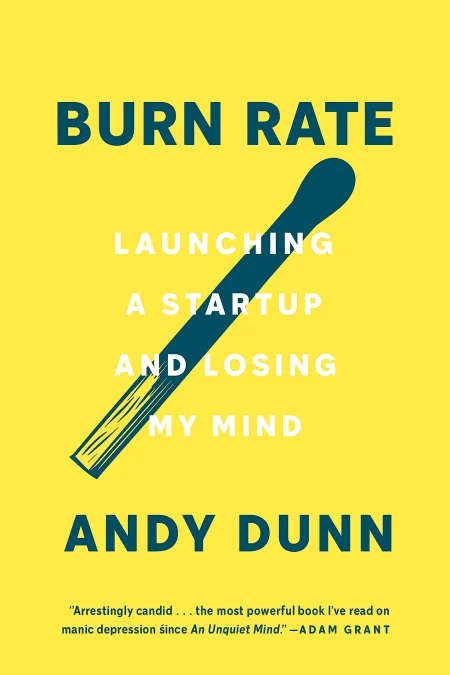
Burn Rate
Launching a Startup and Losing My Mind
Book Edition Details
Summary
In the electrifying world of high-stakes entrepreneurship, Andy Dunn built Bonobos from a modest Manhattan apartment into a powerhouse of innovation, blending the charm of classic menswear with a cutting-edge digital twist. But behind this remarkable success story lurked a fierce adversary—his own mind. Diagnosed with bipolar disorder, Dunn's life teetered on the brink as his formidable ambition clashed with the turmoil of mental illness. In "Burn Rate," Dunn bares his soul, unraveling the exhilarating highs and devastating lows that shaped his journey. This is not just a memoir; it's a profound exploration of the thin line between triumph and catastrophe in the relentless pursuit of the American dream.
Introduction
In the glittering world of Silicon Valley startups, where twenty-something founders chase billion-dollar dreams and "fake it till you make it" is practically a mantra, Andy Dunn seemed to have it all figured out. The co-founder and CEO of Bonobos, the innovative menswear company that pioneered the direct-to-consumer model, he was the poster child for entrepreneurial success. He graced magazine covers, spoke at prestigious conferences, and built a company that would eventually sell to Walmart for over $300 million. Yet beneath the polished exterior of boardroom presentations and venture capital meetings lay a profound secret that would eventually threaten to destroy everything he had built. This is not your typical entrepreneurial success story filled with motivational platitudes about persistence and vision. Instead, it's a raw, unflinching examination of what happens when untreated mental illness collides with the high-pressure world of startup leadership. Through Dunn's journey, readers will discover the complex relationship between creativity and madness, the hidden costs of entrepreneurial ambition, and ultimately, the power of acceptance and proper treatment in reclaiming one's life. His story illuminates the rarely discussed intersection of mental health and business leadership, offering both cautionary lessons and hope for anyone struggling to maintain their sanity while chasing their dreams.
From Gifted Child to Manic Founder
Andy Dunn's story begins in the comfortable suburbs of Chicago, where the seeds of both his entrepreneurial drive and his mental health struggles were quietly taking root. Growing up in a loving multicultural household with an Indian American mother and Scandinavian American father, young Andy seemed destined for success. He was the "gifted child" who skipped third grade, the quiz bowl captain, the one voted "most likely to be a millionaire" by his high school classmates despite having no apparent interest in business at the time. But beneath the surface of academic achievement and family support, warning signs were already emerging. Andy's hypersensitivity to criticism, his difficulty handling rejection, and his tendency to bottle up emotions would prove to be early indicators of the psychological storm brewing within. His first real taste of entrepreneurial inspiration came through a childhood friend whose father owned a successful auto parts business, complete with season tickets to the Chicago Bulls. This glimpse into a world where success meant freedom, influence, and the ability to call your own shots planted a seed that would later bloom in unexpected ways. The transition from gifted student to aspiring entrepreneur accelerated during his time at Northwestern University and later at Stanford Business School. It was at Stanford where Andy first encountered the intoxicating culture of Silicon Valley, where audacious dreams were not just encouraged but expected. This environment, which celebrated visionary thinking and contrarian behavior, would prove to be both a catalyst for his entrepreneurial success and a dangerous playground for his undiagnosed bipolar disorder. The same qualities that made him an effective startup founder, his boundless optimism, relentless energy, and unwavering self-confidence, were also symptoms of a mood disorder that remained hidden behind the acceptable facade of entrepreneurial ambition.
Building an Empire While Battling Depression
The founding of Bonobos in 2007 marked the beginning of what would become both Andy's greatest professional triumph and his most challenging personal battle. What started as his Stanford roommate Brian Spaly's frustration with ill-fitting pants evolved into a revolutionary approach to men's retail, but the journey was far from smooth. Behind the scenes of building a pioneering e-commerce brand, Andy was secretly cycling through extreme emotional states that he couldn't understand or control. The early years of Bonobos were characterized by Andy's manic energy and grandiose vision, traits that served him well in the demanding world of startup fundraising and team building. His ability to work eighteen-hour days, his infectious enthusiasm that could convince investors to write checks, and his seemingly inexhaustible optimism were all powered by unrecognized hypomanic episodes. During these periods, he could raise millions of dollars from angel investors, recruit top talent from established companies, and inspire his team to believe in an impossible dream of disrupting traditional retail. However, these soaring highs were inevitably followed by crushing lows that Andy experienced as profound depression. He would spend entire weekends sleeping sixteen to twenty hours a day, unable to summon the energy for even basic tasks. The contrast was stark: the same man who could electrify a boardroom presentation on Friday might be unable to get out of bed on Sunday. These cycles became more pronounced as the company grew and the pressures mounted, creating a dangerous pattern where Andy's mood swings directly impacted crucial business decisions and his relationships with co-founders, employees, and investors. What made this period particularly treacherous was Andy's complete denial of his 2000 diagnosis of bipolar disorder. He had convinced himself and others that his college breakdown was a one-time event caused by drug use and stress, not an indicator of a lifelong mental health condition. This denial meant that his depression went untreated, his mania unrecognized, and his increasingly erratic behavior was simply attributed to the eccentricities of entrepreneurial leadership.
The Breakdown: When Success Meets Mental Crisis
By 2016, Andy Dunn appeared to be at the pinnacle of his career. Bonobos had grown from a Stanford dorm room idea into a $100 million revenue company with hundreds of employees and a revolutionary retail concept. He was engaged to Manuela, a brilliant journalist and entrepreneur who had captured his heart, and his personal life seemed as successful as his professional one. Yet beneath this veneer of achievement, a perfect storm was brewing that would soon shatter the carefully constructed facade he had maintained for over a decade. The crisis began innocuously enough with a business trip to Las Vegas, where Andy was scheduled to speak at a tech conference. What should have been a routine speaking engagement became the trigger for his most severe manic episode since college. Sleep-deprived and under enormous pressure from ongoing business challenges, Andy's mental state began to deteriorate rapidly. On the flight to Vegas, he became convinced the plane would crash. Once in the city, he started experiencing grandiose delusions, believing he was receiving messages from God and that he had been chosen for a divine mission to save humanity. The episode escalated dramatically when Andy returned to New York and the apartment he shared with Manuela. In a state of complete psychotic break from reality, he became violent, striking both his fiancée and her elderly mother who had come to help. The man who had built a company named after peace-loving apes found himself in handcuffs, being transported from a psychiatric hospital directly to jail, charged with both misdemeanor and felony assault. In a matter of days, everything he had worked for over the past decade hung in the balance. This breakdown represented the collision of multiple factors: years of untreated bipolar disorder, the enormous stress of running a high-growth company, the pressure of maintaining a perfect public image, and the dangerous cycle of self-medication through alcohol and overwork. The episode finally forced a reckoning with the mental health diagnosis he had spent sixteen years denying, but it came at an almost unbearable cost to his relationships, his company, and his sense of self.
Recovery and Redemption: Finding Balance
The aftermath of Andy's 2016 breakdown marked the beginning of his most difficult yet transformative period. Released from Bellevue Hospital psychiatric ward into the custody of police officers, he faced not only potential criminal charges but also the very real possibility of losing everything he held dear. His fiancée Manuela, despite bearing physical evidence of his violence, made the extraordinary decision to stand by him, but only if he committed completely to treatment and recovery. This commitment became the foundation of Andy's reconstruction as both a person and a leader. For the first time in his adult life, he embraced his bipolar diagnosis fully, working intensively with Dr. Z, a psychiatrist who became both his doctor and therapist. Together, they crafted a comprehensive treatment plan that included daily mood-stabilizing medication, regular therapy sessions, and a complete restructuring of how Andy approached his mental health. The medication regimen, particularly Lamictal, proved to be transformative, allowing him to maintain emotional stability while preserving the creative energy that had made him an effective entrepreneur. Perhaps most importantly, Andy learned to be transparent about his condition with those closest to him. He disclosed his mental health history to his board of directors, key employees, and eventually even to Walmart executives during the due diligence process for Bonobos's acquisition. Rather than the career-ending revelations he had feared, these conversations were met with understanding and support. His company continued to thrive under his leadership, and the Walmart acquisition proceeded successfully, validating that mental illness need not be incompatible with business success when properly managed. The path to recovery also required Andy to rebuild his most important relationships. Working with couples therapists, he and Manuela learned to communicate about his condition openly and to establish systems for monitoring his mental state. His family, who had spent years in denial about his illness, finally acknowledged their collective failure to address his diagnosis and committed to supporting his ongoing treatment. By his 2017 wedding to Manuela, Andy had achieved something that once seemed impossible: a stable, authentic life where his mental illness was managed rather than hidden.
Summary
Andy Dunn's journey reveals a profound truth about the intersection of mental illness and extraordinary achievement: that our greatest strengths and our deepest vulnerabilities often spring from the same source. His story demonstrates that success built on denial and secrecy, no matter how impressive externally, remains fundamentally fragile until we learn to integrate all aspects of ourselves with honesty and proper care. The lessons from his experience extend far beyond the entrepreneurial world to anyone grappling with mental health challenges or loving someone who is. His path shows that recovery is not about eliminating our struggles but about learning to work with them constructively, surrounded by people who see us clearly and love us anyway. For business leaders and entrepreneurs especially, Dunn's story offers both warning and hope: that the very traits that drive professional success can become destructive without proper mental health support, but also that transparency and treatment can transform liabilities into managed aspects of a fuller, more authentic life. His journey ultimately affirms that our most profound personal reckonings, while painful, can become the foundation for not just surviving but thriving in ways we never imagined possible.
Related Books
Download PDF & EPUB
To save this Black List summary for later, download the free PDF and EPUB. You can print it out, or read offline at your convenience.
By Andy Dunn
