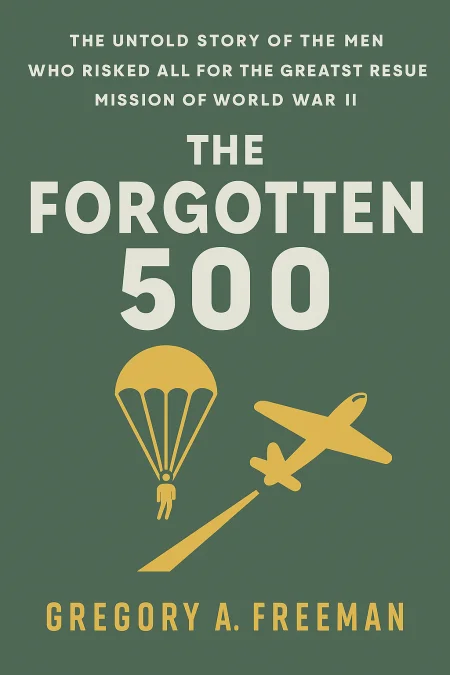
The Forgotten 500
The Untold Story of the Men Who Risked All for the Greatest Rescue Mission of World War II
Book Edition Details
Summary
In the shadowy corridors of World War II history, a tale of audacious bravery and unsung heroes awaits discovery. "The Forgotten 500" plunges readers into the heart of a clandestine rescue mission, where the gritty realities of war meet the indomitable spirit of the Yugoslavian resistance. Over five hundred Allied airmen, stranded behind enemy lines, face insurmountable odds, while the fearless citizens of Yugoslavia, risking their lives, orchestrate an escape that defies the era's political constraints. Hidden from the world for decades, this gripping narrative, stitched together from newly unsealed documents and eyewitness accounts, unveils the colossal scale of the largest rescue operation of the war. Prepare to be swept away by a story of courage, sacrifice, and the relentless pursuit of freedom.
Introduction
In the summer of 1944, hundreds of American airmen found themselves trapped behind enemy lines in Nazi-occupied Yugoslavia, their bombers shot down during dangerous missions to destroy Hitler's oil supplies. What followed was one of the most extraordinary rescue operations of World War II, yet it remains virtually unknown to this day. This hidden chapter of history reveals not just a tale of incredible courage and ingenuity, but also exposes the complex web of political betrayals and shifting alliances that shaped the war's outcome. The story illuminates three crucial aspects of wartime reality that textbooks often overlook. First, it demonstrates how ordinary civilians in occupied territories risked everything to protect Allied servicemen, challenging our understanding of resistance movements. Second, it reveals the bitter political calculations that sometimes sacrificed loyal allies for perceived strategic advantage. Finally, it showcases the remarkable capabilities of America's early intelligence services and their willingness to attempt the seemingly impossible. This narrative will captivate anyone interested in untold stories of World War II, the early days of American intelligence operations, or the human drama that unfolds when politics and warfare collide. It's a story that deserves to be remembered, not just for its heroism, but for the lessons it teaches about loyalty, sacrifice, and the true cost of war.
From Allied Hero to Abandoned Ally: Mihailovich's Fall (1941-1943)
The transformation of General Draza Mihailovich from celebrated Allied hero to abandoned pariah represents one of the most dramatic reversals in wartime diplomacy. In 1941, when Nazi forces crushed Yugoslavia in just eleven days, Mihailovich emerged as a beacon of hope for the Western world. Refusing to surrender, he led a small band of officers into the Serbian mountains, where they began organizing resistance against the German occupation. For two years, Mihailovich was the darling of Allied propaganda. Time magazine featured him on its cover as "the greatest guerrilla fighter of Europe," and readers voted him Man of the Year. His story captured imaginations across America and Britain: a scholarly general with wire-rimmed glasses who transformed into a bearded mountain warrior, leading peasants against the Nazi war machine. The romantic image of this intellectual turned fighter gave hope to Allied populations desperate for good news from the European front. However, Mihailovich's approach to resistance differed fundamentally from what the Allies increasingly demanded. Having witnessed Serbia lose a quarter of its male population in World War I, he refused to sacrifice his people in premature uprisings that would only invite brutal German reprisals. Instead, he gathered strength and waited for Allied forces to arrive, planning to strike when victory was achievable rather than symbolic. This cautious strategy, born from bitter historical experience, would ultimately cost him Allied support. The general's downfall accelerated when Communist leader Josip Broz Tito began his own resistance movement in 1941. Unlike Mihailovich, Tito embraced immediate, aggressive action against the occupiers, regardless of civilian casualties. British agents, influenced by Communist moles within their intelligence services, began reporting that Tito was killing more Germans while Mihailovich was collaborating with the enemy. These reports, later revealed to be largely fabricated, convinced Churchill to abandon the royalist general in favor of the Communist leader, setting the stage for Yugoslavia's postwar fate.
Behind Enemy Lines: The Airmen's Ordeal and Serbian Protection (1944)
By 1944, American bomber crews flying from Italian bases to attack Romanian oil fields faced a deadly gauntlet over Yugoslavia. The Ploesti refineries, producing nearly a third of Hitler's petroleum, were among the most heavily defended targets in Europe. Planes that survived the antiaircraft fire and fighter attacks often limped back damaged, many never making it over the mountains to safety. When engines failed and fuel ran low, crews had no choice but to bail out over the rugged Yugoslav countryside. What these young Americans discovered upon landing challenged everything they had been told about the people below. Instead of the hostile reception they expected, they found themselves embraced by Serbian villagers who risked their lives to protect them. Families gave up their beds, shared their meager food supplies, and organized networks to move the airmen to safety. These acts of generosity came at tremendous cost, as German forces executed entire villages suspected of harboring Allied airmen. The airmen's experiences revealed the true character of Mihailovich's followers. Despite having been abandoned by their former allies, the Chetniks continued to view American fliers as heroes fighting their common enemy. They established a sophisticated system for collecting downed airmen, moving them through mountain villages, and concentrating them in the remote area around Pranjane. Village priests conducted funeral services for American dead, while local women nursed the wounded back to health. As weeks turned to months, hundreds of airmen accumulated in the Serbian mountains, creating an unprecedented rescue challenge. They lived on goat's milk and bread mixed with hay to make it more filling, growing weaker as winter approached. Many began to despair that their own government had forgotten them, unaware that political machinations in Washington and London were preventing any rescue attempt. Their survival depended entirely on the loyalty of people they had never met, in a country most couldn't find on a map.
Operation Halyard: The Greatest WWII Rescue Mission
When George Vujnovich learned of the stranded airmen through a letter from his wife in Washington, he faced an almost impossible challenge. How do you rescue over 500 Allied airmen from behind enemy lines when your government has officially abandoned their protectors? The answer lay in one of the most audacious rescue operations ever attempted, requiring unprecedented cooperation between the OSS, the Air Force, and the very Yugoslav forces that had been branded as collaborators. Operation Halyard began with Vujnovich convincing President Roosevelt to override British objections and authorize the mission. "Screw the British! Let's get our boys out!" Wild Bill Donovan reportedly told the President, cutting through diplomatic niceties to focus on the human cost of political maneuvering. The operation required sending OSS agents back into Mihailovich's territory to coordinate the rescue, despite official policy that labeled such contact as collaboration with the enemy. The logistical challenges seemed insurmountable. The airmen and local villagers would have to construct a landing strip capable of handling C-47 transport planes, using nothing but farm tools and bare hands. The work had to be done in secret, despite constant German patrols and reconnaissance flights. Most incredibly, the rescue flights would have to land at night on this improvised runway, deep in enemy territory, without fighter escort or navigational aids. George Musulin, the burly OSS agent who had lived with Mihailovich's forces for months, led the advance team back into Yugoslavia. What he found exceeded all expectations: not 100 airmen as originally reported, but over 500 Allied personnel waiting for rescue. The successful completion of Operation Halyard between August and December 1944 saved more lives than any other rescue mission of the war. Yet the operation remained classified for decades, its success an embarrassment to those who had claimed Mihailovich could not be trusted. The rescued airmen returned home to silence, forbidden from discussing their experiences or thanking the people who had saved their lives.
Communist Victory and Historical Truth: Legacy of Betrayal (1945-1997)
With the war's end, Tito's Communist forces, backed by Soviet arms and Western recognition, systematically hunted down Mihailovich and his remaining followers. The general who had once graced the cover of Time magazine was now branded a war criminal and Nazi collaborator. Despite offers of safe passage to exile, Mihailovich chose to remain in Yugoslavia, moving from village to village as his people continued to revere him as a living saint. His capture in March 1946 marked the beginning of the final act in this tragic drama. The trial that followed was a masterpiece of Communist propaganda, designed not merely to eliminate Tito's rival but to rewrite the history of wartime Yugoslavia. In a Belgrade courtroom rigged with floodlights for maximum theatrical effect, prosecutors accused Mihailovich of collaborating with the very Nazi forces he had fought for five years. The charges were as absurd as they were politically motivated, portraying resistance to Communist takeover as treason and loyalty to the Western Allies as collaboration with fascism. Meanwhile, in the United States, the airmen Mihailovich had saved launched a desperate campaign to save their rescuer's life. Led by Richard Felman and other rescued fliers, they organized publicity campaigns, lobbied government officials, and flew to Washington to plead for intervention. Their efforts generated significant public sympathy and media attention, but the State Department, unwilling to antagonize Tito's regime, refused to allow the airmen to testify on Mihailovich's behalf or even to forward their documentation to Yugoslav authorities. The full extent of the betrayal only became clear in 1997 when British intelligence files revealed that James Klugmann, a Soviet agent embedded in the Special Operations Executive, had systematically falsified reports about Mihailovich while promoting Tito's cause. This Communist mole had played a crucial role in convincing Churchill and other Allied leaders to abandon their loyal ally in favor of Stalin's puppet. The revelation confirmed what many had long suspected: that the abandonment of Mihailovich was not merely a strategic miscalculation, but the result of deliberate Communist subversion.
Summary
Operation Halyard illuminates the central tension between political expediency and moral obligation that defines much of wartime decision-making. The story reveals how intelligence can be manipulated to serve ideological goals, how loyal allies can be sacrificed for perceived strategic advantage, and how ordinary people often display extraordinary courage when their governments fail them. The Communist infiltration of Allied intelligence services succeeded in delivering Yugoslavia to Soviet influence, demonstrating the long-term consequences of wartime political calculations. The parallels to contemporary conflicts are striking and sobering. Today's policymakers face similar pressures to choose between competing factions in complex regional conflicts, often with incomplete or biased information. The Yugoslav experience suggests three crucial lessons: first, the importance of verifying intelligence sources and understanding their motivations; second, the need to honor commitments to allies who risk everything to support our causes; and third, the recognition that short-term military gains achieved through morally questionable alliances often create long-term strategic disasters. Perhaps most importantly, Operation Halyard reminds us that individual acts of courage and compassion can transcend the failures of governments and institutions. The Serbian villagers who protected American airmen, the OSS agents who risked their careers to organize the rescue, and the Air Force crews who flew into enemy territory all demonstrated that doing the right thing sometimes requires defying official policy. In an era of increasing cynicism about government and institutions, their example offers both inspiration and a practical guide for action when conscience conflicts with convenience.
Related Books
Download PDF & EPUB
To save this Black List summary for later, download the free PDF and EPUB. You can print it out, or read offline at your convenience.
By Gregory A. Freeman
