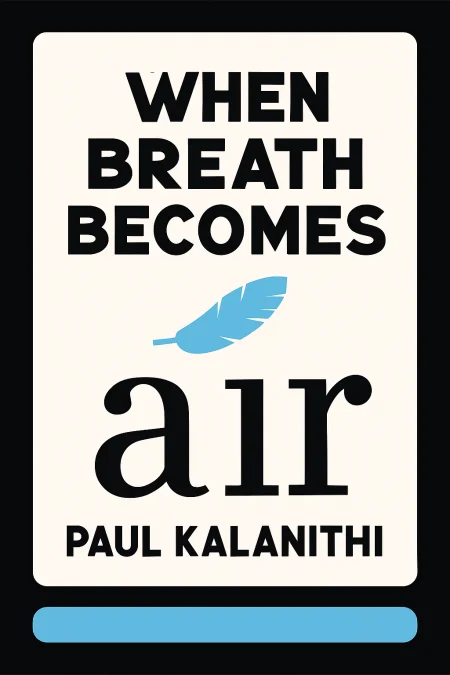
When Breath Becomes Air
Finding hope in the face of insurmountable odds
byPaul Kalanithi, Abraham Verghese
Book Edition Details
Summary
At the brink of an illustrious career, Paul Kalanithi's world was irrevocably altered by a devastating cancer diagnosis. As a neurosurgeon accustomed to navigating the delicate boundaries of life and death, he suddenly found himself on the opposite side of the stethoscope. "When Breath Becomes Air" captures Kalanithi's profound quest to uncover the essence of existence amid the relentless shadow of mortality. Through the lens of a medical professional turned patient, this memoir eloquently explores the intricate dance between holding on and letting go, between nurturing new life and facing the end of one's own. Kalanithi's poignant reflections on purpose, identity, and the human condition offer a heart-stirring testament to resilience and hope, leaving readers with the indelible question: What truly gives life meaning when time is slipping away?
Introduction
In the quiet hours before dawn, when hospital corridors echo with the soft footsteps of night staff, a young neurosurgeon faced the most challenging case of his career—his own mortality. Paul Kalanithi was thirty-six years old, at the pinnacle of his medical training, when a routine scan revealed the devastating truth: his lungs were riddled with cancer. In an instant, the man who had spent years guiding others through life's most profound transitions found himself crossing the threshold from doctor to patient, from the one who delivers difficult news to the one who receives it. What makes Kalanithi's story extraordinary is not merely the cruel irony of a healer becoming gravely ill, but the profound wisdom he extracted from this experience. A neurosurgeon by training and a philosopher by nature, he possessed a unique dual perspective that allowed him to examine mortality with both clinical precision and existential depth. His journey reveals the complex interplay between science and meaning, between the technical mastery required to save lives and the deeper questions about what makes life worth living. Through his story, readers encounter a meditation on purpose, the weight of medical responsibility, and the courage required to find meaning even in the face of certain death.
From Literature to Medicine: Seeking Life's Meaning
Paul Kalanithi's path to medicine began not in a laboratory or hospital, but in the desert landscapes of Arizona, surrounded by books that opened windows to profound questions about human existence. Growing up in Kingman, a small town his father had chosen for its promise and affordability, Paul was shaped by his mother's fierce determination that her children receive an education that would transcend their circumstances. When the family relocated from affluent Westchester County, his mother acquired a college preparatory reading list and methodically worked through it with her sons, ensuring they would not be intellectually diminished by their new environment. The transformation was remarkable. By age ten, Paul was reading Orwell's dystopian visions; by twelve, he was exploring the philosophical depths of Sartre and Camus. Literature became his lens for understanding the world, each book adding layers to his developing worldview. Hamlet accompanied him through adolescent crises, while romantic poetry inspired midnight adventures that had more to do with beauty than rebellion. These weren't merely academic exercises but profound encounters with fundamental questions about meaning, mortality, and human relationships. The desert setting, with its harsh beauty and ever-present reminders of life's fragility, provided the perfect backdrop for a young mind grappling with existence's biggest questions. At Stanford, this literary foundation expanded into a formal exploration of what makes human life meaningful. Paul pursued dual degrees in English literature and human biology, driven by a conviction that meaning emerged from the intersection of human relationships and moral values. He found in literature the richest account of mental life, while neuroscience offered elegant explanations for the brain's mechanisms. This wasn't intellectual dilettantism but a focused search for understanding how consciousness, mortality, and meaning interconnected. The question that would define his life was already taking shape: how does the physical machinery of the brain give rise to the profound experiences that make us human? The transition from literature to medicine represented not an abandonment of his philosophical interests but their practical application. After completing his master's degree in English literature, Paul realized that direct engagement with life-and-death questions was essential for generating substantial moral insights. Words, no matter how beautifully crafted, felt weightless compared to the immediate reality of human suffering. Medical school offered the opportunity to encounter meaning not through books but through direct service to others in their most vulnerable moments, where abstract questions about mortality became urgently real.
In Perfect Health I Begin: The Making of a Neurosurgeon
The journey through medical training revealed both the profound responsibility and the transformative power of medicine. Paul's first encounter with death came during his obstetrics rotation, where he witnessed both the miracle of birth and the tragedy of loss in a single shift. Delivering twins born at the edge of viability—twenty-three weeks and six days—he experienced the exhilarating possibility of saving lives followed by the crushing reality of their deaths within twenty-four hours. These early experiences taught him that medicine existed in the space between hope and despair, requiring practitioners to hold both possibilities simultaneously while maintaining their humanity. Neurosurgery called to Paul because it represented the most direct confrontation with questions of identity, meaning, and mortality. Every brain operation necessarily involved manipulating the substance of selfhood, and every conversation with patients undergoing neurological surgery confronted fundamental questions about what makes life worth living. Would you sacrifice your ability to speak for a few extra months of silent existence? How much neurological suffering is acceptable before death becomes preferable? These weren't abstract philosophical dilemmas but daily realities that required both technical excellence and profound moral sensitivity. The training itself was brutally demanding, requiring not just intellectual mastery but physical endurance and emotional resilience. Hundred-hour work weeks, complex operations lasting through the night, and the constant pressure to make decisions where millimeters meant the difference between recovery and catastrophe. Paul learned that technical excellence wasn't merely a professional goal but a moral requirement, as the consequences of imperfection could devastate not just patients but entire families. Every successful surgery brought euphoria; every complication or death demanded deep self-examination about the weight of responsibility he had chosen to bear. Through seven years of residency, Paul developed not just surgical skills but a philosophy of medical practice. He came to understand that the physician's role extended beyond technical intervention to encompass a kind of pastoral care, helping patients and families navigate the most difficult passages of human experience. The doctor's words could heal or wound, provide clarity or confusion, offer hope or despair. This recognition transformed his approach to patient care, making every interaction an opportunity to honor the full humanity of those who had placed their trust in his hands.
Cease Not Till Death: Facing Terminal Illness
The diagnosis arrived with the stark clarity of a CT scan: innumerable tumors scattered throughout his lungs, his spine deformed, his liver partially obliterated. In an instant, Paul Kalanithi transformed from neurosurgeon to patient, from the one who interpreted such images for others to the one whose life they now defined. The irony was not lost on him—after years of guiding patients through similar revelations, he found himself in uncharted territory, despite his medical knowledge. The abstract concept of mortality he had studied and confronted professionally became intensely personal, requiring him to navigate questions he had helped others face but never truly experienced himself. The physical reality of illness proved as challenging as the existential crisis it provoked. The man who had stood for hours in operating rooms, whose hands could perform delicate microsurgery, found himself exhausted by the simple act of getting out of bed. His identity, so closely tied to his physical capabilities and professional role, underwent radical revision. The future he had carefully constructed—an academic career balancing surgery and research, a family with Lucy, the realization of decades of preparation—evaporated, replaced by uncertainty measured not in decades but potentially in months or years. Treatment became a complex dance between hope and realism. The discovery of a targetable mutation in his cancer offered the possibility of extended survival through a simple daily pill rather than debilitating chemotherapy. This small piece of molecular fortune provided enough stability to allow Paul to contemplate returning to surgery, to reclaim some portion of his former identity. The decision to operate again represented both a practical choice and a philosophical statement: he would continue to live as himself, defined by his calling and capacity to serve others, rather than retreat into the role of passive patient awaiting death. Yet even as treatment provided respite, the fundamental questions remained unanswered. Without knowing whether he had months or years remaining, how should he spend his time? The uncertainty that had once seemed manageable in the abstract became paralyzing when applied to daily decisions about work, relationships, and planning for the future. Paul discovered that terminal illness was not life-clarifying but profoundly disorienting, destroying the normal frameworks for making decisions while demanding choices that would define whatever time remained.
Living with Mortality: Finding Purpose in Limited Time
The question of how to live with limited time led Paul to profound reflections on meaning and purpose that transcended his personal circumstances. Rather than retreat from the responsibilities that had defined his professional life, he chose to re-engage with neurosurgery, understanding that his identity as a healer remained central to who he was, regardless of his prognosis. This decision required not just physical courage but philosophical conviction: he would define himself by his capacity to serve others rather than by his illness, finding meaning in the striving itself rather than in guaranteed outcomes. The birth of his daughter Cady added new dimensions to these questions about time and meaning. Paul and Lucy's decision to have a child while facing his terminal diagnosis represented a profound act of hope—not hope for cure or extended survival, but hope that meaning could be created and shared even in the shadow of loss. Holding his newborn daughter, Paul experienced what he described as "a joy that does not hunger for more and more but rests, satisfied." In Cady's presence, the abstract questions about mortality gave way to immediate, tangible purpose: he could love, nurture, and provide for new life even as his own approached its end. Writing became Paul's way of wrestling with these profound questions and sharing his insights with others who would face similar challenges. He understood that his unique perspective—as both physician and patient, as someone trained to think about mortality professionally who now confronted it personally—gave him special insight into questions that ultimately confront all human beings. The act of writing allowed him to transform his experience from private suffering into public service, offering others the benefit of his hard-won wisdom about facing mortality with dignity and purpose. The final months revealed Paul's extraordinary capacity to find meaning even as his physical condition deteriorated. Despite increasing weakness, pain, and the knowledge that his time was running short, he continued to write, care for his family, and maintain connections with friends and colleagues. His approach to dying became an extension of his approach to living: thoughtful, purposeful, and oriented toward service to others. He understood that how one dies is as important as how one lives, and that facing mortality with courage and grace could itself be a gift to those who would follow the same path.
Summary
Paul Kalanithi's life demonstrates that meaning emerges not from the length of our days but from the depth of our engagement with the fundamental questions of human existence. His journey from literature student to neurosurgeon to cancer patient and finally to writer reveals how confronting mortality can clarify what truly matters: the relationships we build, the service we provide to others, and the courage with which we face uncertainty. His story suggests that rather than seeking to avoid or deny death, we find greater purpose by accepting mortality as the condition that gives urgency and meaning to our choices. From Kalanithi's experience, we can learn that identity need not be destroyed by illness or suffering but can be transformed and deepened through it. His decision to continue practicing neurosurgery while battling cancer, to have a child while facing terminal illness, and to write about mortality while dying all demonstrate that purpose can persist even in the most challenging circumstances. For anyone grappling with questions about meaning, purpose, or how to live with uncertainty, Kalanithi's journey offers a model of thoughtful engagement with life's deepest challenges and the possibility of finding profound purpose even in the face of loss.
Related Books
Download PDF & EPUB
To save this Black List summary for later, download the free PDF and EPUB. You can print it out, or read offline at your convenience.
By Paul Kalanithi
