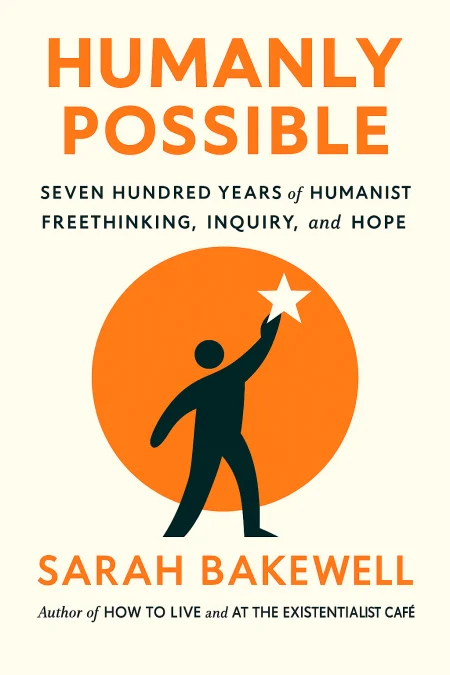
Humanly Possible
Seven Hundred Years of Humanist Freethinking, Inquiry, and Hope
Book Edition Details
Summary
In a world tangled in divisions, Sarah Bakewell's "Humanly Possible" offers a beacon of unity and understanding through the lens of humanism's rich tapestry. This enthralling narrative spans seven centuries, weaving together the lives and philosophies of writers, thinkers, and visionaries who dared to ponder what it means to be genuinely human. From the fervent intellectuals of the Renaissance to the daring freethinkers of modernity, Bakewell conjures a vivid panorama of humanity's perpetual quest for meaning. Her exploration delves into the core of humanism's enduring power—its celebration of shared humanity, ethical living, and cultural vitality, despite the persistent shadows cast by dogma and tyranny. This is not merely a historical account but a vibrant call to embrace our collective spirit and nurture a world where curiosity, compassion, and creativity reign supreme.
Introduction
The humanist tradition represents one of the most enduring yet misunderstood intellectual movements in Western civilization, spanning seven centuries of persistent inquiry into what it means to live a fully human life. This exploration challenges the common misconception that humanism emerged as a modern secular reaction against religion, revealing instead a complex philosophical tradition that has consistently placed human dignity, rational inquiry, and moral agency at the center of intellectual and ethical discourse. The tradition's power lies not in systematic doctrine but in its method of critical questioning and unwavering faith in human potential to shape understanding through reason and experience. The investigation employs biographical analysis and intellectual genealogy to demonstrate how humanist ideas evolved through personal struggles, institutional conflicts, and cultural transformations. From medieval manuscript hunters who bypassed ecclesiastical authority to Enlightenment philosophes who challenged political orthodoxy, each generation of humanist thinkers responded to the fundamental tension between received wisdom and independent inquiry. The evidence reveals how abstract principles gain meaning only through lived experience and practical application, showing that humanism's greatest contribution may be its capacity for self-correction and continuous expansion of moral concern. Readers will discover how humanist thinking has consistently broadened its circle of concern, gradually extending the promise of human dignity and intellectual freedom beyond its original boundaries to encompass previously excluded groups. The narrative demonstrates that understanding this tradition's evolution provides crucial insights for navigating contemporary challenges while maintaining commitment to the core insight that human flourishing remains the proper measure of social and political arrangements.
Historical Evolution: From Medieval Recovery to Renaissance Human Dignity
The humanist tradition begins with an extraordinary act of intellectual archaeology that fundamentally transformed the relationship between past and present. Medieval scholars like Petrarch and Boccaccio did not merely discover ancient texts but created a revolutionary approach to knowledge that bypassed ecclesiastical authority by establishing direct dialogue with classical authors. This recovery project operated simultaneously on multiple levels: philological precision in establishing accurate texts, rhetorical mastery in reviving eloquent expression, and moral philosophy in extracting wisdom for contemporary life. The method proved transformative because it challenged the medieval synthesis that had subordinated classical learning to Christian doctrine. Rather than treating ancient authors as mere preparation for revealed truth, humanist scholars engaged with figures like Cicero as equals in an ongoing conversation about human nature, political organization, and ethical choice. Petrarch's letters to Cicero exemplify this approach, treating the Roman orator not as a historical curiosity but as a living interlocutor whose insights remain relevant to contemporary dilemmas about virtue, ambition, and civic responsibility. This textual archaeology required new institutions and practices that operated independently of traditional academic hierarchies. The humanist circles that formed around figures like Coluccio Salutati and Poggio Bracciolini created networks of correspondence, manuscript exchange, and collaborative scholarship that developed their own standards of evidence and criteria for authenticity. These networks established intellectual authority based on expertise rather than institutional position, creating precedents for scholarly independence that would prove crucial for later democratic development. The printing revolution amplified these developments by making accurate texts widely available and creating new forms of scholarly community. Publishers like Aldus Manutius transformed humanist scholarship from an elite pursuit into a broader cultural movement, while editors like Erasmus demonstrated how textual criticism could serve both scholarly precision and religious reform. The result was an intellectual culture that valued critical inquiry over received wisdom and individual judgment over collective authority, establishing patterns of cultural renewal that became hallmarks of the humanist tradition.
Core Principles: Reason, Individual Worth, and Universal Human Rights
The philosophical architecture of humanism rests on interconnected principles that distinguish it from both religious orthodoxy and materialistic reductionism while providing a coherent framework for understanding human experience and moral obligation. Human dignity serves as the foundational concept, asserting that individuals possess inherent worth independent of their social status, religious beliefs, or utilitarian value to others. This dignity derives not from divine creation or natural hierarchy but from distinctive human capacities for reason, creativity, and moral choice that enable people to shape their own lives and contribute to collective flourishing. Rational inquiry emerges as the primary method for understanding both natural phenomena and human affairs, though humanistic reason differs significantly from narrow technical rationality. This approach emphasizes critical thinking, evidence-based judgment, and openness to revision while recognizing the legitimate roles of emotion, imagination, and cultural tradition in human experience. The humanistic commitment to reason manifests not as dogmatic scientism but as intellectual humility combined with confidence in human capacity to make meaningful progress in knowledge and wisdom through disciplined inquiry and open dialogue. The principle of human flourishing provides the ethical framework that connects individual development to social responsibility. This involves both negative freedoms from oppression, ignorance, and material deprivation, and positive freedoms for education, creative expression, and meaningful relationships. Humanistic ethics emphasizes the interconnectedness of individual and social well-being while respecting the diversity of ways people might choose to live fulfilling lives, creating space for cultural difference within commitment to universal human worth. These core principles generate a distinctive approach to education that emphasizes critical thinking, cultural literacy, and moral development rather than mere technical training or ideological indoctrination. The humanistic educational ideal seeks to cultivate autonomous individuals capable of thoughtful citizenship while preserving and transmitting the cultural achievements that make such autonomy possible. This educational vision assumes that engagement with the best expressions of human thought and creativity can develop both intellectual sophistication and ethical sensitivity necessary for democratic participation.
Modern Challenges: Totalitarianism, Technology, and Humanistic Resilience
The twentieth century subjected humanistic values to unprecedented stress through totalitarian movements that explicitly rejected individual dignity and rational discourse in favor of ideological conformity and violent coercion. The rise of fascism and communism forced humanistic thinkers to confront the possibility that their tradition's emphasis on education, tolerance, and gradual reform might prove inadequate against systematic assault on human freedom and dignity. Totalitarian regimes demonstrated how humanistic institutions could be captured and transformed into instruments of propaganda and control, revealing the fragility of cultural achievements that humanists had assumed were permanently secured. The destruction of books, persecution of intellectuals, and manipulation of educational systems during this period prompted deeper reflection on the social and political conditions necessary for humanistic values to flourish. Thinkers like Bertrand Russell and Thomas Mann recognized that defending humanistic principles required more than intellectual argument; it demanded practical organization and institutional protection. This recognition led to new forms of international cooperation, human rights advocacy, and cultural preservation that could operate across national boundaries while maintaining commitment to democratic values. Technological developments created additional challenges for humanistic thought, particularly in communication and warfare. Nuclear weapons raised questions about human survival that transcended traditional ethical frameworks, while mass media enabled unprecedented manipulation of public opinion. The development of artificial intelligence and genetic engineering has continued this trend, raising fundamental questions about human nature and agency that require new forms of humanistic reflection and response. The humanistic response to these challenges involved both theoretical innovation and practical adaptation. Contemporary humanists have developed new frameworks for understanding how democratic societies can protect themselves against authoritarian threats without abandoning their commitment to open debate and individual freedom. This work has required acknowledging the darker aspects of human nature while maintaining confidence in the possibility of moral progress through education and institutional reform, demonstrating the tradition's capacity for self-critical evolution while preserving its core commitments.
Contemporary Relevance: Global Citizenship and Practical Humanistic Values
Contemporary humanism faces the challenge of translating traditional insights about human dignity and rational inquiry into responses to global problems that transcend national boundaries and cultural traditions. Climate change, technological disruption, economic inequality, and cultural conflict require forms of cooperation and understanding that build upon humanistic values while extending them to unprecedented scales of organization and complexity. The renewal of humanistic thought involves recovering its core insights while adapting them to circumstances that earlier generations could not have imagined. The practical dimension of contemporary humanism appears in movements for human rights, educational reform, environmental protection, and democratic governance that draw upon humanistic traditions while addressing specifically modern challenges. These efforts require developing new forms of civic engagement that can operate across cultural boundaries while respecting legitimate differences in values and priorities. The goal is not cultural homogenization but rather creation of frameworks for cooperation that preserve space for diversity and disagreement while maintaining commitment to universal human dignity. Global citizenship emerges as a contemporary expression of humanistic values that extends traditional concern for local community to encompass responsibility for worldwide human welfare and environmental sustainability. This expanded vision requires both technical expertise and moral wisdom, combining scientific understanding with ethical reflection in ways that honor the complexity of human experience while addressing urgent collective challenges. Contemporary humanists argue that global problems cannot be solved through purely technical means but require the kind of thoughtful deliberation and moral imagination that the humanistic tradition has always promoted. The future of humanistic thought depends upon its ability to demonstrate continued relevance to pressing contemporary concerns while maintaining fidelity to its core commitments. This requires neither uncritical acceptance of traditional formulations nor wholesale abandonment of inherited wisdom, but rather the kind of thoughtful adaptation that has characterized the humanistic tradition throughout its history. The challenge is to show how attention to human dignity, rational inquiry, and ethical responsibility can contribute to addressing the complex problems facing contemporary global civilization while preserving the cultural achievements that make human flourishing possible.
Summary
The humanist tradition offers a distinctive approach to understanding human existence that emphasizes both the potential and responsibility that come with rational consciousness and moral agency. Through seven centuries of evolution from Renaissance literary studies through Enlightenment social reform to contemporary global engagement, this intellectual tradition has consistently demonstrated that meaningful progress in human understanding and cooperation requires neither dogmatic certainty nor relativistic skepticism, but rather sustained commitment to thoughtful inquiry, respectful dialogue, and practical wisdom that honors both human aspiration and human limitation. The tradition's enduring significance lies not in any particular set of beliefs but in its fundamental method of critical questioning combined with unwavering faith in human capacity to shape understanding through reason and experience, providing intellectual frameworks that remain essential for navigating contemporary challenges while maintaining hope for continued human flourishing in an interconnected world.
Related Books
Download PDF & EPUB
To save this Black List summary for later, download the free PDF and EPUB. You can print it out, or read offline at your convenience.
By Sarah Bakewell
