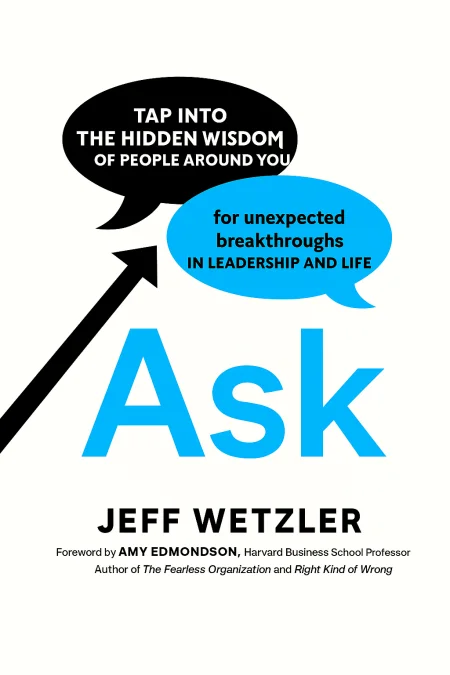
Ask
Tap Into the Hidden Wisdom of People Around You for Unexpected Breakthroughs in Leadership and Life
Book Edition Details
Summary
In the bustling corridors of modern enterprise, the true art of communication often gets lost. Jeff Wetzler, a pioneering force in adult development and co-founder of Transcend, challenges this norm with "Ask," a transformative guide that reshapes the way we seek and share insights. Navigating through his Five Practices, Wetzler empowers leaders, educators, and changemakers to unearth the unspoken truths within their teams. This book dismantles the barriers of conventional dialogue, offering a fresh lens to view the power of inquiry. More than just a manual, "Ask" is your compass to unlocking authentic connections and making informed decisions that propel success across corporate giants, intimate startups, and educational institutions alike. Here, the secret lies not in what you say, but in how you ask.
Introduction
Picture this: You're sitting across from your teenage daughter at dinner, asking how her day went. "Fine," she mumbles, barely looking up from her plate. But later that evening, as you're tucking her into bed, she suddenly opens up about the anxiety she's been feeling, the friendship drama that's been weighing on her heart, and dreams she's afraid to share. What made the difference? The right moment, the right approach, and most importantly, your genuine curiosity about her inner world. We live surrounded by treasure troves of wisdom—in our colleagues who see problems we miss, in our family members who understand us better than we think, in strangers whose experiences could transform our perspective. Yet most of us walk through life only scratching the surface of what others truly think, feel, and know. We make assumptions, fill in blanks with our own interpretations, and wonder why we feel disconnected or why our decisions sometimes go awry. The secret isn't mind-reading or manipulation—it's learning to ask the right questions in the right way. When we master this art, we don't just gather information; we build bridges, solve problems we didn't even know existed, and create relationships rich with authentic connection. This isn't about becoming a better interrogator; it's about becoming someone others trust with their truths, someone who can unlock the collective genius that surrounds us all.
The Hidden Gold Mine in Every Conversation
Sarah thought she was being a good manager. When her team member Marcus seemed disengaged during meetings, she assumed he was overwhelmed by the heavy workload everyone was carrying. She began checking in more frequently, asking if he needed help with his tasks, and even considered reassigning some of his projects to lighten his load. But Marcus continued to seem distant, his contributions minimal, his enthusiasm clearly waning. What Sarah didn't realize was that Marcus was harboring a completely different set of concerns. He wasn't overwhelmed by the work itself—he was frustrated because he felt his ideas weren't being heard or valued. He had suggestions for improving their processes, concerns about the direction of a key project, and insights from his previous experience that he believed could benefit the entire team. But every time he started to speak up in meetings, he sensed that the floor belonged to the more senior members. So he retreated into his shell, carrying a wealth of unspoken knowledge that could have transformed their approach. This scenario plays out in workplaces, homes, and communities everywhere. Chris Argyris, the renowned Harvard professor, discovered this phenomenon through his research on organizational communication. He asked people to document their conversations using a simple two-column format: on the right, what was actually said; on the left, what they were thinking and feeling but never expressed. The results were startling. In every interaction, there existed a "left-hand column" of unspoken thoughts, feelings, and observations that never made it into the actual conversation. The tragedy isn't just what we fail to learn—it's what we lose. When Marcus's insights remained trapped in his left-hand column, Sarah missed opportunities to improve their team's effectiveness. Marcus felt undervalued and disconnected. The entire organization lost access to his unique perspective and expertise. Multiply this across thousands of daily interactions, and we begin to see the staggering cost of unspoken wisdom. The very people closest to our challenges often hold the keys to our solutions, but we never think to ask for them, or we ask in ways that keep the door firmly closed.
From Barriers to Bridges: Creating Safe Spaces
Jamie McKee knew something most investors don't understand: the power of creating safety for difficult conversations. When she met with entrepreneurs seeking funding, instead of immediately diving into performance metrics, she would start with an unexpected declaration. "Before you tell me how things are going," she would say, "I want you to know that I assume things aren't progressing exactly as you predicted when you pitched me. If you had the power to predict the future perfectly, you wouldn't be in this business—you'd be picking lottery numbers. I expect twists and turns, and I want to hear about those." With these simple words, Jamie transformed the entire dynamic. Entrepreneurs who had walked into her office prepared to showcase only their victories suddenly felt permission to share their real challenges. They talked about market shifts they hadn't anticipated, team members who weren't working out, and strategic pivots they were considering. These honest conversations didn't make Jamie less likely to invest—they made her a better partner, able to provide relevant support and realistic timelines. The reason so many people hold back from sharing what they really think, feel, and know isn't maliciousness or lack of caring. It's fear—fear of being judged, fear of disappointing others, fear of making things awkward, or fear that their perspective isn't valued. Sometimes they simply lack the words to express complex emotions or half-formed ideas. Other times, they're too exhausted by the demands of daily life to invest the emotional energy that vulnerable sharing requires. Creating safety isn't about removing all risk—that's impossible. It's about demonstrating that the rewards of sharing outweigh the risks. This happens through small signals: the way we respond to initial tentative offerings, the questions we ask that show genuine interest, the vulnerability we model by sharing our own uncertainties. When people see that we can handle difficult truths without defensive reactions, that we value their perspective even when it differs from our own, and that sharing with us leads to better outcomes for everyone, the barriers begin to crumble. What emerges is something magical: authentic connection and collaborative problem-solving that neither person could have achieved alone.
The Art of Quality Questions and Deep Listening
When Isaac finally sat down with Anna, his board member, at a local restaurant, he thought he was simply seeking clarification about the lack of progress on fundraising. His startup needed investment to continue growing, and despite the board's commitment to help, months had passed with little action. Isaac expected to hear about busy schedules or challenging market conditions. Instead, Anna's first response stopped him cold: "Our sense is that the strategy may need some adjustment." Rather than getting defensive, Isaac chose curiosity. "Can you say more about what you mean by that?" he asked. Anna explained that while the board believed in his leadership and the company's mission, they had concerns about whether the product could truly stand out in an increasingly crowded market. As Isaac continued asking questions—about specific competitors, about market evidence, about what would need to change—a completely different picture emerged. The board wasn't being lazy or uncommitted. They were being strategic, withholding their support until they felt confident in the direction. The difference between Isaac's initial assumptions and this reality illustrates why the quality of our questions matters so much. Clumsy questions—those that can be answered with a simple yes or no, or that contain our assumptions baked right in—rarely yield useful insights. Attack questions, disguised as inquiry but really designed to prove a point, shut down honest sharing entirely. But quality questions, those that genuinely seek to understand another person's perspective, can unlock extraordinary wisdom. Quality questions work because they demonstrate something powerful: that we value what the other person knows, thinks, and feels. When Isaac asked Anna to explain her reasoning, he wasn't just gathering information—he was showing respect for her expertise and judgment. This respect created space for her to share not just her conclusions, but the thinking behind them. She talked about pattern recognition from previous investments, about market dynamics he hadn't fully considered, about the kind of evidence that would increase her confidence in his approach. But asking good questions is only half the equation. The other half is listening in a way that honors what people choose to share. This means listening not just for facts, but for emotions and intentions. It means pausing when someone seems to have more to say, rather than rushing to fill silence with our own thoughts. It means checking our understanding by reflecting back what we've heard, ensuring we haven't filtered their message through our own assumptions. When we listen with this kind of depth and attention, people feel truly heard—and they're far more likely to trust us with even more vulnerable truths in the future.
Building a Culture of Curious Leadership
At the pinnacle of her career as CEO of Mondelēz International, Irene Rosenfeld faced a seemingly simple problem that revealed something profound about organizational learning. A board member had purchased packages of Oreos only to find them crumbled into pieces. When Irene investigated, she discovered this wasn't an isolated incident—the problem was widespread, affecting customers across multiple markets. The truly shocking revelation, however, was that factory workers had likely noticed the issue months earlier but had never felt safe or empowered to speak up. This incident became a turning point for Irene's understanding of leadership. She realized that the traditional model of leaders having all the answers and employees simply executing instructions was not just outdated—it was dangerous. The people closest to the actual work, the ones who could spot problems early and suggest innovative solutions, were being systematically silenced by organizational cultures that prioritized hierarchy over wisdom. Irene began transforming her approach to leadership, and with it, the culture of her organization. Instead of presenting herself as the person with all the answers, she became the person with the most important questions. She started sharing her dilemmas publicly, asking for input from employees at all levels, and most importantly, demonstrating through her actions that speaking up led to positive change, not punishment. When she received difficult feedback, she thanked people for their courage in sharing it, explained what she planned to do with their insights, and followed up to show the impact of their contributions. This transformation from traditional authority-based leadership to curious, learning-oriented leadership created ripple effects throughout the organization. Employees began to see themselves not as order-takers but as problem-solvers and innovators. Teams started collaborating more effectively because they were focused on shared learning rather than individual self-protection. Decision-making improved because it incorporated diverse perspectives and real-world insights from multiple levels of the organization. The shift requires courage from leaders at every level. It means admitting what we don't know, asking for help publicly, and sometimes discovering that our initial instincts were wrong. But the payoff is extraordinary: organizations become more agile, more innovative, and more resilient. Problems get solved faster because they're identified earlier. Solutions are more effective because they're informed by the collective wisdom of everyone involved. And perhaps most importantly, people feel valued and engaged because their voices truly matter.
Summary
The journey from assumption to understanding, from isolation to connection, from limited perspective to collective wisdom begins with a simple shift in how we approach our daily interactions. Instead of rushing to conclusions or waiting for our turn to speak, we can choose to become genuinely curious about what others around us truly think, feel, and know. This transformation isn't just about gathering better information, though that's certainly a valuable outcome. It's about recognizing that every person we encounter carries within them experiences, insights, and wisdom that we lack. When we approach others with authentic curiosity, create safety for them to share vulnerably, ask questions that honor their perspective, and listen with our whole attention, we don't just learn facts—we build relationships that can weather any storm and solve any challenge. Perhaps most importantly, this approach to human connection offers hope in a world that often feels divided and disconnected. When we see each person as a teacher rather than an obstacle, when we approach disagreement as an opportunity to learn rather than a battle to win, we begin to repair the fabric of trust that holds communities, organizations, and families together. The wisdom we seek isn't locked away in distant experts or expensive consultants—it's all around us, waiting patiently in the hearts and minds of the people we already know. All we have to do is learn to ask, listen, and remain open to being surprised by what we discover.
Related Books
Download PDF & EPUB
To save this Black List summary for later, download the free PDF and EPUB. You can print it out, or read offline at your convenience.
By Jeff Wetzler
