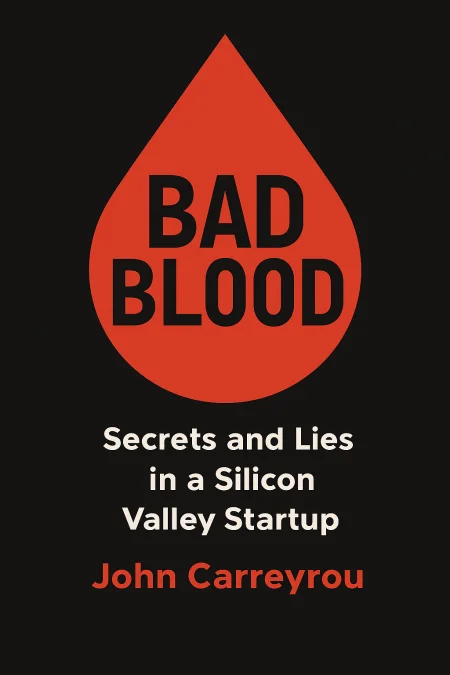
Bad Blood
Secrets and Lies in a Silicon Valley Startup
Book Edition Details
Summary
Silicon Valley's most electrifying saga unfolds within the corridors of Theranos, where ambition soared too high and reality lagged dangerously behind. Elizabeth Holmes, a Stanford dropout with a vision to revolutionize blood testing, swiftly became the toast of the tech world, drawing comparisons to Steve Jobs and amassing billions in investments. But beneath the glittering facade lay a house of cards, teetering on the brink of collapse. In "Bad Blood," Pulitzer Prize-winning journalist John Carreyrou delivers a gripping exposé of Holmes's empire, unraveling a tale of deception and hubris that captivated the world. As lawsuits loomed and Theranos crumbled, Carreyrou's relentless pursuit of truth illuminates the perilous dance between innovation and integrity.
Introduction
In the heart of Silicon Valley, where billion-dollar dreams collide with harsh realities, few stories capture the intoxicating power of charisma and the devastating consequences of unchecked ambition quite like that of Elizabeth Holmes. Once celebrated as the world's youngest female billionaire, Holmes embodied the Valley's most cherished mythology: a visionary Stanford dropout who promised to revolutionize healthcare through revolutionary blood-testing technology. Her company, Theranos, claimed it could run hundreds of medical tests from a single drop of blood, potentially transforming how diseases are detected and treated worldwide. Yet beneath her carefully crafted image of the ascetic genius—complete with black turtlenecks and mysteriously deep voice—lay one of the most elaborate corporate deceptions in modern history. Holmes's story reveals the dangerous intersection where Silicon Valley's "fake it till you make it" culture meets the life-and-death realities of medical testing. Her journey from celebrated innovator to convicted fraudster exposes how easily prestigious reputations, compelling narratives, and charismatic leadership can substitute for actual scientific evidence, even among the most sophisticated investors and advisors. Through Holmes's extraordinary rise and spectacular downfall, we witness the anatomy of deception on an unprecedented scale, the moral courage required to expose powerful fraudsters, and the ultimate reckoning that brought down one of Silicon Valley's most celebrated unicorns. Her tale serves as both a cautionary narrative about the perils of unchecked ambition and a testament to the critical importance of scientific integrity in industries where human lives hang in the balance.
The Making of a Silicon Valley Visionary
Elizabeth Anne Holmes was born into a world of privilege and towering expectations that would shape her relentless pursuit of greatness. Her family legacy carried both the weight of extraordinary achievement and the shadow of squandered potential—her great-great-grandfather had founded Cincinnati General Hospital, while other relatives had lost vast fortunes through poor decisions. These contrasting family narratives instilled in young Elizabeth both an obsession with success and a deep fear of mediocrity that would drive her throughout her life. From childhood, Holmes displayed an unusual combination of calculated ambition and magnetic charisma. When asked at age nine what she wanted to be when she grew up, she replied without hesitation: "I want to be a billionaire." This wasn't mere childhood fantasy but a glimpse into a mind already fixated on power, recognition, and historical significance. Her parents actively encouraged these grandiose aspirations, filling her with stories of family greatness while warning of the consequences of wasting one's potential. The young woman who arrived at Stanford in 2002 was already a master of reinvention, having transformed herself from an awkward teenager into a poised and purposeful student. Her choice to study chemical engineering wasn't driven by scientific passion but by strategic calculation—she recognized biotechnology as a pathway to both wealth and world-changing impact. Even her decision to attend Stanford was tactical, understanding it as the epicenter of entrepreneurial culture where dropping out to start a revolutionary company was seen as a badge of honor rather than academic failure. Holmes's encounter with chemical engineering professor Channing Robertson proved pivotal in her transformation from ambitious student to Silicon Valley founder. Robertson, a respected figure in academic and venture capital circles, became captivated by his young student's intensity and vision. When Holmes approached him with her idea for a wearable patch that could monitor blood chemistry and deliver medication, Robertson saw revolutionary potential where others might have seen impossibility. His endorsement provided the credibility that allowed Holmes to raise her first millions, despite having no medical training or relevant experience in the field she claimed to be revolutionizing.
Building Theranos: Promise and Deception
Holmes's transformation from Stanford dropout to Silicon Valley sensation required an extraordinary ability to make the impossible sound inevitable. When her original wearable patch concept proved scientifically unfeasible, she pivoted seamlessly to blood testing, claiming her miniaturized devices could perform hundreds of tests from a single drop of blood. This pivot revealed Holmes's most dangerous talent: her capacity to present fundamental failures as strategic evolutions while maintaining unwavering confidence in her ultimate vision. The early years of Theranos were characterized by a pattern that would define the company's entire existence—promising breakthrough technology that didn't work while using charisma and prestigious connections to maintain the illusion of progress. Holmes recruited legendary board members like former Secretary of State George Shultz and venture capitalist Don Lucas, understanding that their reputations would serve as powerful validators for her claims. She cultivated an image of the ascetic genius, working eighteen-hour days and sleeping four hours a night, while carefully controlling information flow to prevent anyone from seeing the full scope of the company's technical failures. Her relationship with Ramesh "Sunny" Balwani, nearly twenty years her senior and a veteran of the dot-com boom, provided both personal support and business credibility. Balwani's previous success selling a company for over $200 million during the internet bubble gave Theranos an aura of proven entrepreneurial expertise. Together, they created a culture of extreme secrecy and intimidation, compartmentalizing employees to prevent them from understanding the scope of the company's failures while using aggressive legal tactics to silence anyone who raised concerns about patient safety or scientific integrity. Holmes's genius lay not in scientific innovation but in understanding the psychology of Silicon Valley's ecosystem. She knew that investors wanted to believe in revolutionary technology, that prestigious advisors craved association with the next breakthrough, and that media loved stories of young visionaries challenging established industries. By masterfully managing these relationships and controlling the narrative around Theranos, she raised hundreds of millions of dollars and achieved a multi-billion-dollar valuation without ever producing technology that could deliver on her extraordinary promises.
The Unraveling: Whistleblowers and Investigation
The collision between Holmes's elaborate fiction and medical reality began when Theranos launched blood-testing services in Walgreens stores in 2013. Despite years of development and hundreds of millions in funding, the company's proprietary devices could perform only a handful of basic tests, producing results so unreliable they endangered patient safety. To maintain the illusion of comprehensive testing capabilities, Theranos secretly used traditional machines from other manufacturers, diluting tiny finger-stick samples in ways that compromised accuracy and violated regulatory standards. Inside Theranos laboratories, a culture of scientific misconduct flourished under impossible pressure to validate non-functional technology. Quality control failures were systematically ignored, proficiency testing was manipulated, and employees who raised concerns about patient welfare faced immediate termination and legal threats. The few scientists with integrity found themselves trapped between professional obligations and corporate intimidation, watching helplessly as patients received potentially dangerous test results based on fundamentally flawed processes. The beginning of Holmes's downfall came from an unexpected source: Tyler Shultz, grandson of board member George Shultz, who witnessed firsthand the gap between the company's public claims and internal reality. Despite enormous personal cost and family pressure, Shultz documented fraudulent practices and eventually contacted journalists, choosing ethical responsibility over loyalty to his grandfather and personal safety. His courage, along with other whistleblowers like Erika Cheung, provided crucial evidence for investigators seeking to expose the truth behind Theranos's carefully constructed facade. When Wall Street Journal reporter John Carreyrou began investigating Theranos in 2015, he encountered a sophisticated disinformation campaign orchestrated by Holmes and celebrity attorney David Boies. The company deployed every weapon in its arsenal—threatening lawsuits, attempting to discredit sources, and leveraging powerful connections—to prevent publication of the truth. Yet Carreyrou's methodical investigation revealed the systematic deception that had fooled investors, patients, and regulators for over a decade, triggering regulatory investigations and criminal charges that would ultimately destroy the company and send Holmes to prison.
Downfall: Legal Consequences and Legacy
The collapse of Theranos was as swift and dramatic as its rise had been meteoric. Within months of Carreyrou's initial exposé, Holmes faced federal charges for wire fraud and conspiracy, accused of deliberately misleading investors and endangering patients through her company's fraudulent blood-testing services. The Securities and Exchange Commission filed parallel civil charges, forcing Holmes to pay substantial penalties and accept a permanent ban from serving as an officer or director of public companies. Her transformation from Silicon Valley royalty to criminal defendant represented one of the most spectacular corporate collapses in American business history. The human cost of Holmes's deception extended far beyond financial losses to investors. Patients who relied on Theranos blood tests received inaccurate results that could have led to misdiagnosis, unnecessary medical procedures, or delayed treatment for serious conditions. The company was ultimately forced to void nearly one million test results, effectively admitting that none of its proprietary testing could be trusted. This massive invalidation of medical data represented an unprecedented breach of the fundamental trust between patients and healthcare providers. Holmes's legal strategy during her criminal trial revealed the same manipulative tactics she had employed throughout her career. She attempted to portray herself as a victim of Balwani's psychological and sexual abuse, claiming her romantic partner had controlled and manipulated her into committing fraud. While this defense strategy generated significant media attention, it ultimately failed to convince jurors, who found Holmes guilty on multiple counts of fraud. Her sentence of over eleven years in federal prison marked the definitive end of her reign as Silicon Valley's celebrated wunderkind. The broader implications of the Theranos scandal reverberated throughout Silicon Valley and the healthcare industry. The case exposed dangerous flaws in the venture capital ecosystem, where charismatic founders could raise enormous sums based on unverified claims and celebrity endorsements rather than scientific evidence. It highlighted the particular risks of applying traditional tech industry mantras like "move fast and break things" to healthcare, where the stakes involve human lives rather than user engagement metrics. The scandal prompted calls for greater regulatory oversight of medical testing and increased scrutiny of healthcare startups making extraordinary claims without peer-reviewed validation.
Summary
Elizabeth Holmes's extraordinary journey from celebrated visionary to convicted fraudster serves as perhaps the most important cautionary tale of Silicon Valley's modern era, revealing how charisma, ambition, and strategic deception can create the illusion of revolutionary innovation while endangering the very people such innovation claims to serve. Her ability to maintain a multi-billion-dollar fraud for over a decade exposed dangerous weaknesses in our systems of investment, regulation, and media scrutiny, particularly in industries where technical complexity can obscure fundamental failures and where the consequences of deception extend far beyond financial losses to matters of life and death. The courage demonstrated by whistleblowers like Tyler Shultz and Erika Cheung reminds us that integrity often requires enormous personal sacrifice and that speaking truth to power remains one of our most essential civic duties. Their willingness to risk careers, relationships, and legal retaliation to protect patients from harm proves that individual conscience can ultimately triumph over institutional pressure and corporate intimidation. For anyone working in industries that affect public welfare, their example provides both inspiration and a practical roadmap for ethical action when confronted with systematic wrongdoing that threatens innocent people.
Related Books
Download PDF & EPUB
To save this Black List summary for later, download the free PDF and EPUB. You can print it out, or read offline at your convenience.
By John Carreyrou
