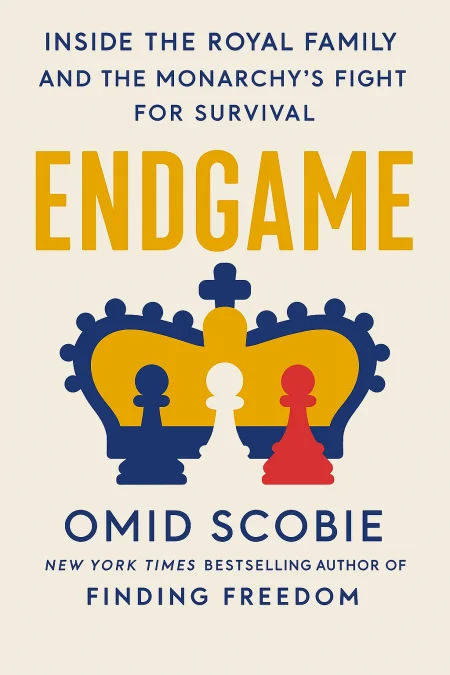
Endgame
Inside the Royal Family and the Monarchy's Fight for Survival
Book Edition Details
Summary
Omid Scobie, a revered voice in royal reportage, delivers a riveting exposé with "Endgame," peeling back the gilded layers of the British monarchy to reveal a family in disarray. Post-Elizabethan Britain faces an identity crisis as the crown's stoic façade crumbles, besieged by outdated traditions and internal power struggles. Scobie’s incisive narrative unveils an unpopular king, an ambitious heir, and a queen fiercely guarding her legacy, while a disillusioned prince forges a path anew, severed from royal ties. This gripping account doesn't just chronicle the monarchy's potential downfall; it poses a poignant question: can the age-old institution evolve, or is this the final chapter for the House of Windsor? A must-read for those fascinated by the royal family's turbulent dance with modernity.
Introduction
On a crisp September morning in 2022, as the last notes of a Highland lament echoed across the Scottish moors, Queen Elizabeth II's death at Balmoral Castle marked not merely the end of Britain's longest reign, but the beginning of a constitutional crisis that would expose the monarchy's deepest vulnerabilities. The carefully orchestrated transition to King Charles III, planned for decades, quickly unraveled into a series of missteps that revealed an institution struggling to maintain relevance in an age of democratic accountability and social justice. This extraordinary examination reveals how the world's most famous royal family became trapped between ancient traditions and modern expectations, leading to explosive family feuds, damaging racism allegations, and a media war that has stripped away centuries of carefully cultivated mystique. From the Sussex exodus that divided a nation to Prince Andrew's disgraceful fall from grace, from the Commonwealth's quiet rebellion to the rise of republican sentiment among younger generations, we witness an institution facing its greatest existential threat not from foreign enemies, but from the very people it claims to serve. For anyone seeking to understand how power operates in the twenty-first century, how institutional racism persists despite public commitments to diversity, or why hereditary privilege increasingly struggles to justify itself in democratic societies, this account offers unprecedented insight into the forces reshaping not just the British monarchy, but the nature of authority itself in our interconnected world.
Elizabeth's Death and Charles's Troubled Transition (2022)
The final act of the Elizabethan age unfolded with the quiet dignity that had defined seven decades of unwavering service. Queen Elizabeth II spent her last summer at beloved Balmoral Castle, insisting on fulfilling her constitutional duties even as her health declined. On September 6, 2022, just two days before her death, the 96-year-old monarch welcomed new Prime Minister Liz Truss with characteristic grace, completing her final official act with the same sense of duty that had guided her entire reign. When the end came on September 8 at 3:10 p.m., surrounded by family in the Scottish Highlands she cherished, it marked the close of an era of stability that had shielded the monarchy from its own contradictions. The ten days of mourning that followed showcased the institution at its most magnificent, with elaborate processions and a funeral watched by 4.1 billion people worldwide, temporarily masking the deep structural problems that would soon emerge. King Charles III's ascension began with promise but quickly devolved into embarrassing missteps that revealed his unfitness for the role he had spent decades preparing to assume. Within days, his infamous "pen incidents" went viral, showing the new monarch throwing tantrums over faulty writing instruments during solemn state occasions. These seemingly trivial moments exposed a deeper truth about Charles: his legendary irascibility and sense of entitlement were fundamentally incompatible with the dignified restraint expected of a sovereign. The contrast with his predecessor proved stark and damaging. Where Elizabeth had maintained an aura of mystery and constitutional neutrality, Charles brought decades of controversial opinions, questionable financial dealings, and a lifetime of poor judgment. His history of accepting cash donations from foreign dignitaries, his architectural interventions, and his messy personal relationships had already tarnished his reputation before he inherited the crown. Without Elizabeth's unifying presence, the monarchy's carefully constructed facade began to crumble, setting the stage for the crises that would define his troubled reign.
The Sussex Exodus and Media War (2020-2023)
The departure of Prince Harry and Meghan Markle from royal duties in January 2020 transformed from a private family matter into a global media phenomenon that exposed the monarchy's most toxic secrets. What began as the couple's desire for a "half in, half out" arrangement quickly escalated into a full-scale exodus that would reverberate through the institution for years, revealing the extent to which palace officials had weaponized the British press against their own family members. The Sussex crisis reached its explosive climax with the couple's March 2021 interview with Oprah Winfrey, where they detailed their experiences of institutional racism and deliberate neglect. Meghan's revelation about family discussions concerning their son Archie's skin color, combined with her account of being denied mental health support while contemplating suicide, painted a devastating picture of an institution more concerned with protecting its image than supporting its members. The palace's response, with its carefully crafted phrase "recollections may vary," demonstrated their continued mastery of deflection while avoiding any meaningful accountability. The media war that followed revealed both the monarchy's power and its limitations in the digital age. Traditional tactics of strategic leaks and coordinated counter-narratives, which had worked effectively in previous decades, seemed to backfire as global audiences increasingly sympathized with the Sussex narrative. Each revelation from Harry and Meghan, from their Netflix documentary series to Harry's explosive memoir "Spare," prompted fierce retaliation from palace-friendly outlets, creating a cycle of claim and counter-claim that dominated headlines and damaged the institution's credibility. The breakdown of the royal family's traditional "never complain, never explain" doctrine marked a fundamental shift in how the monarchy operated. Anonymous briefings and off-the-record conversations became weapons in an internal family war, with journalists serving as proxies in the battle for public sympathy. The institution that had once masterfully managed its image found itself unable to control the narrative, as the Sussex story evolved from a family drama into a broader indictment of royal culture and values, permanently altering the relationship between the monarchy and the media that had long protected it.
Scandals, Racism, and Institutional Crisis (2019-2023)
The allegations of institutional racism that emerged from the Sussex crisis exposed deeper structural problems that the monarchy had managed to keep hidden for decades. The revelation that unnamed family members had expressed concerns about Archie's skin color struck at the heart of the institution's claims to represent modern, multicultural Britain, gaining credibility from the royal family's well-documented history of racially insensitive behavior and exclusionary practices. Prince Andrew's association with convicted sex offender Jeffrey Epstein had festered as a public relations disaster since 2019, when his disastrous Newsnight interview made him an international laughingstock. His claims that he couldn't sweat and his vivid memory of being at Pizza Express became memes that undermined the entire institution's dignity. When Virginia Giuffre's civil lawsuit threatened to drag the monarchy through American courts, the family faced an impossible choice between public humiliation and private capitulation, ultimately stripping Andrew of his military titles while continuing to provide him with financial support. King Charles's own ethical lapses added another layer of controversy to an already damaged institution. Revelations about his acceptance of millions in cash donations, including money from the family of Osama bin Laden, raised serious questions about the monarchy's judgment and standards. The cash-for-honors scandal involving his trusted aide Michael Fawcett, combined with his history of architectural meddling and failed development projects, painted a picture of a king guided more by personal whims than constitutional duty. The cumulative effect of these scandals was a significant erosion in public trust, particularly among younger generations who increasingly viewed the monarchy as an expensive anachronism incompatible with democratic values. Opinion polls showed declining support for the institution, while organizations like Republic, once dismissed as fringe groups, began attracting mainstream attention and support. The royal family's attempts to modernize their image through charitable work and diversity initiatives seemed increasingly hollow against the backdrop of scandal and controversy, as the gap between their public promises and private behavior became impossible to ignore.
Commonwealth Collapse and Republican Rise (2021-Present)
The death of Queen Elizabeth II accelerated the dissolution of the Commonwealth realm with unprecedented speed, as nations that had maintained constitutional ties to the crown out of respect for the late queen began severing those connections under her successor. Barbados had already led the way by becoming a republic in November 2021, but the pace of change quickened dramatically after Charles's accession, with Jamaica, Australia, and New Zealand all beginning serious discussions about constitutional reform. The symbolic rejections proved as telling as the formal constitutional changes. Australia's decision to remove the monarch's image from its currency, New Zealand's quiet distancing from royal ceremonies, and Canada's increasingly perfunctory acknowledgment of royal authority reflected a broader shift in how former colonies viewed their relationship with Britain. These nations no longer saw themselves as grateful dominions, but as independent countries with their own identities and interests that no longer required validation from a distant crown. King Charles's attempts to maintain Commonwealth unity through personal diplomacy appeared increasingly futile against this tide of republican sentiment. His coronation in May 2023, while magnificent in its pageantry, was notable for the absence of many Commonwealth leaders and the lukewarm response it received across former British territories. The very qualities that had made his mother an effective Commonwealth leader—her careful neutrality, her historical connection to the imperial past, and her personal dignity—were precisely what Charles lacked as he struggled with domestic scandals and family feuds. Within Britain itself, republican sentiment reached levels not seen since the 1990s, with nearly a quarter of the population now favoring abolition of the monarchy. The generational divide proved particularly stark, as younger citizens increasingly questioned whether hereditary privilege had any place in a modern democracy. The monarchy's response—increased security at royal events and desperate attempts to demonstrate relevance through charitable work—seemed to acknowledge the growing threat to their survival while offering no clear path forward, suggesting an institution in terminal decline rather than one capable of meaningful reform.
Summary
The crisis engulfing the House of Windsor reflects a fundamental contradiction at the heart of modern monarchy: an ancient institution built on hereditary privilege struggling to maintain legitimacy in an age that increasingly values transparency, equality, and democratic accountability. The central tension runs between the monarchy's need for public support and its instinctive resistance to the openness and reform that contemporary society demands. The royal family's treatment of Meghan Markle, their handling of Prince Andrew's scandals, and their response to institutional racism allegations all demonstrate the same pattern: prioritizing short-term damage control over genuine reform, choosing image management over authentic change. This approach may have worked in an era of deference and limited media scrutiny, but it proves catastrophically inadequate in our interconnected world where authenticity matters more than tradition and where social media can instantly expose the gap between public promises and private behavior. The monarchy's decline offers crucial lessons for any institution struggling to adapt to modern expectations. First, organizations that refuse to acknowledge and address their own structural problems will inevitably face more devastating reckonings as society evolves around them. Second, the old strategies of media manipulation and selective transparency have become liabilities that can destroy credibility faster than they can protect it. Finally, the human cost of maintaining institutional power through personal sacrifice and family destruction ultimately undermines the very legitimacy that power seeks to preserve. Only through genuine accountability, meaningful diversity, and transparent governance can any institution hope to survive the twenty-first century with its dignity intact.
Related Books
Download PDF & EPUB
To save this Black List summary for later, download the free PDF and EPUB. You can print it out, or read offline at your convenience.
By Omid Scobie
