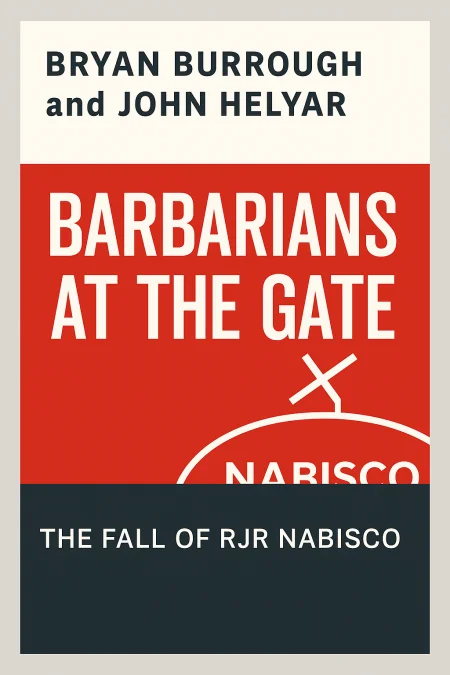
Barbarians at the Gate
The Fall of RJR Nabisco
Book Edition Details
Summary
Amid the high-stakes world of corporate power plays, "Barbarians at the Gate" unfolds as a riveting chronicle of one of the most audacious business maneuvers in American history. With the financial world watching, the ambitious leveraged buyout of RJR Nabisco in the 1980s turns into a dramatic saga of greed, ambition, and unrestrained excess. Penned with piercing insight by Bryan Burrough and John Helyar, this masterpiece of investigative journalism provides a window into the extravagant machinations and personalities that defined an era. As relevant today as it was at its inception, this story serves as a compelling cautionary tale, underlining the consequences of unchecked ambition. With its gripping narrative and profound implications, "Barbarians at the Gate" remains a definitive account of corporate America’s most tumultuous moments.
Introduction
In the autumn of 1988, a corporate drama unfolded that would forever change how America viewed business leadership and Wall Street finance. What began as one CEO's frustration with his company's stock price escalated into the largest corporate takeover battle in history, exposing a world where executives lived like royalty while ordinary shareholders watched their investments languish. This extraordinary tale reveals the inner workings of leveraged buyouts, where borrowed money became the weapon of choice for corporate raiders and investment bankers alike, transforming respected companies into vehicles for personal enrichment. The story illuminates three critical questions that remain urgently relevant today: How do corporate incentives shape executive behavior when left unchecked? What happens when financial engineering replaces genuine business building as the primary focus of corporate leadership? And can a system that rewards short-term thinking ever serve the long-term interests of employees, communities, and the broader economy? Through meticulous reporting and unprecedented access to the key players, this account demonstrates how the pursuit of the ultimate deal corrupted judgment, destroyed relationships, and ultimately exposed the moral bankruptcy lurking beneath Wall Street's glittering surface. This narrative serves as essential reading for anyone seeking to understand how modern corporate America operates, why executive compensation became disconnected from performance, and how the seeds of future financial crises were planted in boardrooms where ego trumped ethics and greed masqueraded as strategy. The lessons learned from this epic battle continue to resonate as we grapple with similar challenges in our current era of private equity dominance and activist investing.
Corporate Excess and Executive Privilege (1970s-1987)
The stage for history's greatest corporate battle was set not in Wall Street's gleaming towers, but in the executive suites where a culture of unprecedented corporate excess had taken root during the transformative decades of the 1970s and 1980s. This period witnessed the emergence of a new breed of corporate leader, epitomized by executives who viewed companies not as institutions to be stewarded but as vehicles for personal enrichment and lifestyle enhancement. The old Protestant work ethic and corporate loyalty were giving way to a more mercenary approach where executives owed allegiance only to their own advancement. Ross Johnson's ascent from a middle-class Canadian upbringing to the pinnacle of American corporate power embodied this transformation of business leadership. Unlike the company men of previous generations who built careers through patient stewardship, Johnson represented executives who were restless, deal-driven, and utterly unbound by tradition. His journey through a series of corporate coups at Standard Brands and Nabisco revealed a man who viewed business as an endless game where the only sin was standing still. Johnson's philosophy was simple: life was too short to fly commercial or eat ordinary food, and shareholders existed primarily to fund executive comfort. By the mid-1980s, RJR Nabisco had become a monument to managerial privilege, maintaining a fleet of corporate jets that rivaled small airlines, lavish apartments in major cities, and entertainment budgets that funded everything from golf tournaments to celebrity endorsements. The Atlanta headquarters resembled a corporate palace more than a business operation, complete with marble floors and dining rooms that served gourmet meals to executives who had grown accustomed to treating the company treasury as their personal account. This culture of excess was not merely about luxury; it represented a fundamental shift in how corporate leaders viewed their relationship with shareholders and their responsibilities to the companies they managed. The disconnect between executive priorities and business realities created the perfect conditions for what would follow. Rather than addressing fundamental business challenges or implementing operational improvements that might have boosted share prices for all investors, management teams focused on maintaining their luxurious lifestyles while competitive positions gradually eroded. This period established the precedent that corporate resources could be diverted to executive benefit with minimal oversight, setting the stage for even greater abuses of corporate power.
Wall Street's LBO Revolution and the Buyout Wars (1988)
The 1980s witnessed the emergence of a new financial aristocracy, epitomized by leveraged buyout pioneers who discovered they could control vast industrial empires with surprisingly little of their own money. Henry Kravis and George Roberts of Kohlberg Kravis Roberts perfected the art of using borrowed money to acquire established companies, strip away their inefficiencies, and sell them for enormous profits. Their success had made them legends on Wall Street and demonstrated how financial engineering had become more lucrative than actually building businesses. The LBO revolution represented a fundamental shift in how American capitalism operated, moving from providing capital for growth to restructuring existing assets. These financial specialists discovered that by loading companies with debt, they could force dramatic cost-cutting and efficiency improvements that generated spectacular returns for investors. The mathematics were compelling: a small equity investment leveraged with massive borrowings could yield returns of 200 to 1 within just a few years, as demonstrated by deals like Gibson Greetings that became Wall Street's equivalent of striking gold. When Ross Johnson announced his intention to take RJR Nabisco private in October 1988, he unleashed forces that quickly spiraled beyond anyone's control. What began as Johnson's attempt to solve his stock price problem became a feeding frenzy that attracted every major Wall Street firm and fundamentally altered the relationship between corporate management and shareholders. The battle revealed the true nature of 1980s corporate culture, where management teams negotiated unprecedented personal enrichment packages while company stock languished, exposing the disconnect between executive compensation and shareholder value. Kravis's response was swift and devastating. Within days of Johnson's proposal, he launched an unprecedented hostile tender offer, instantly transforming a management-friendly transaction into a full-scale corporate war. This move violated one of Wall Street's unwritten rules, as LBO firms typically worked with management rather than against them. The hostile bid unleashed a cascade of consequences that neither side had anticipated, forcing the comfortable assumptions about friendly deal-making to give way to raw financial combat. The stage was set for an even more dramatic confrontation that would test the limits of financial engineering and expose the personal ambitions driving Wall Street's deal-making machine.
The Twenty-Five Billion Dollar Auction Battle
As the bidding war intensified, the RJR Nabisco battle became a public spectacle that exposed the excesses of Wall Street culture and transformed a routine corporate transaction into a symbol of American greed. The disclosure of Johnson's management agreement, which could have netted him and his team nearly two billion dollars, triggered a firestorm of criticism that reached from corporate boardrooms to congressional hearing rooms. Suddenly, the fight for RJR Nabisco was front-page news, with executives cast as villains in a morality play about corporate excess and misplaced priorities. The auction evolved into a masterclass in financial brinkmanship, with multiple bidding groups pushing the price to unprecedented heights while maneuvering for tactical advantage. Each round of bidding brought new complications, unexpected alliances, and strategic maneuvers as participants discovered that winning at any cost had become their primary objective. The RJR Nabisco board found itself managing an auction that had spiraled completely out of control, struggling to maintain the appearance of fairness while managing competing interests and enormous egos. Behind the scenes, the bidding groups engaged in increasingly desperate attempts to gain advantage through political maneuvering, media manipulation, and strategic leaks designed to undermine competitors. The contest revealed how disconnected Wall Street had become from Main Street, operating in a rarefied world where billion-dollar transactions were routine and the human costs of corporate restructuring were merely footnotes in financial models. Investment bankers and lawyers continued to rack up enormous fees, seemingly oblivious to the public relations disaster unfolding around them. The climactic auction reached twenty-five billion dollars, with Kravis ultimately prevailing through superior financial engineering and more reliable funding sources rather than simply offering the highest price. His victory was built on a clearer vision for operating the company after the buyout and demonstrated that winning required more than just financial firepower. The aftermath sent shockwaves through corporate America that are still felt today, marking both the peak of the LBO boom and the beginning of a broader reckoning with the costs of financial excess. The transaction became a watershed moment that would influence corporate governance, executive compensation, and takeover regulation for decades to come.
Legacy of Financial Engineering Over Business Building
The RJR Nabisco saga marked both the climax and the beginning of the end for the 1980s takeover boom, revealing the fundamental flaws in prioritizing financial manipulation over genuine business building. The deal's ultimate failure to create lasting value exposed how the massive debt burdens required for such transactions forced short-term thinking and asset stripping that weakened companies' competitive positions. Rather than spurring innovation or efficiency, the leveraged buyout model when applied to mature businesses often resulted in the destruction of long-term value in pursuit of quick financial returns. The human toll of the transaction extended far beyond the boardroom, affecting communities like Winston-Salem that had built their identities around stable corporate citizenship. Thousands of employees lost their jobs as new owners moved quickly to reduce costs and service debt, while corporate cultures built over decades were dismantled in favor of financial optimization. The episode demonstrated that globalized capital recognized no loyalty to place or tradition, foreshadowing the growing inequality and social fragmentation that would characterize subsequent decades. Perhaps most significantly, the battle exposed the corruption of corporate governance that occurred when boards became captive to charismatic CEOs and financial incentives overwhelmed fiduciary responsibilities. The directors' failure to provide meaningful oversight while enjoying lavish perks illustrated how the system of checks and balances had broken down. Without genuine accountability, corporate power would inevitably be abused, regardless of the personal charm or apparent competence of individual leaders. The concentration of economic power in the hands of financial specialists fundamentally altered how business decisions were made, shifting focus from operational excellence to financial optimization. This transformation established patterns that continue to influence corporate behavior today, where quarterly earnings targets often take precedence over long-term strategic investments. The legacy of this period serves as a cautionary tale about what happens when the pursuit of short-term financial gains becomes disconnected from the underlying purpose of business enterprise: creating genuine value for customers, employees, and society.
Summary
The rise and fall of RJR Nabisco illuminates the central tension between financial capitalism and productive enterprise that continues to shape our economy today. The story reveals how the pursuit of short-term financial gains corrupted the fundamental purpose of business, transforming companies from engines of innovation and employment into vehicles for wealth extraction by financial intermediaries. The leveraged buyout boom represented the triumph of financial engineering over genuine value creation, demonstrating how sophisticated techniques could generate paper profits while destroying real economic capacity and undermining the social fabric of communities. The lessons remain urgently relevant as we grapple with similar challenges in our current era of private equity dominance and activist investing. First, corporate governance systems require constant vigilance and reform to prevent the capture of boards by self-interested management and financial sponsors who prioritize personal enrichment over long-term value creation. Second, we need financial regulations that distinguish between productive investment and speculative manipulation, ensuring that capital markets serve their fundamental purpose of allocating resources efficiently rather than simply generating fees for intermediaries. Finally, we must remember that businesses exist within communities and have obligations beyond maximizing short-term returns, requiring a broader stakeholder perspective that balances profit with social responsibility and sustainable growth. The ultimate tragedy of the RJR Nabisco battle was not just the destruction of shareholder value or the elimination of jobs, but the demonstration that American capitalism had lost its moral compass. The episode showed how easily the pursuit of wealth could corrupt institutions, relationships, and entire industries when left unchecked by meaningful oversight or ethical constraints. Understanding these dynamics remains essential for anyone seeking to restore integrity to corporate leadership and ensure that the financial system serves society's broader interests rather than merely enriching those positioned to manipulate it.
Related Books
Download PDF & EPUB
To save this Black List summary for later, download the free PDF and EPUB. You can print it out, or read offline at your convenience.
By Bryan Burrough
