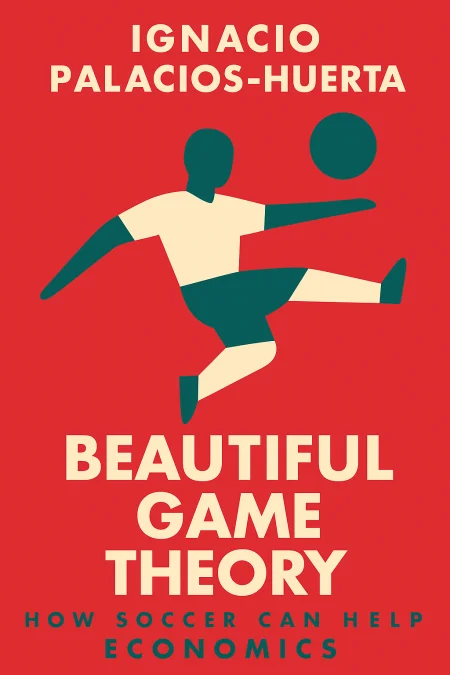
Beautiful Game Theory
How Soccer Can Help Economics
Book Edition Details
Summary
Soccer isn't just a game; it's a lens through which the secrets of economics are unveiled. In "Beautiful Game Theory," Ignacio Palacios-Huerta transforms the world's beloved sport into a playground of economic exploration. By diving deep into the rhythm of penalty shootouts and the whistle-blowing precision of referees, this book reveals the hidden strategies and human behaviors that shape not only the pitch but our understanding of economics. With clever insights into game theory and microeconomics, Palacios-Huerta invites students, researchers, and soccer aficionados alike to witness how the dynamics of the sport reflect broader economic truths. Here, soccer meets science, offering a fresh playbook on the intersection of sports and the economy, bound to leave you both entertained and enlightened.
Introduction
How can we test economic theories in environments where real stakes matter and genuine strategic thinking occurs? While economists have long relied on laboratory experiments and statistical models, these approaches often fail to capture the intensity and authenticity of actual decision-making under pressure. The world's most popular sport emerges as an unexpected solution to this methodological challenge, providing a natural laboratory where strategic interactions unfold with observable precision and meaningful consequences. Professional soccer offers economists what they have always sought: a controlled environment where game theory, market efficiency, and behavioral economics can be tested with real participants facing genuine incentives. The penalty kick becomes a perfect test of minimax theory, referee decisions reveal how social pressure influences judgment, and betting markets demonstrate information processing in real-time. Rather than applying economic principles to understand sports, this approach reverses the relationship, using athletic competition to validate fundamental theories about human behavior. The insights generated extend far beyond the pitch, illuminating how people make strategic choices in high-pressure situations, how markets process information, and how incentive systems can produce unintended consequences across all domains of human activity.
Testing Minimax Theory Through Penalty Kicks
The minimax theorem represents one of game theory's most fundamental insights, proposing that in zero-sum competitive situations, optimal strategy involves randomizing choices according to specific mathematical proportions. This elegant solution to strategic conflict suggests that when facing an opponent, predictability becomes a liability, while carefully calibrated randomization creates equilibrium where neither player can gain advantage through pattern recognition or strategic adjustment. The theorem's mathematical beauty lies in its precision: each player should mix their strategies in exact proportions that render their opponent indifferent between available choices. In penalty kicks, this translates to specific probabilities for shooting left, right, or center, with corresponding optimal responses from goalkeepers. The theory predicts that successful randomization will produce equal payoffs across all strategies, making each choice equally effective against optimally playing opponents. Professional soccer provides unprecedented empirical validation for these theoretical predictions. Analysis of thousands of penalty kicks from elite European leagues reveals remarkable convergence between mathematical theory and athletic intuition. Players achieve nearly identical success rates across different shooting directions, while their choice sequences exhibit the random patterns that theory demands. Goalkeepers similarly distribute their diving decisions in proportions that closely approximate theoretical optima, suggesting that competitive pressure naturally drives participants toward equilibrium strategies. The practical implications extend beyond academic validation to real-world strategic advice. Teams that deviate from optimal mixing strategies, as occurred in several high-profile tournament finals, suffer measurable disadvantages that can determine championship outcomes. This convergence between theory and practice demonstrates that human beings, when operating within their domains of expertise under genuine competitive pressure, can achieve sophisticated strategic thinking that laboratory subjects consistently fail to replicate.
Market Efficiency and Information Processing in Betting
Market efficiency theory posits that prices instantly reflect all available information, making systematic profit impossible except through superior information or pure chance. This cornerstone of modern finance faces constant empirical challenges, as researchers struggle to identify settings where information arrival can be precisely measured and market responses accurately tracked without confounding variables. Soccer betting markets offer an ideal testing ground for efficiency theory because they possess unique characteristics that eliminate common research problems. Information arrives in discrete, observable events with clear timestamps and unambiguous impact on outcomes. Goals, red cards, and injuries represent clean information shocks that allow researchers to measure exactly when news becomes public and how quickly markets adjust prices accordingly. The halftime interval provides a particularly elegant natural experiment for testing market efficiency. During this fifteen-minute break, trading continues while no new game information can possibly arrive, creating a rare situation where efficient markets should exhibit price stability. Any goal scored just before halftime should be fully incorporated into betting odds immediately, leaving no basis for further price movements during the information-free interval. Empirical analysis of thousands of matches confirms that betting exchanges achieve remarkable efficiency during these halftime periods. Prices remain stable when no new information can arrive, while they adjust rapidly and accurately when observable events occur during play. This finding provides robust evidence for market efficiency theory in a setting free from the ambiguities that plague traditional financial market studies, demonstrating that competitive markets can process information with impressive speed and precision when conditions allow clear measurement of their performance.
Incentive Design and Unintended Behavioral Consequences
Incentive theory examines how rewards and punishments shape behavior, traditionally predicting that stronger incentives motivate greater effort and improved performance. However, this seemingly straightforward relationship becomes complex when participants can choose between productive activities that create value and destructive activities that merely redistribute it from competitors. The structure of incentive systems determines not only effort levels but also the direction of that effort. When rewards depend on relative rather than absolute performance, participants face strategic choices between improving their own outcomes and sabotaging competitors. This multi-task problem becomes particularly acute when destructive activities are easier to execute, harder to detect, or more immediately effective than productive alternatives. FIFA's decision to increase winning rewards from two to three points while maintaining draw values at one point provides a natural experiment in incentive modification. The change intended to encourage more attacking play and higher-scoring games by strengthening the motivation to win rather than settle for draws. The policy appeared theoretically sound, creating stronger incentives for the desired behavior without directly punishing defensive strategies. The actual behavioral response revealed the complexity of competitive incentive systems. Teams did increase offensive activities such as shots and attacking plays by approximately ten percent, consistent with the policy's intentions. However, they simultaneously increased defensive sabotage activities, including tactical fouls and time-wasting behavior, by even larger margins. This dual response reflected the strategic reality that preventing opponents from scoring becomes more valuable when winning carries greater rewards. The net effect contradicted FIFA's objectives entirely. Despite increased offensive effort, goal scoring remained unchanged as defensive countermeasures neutralized attacking improvements. Match quality arguably declined as increased fouling and disruption made games less entertaining for spectators. This outcome illustrates a fundamental principle of incentive design: when agents can pursue both productive and destructive activities, stronger incentives may encourage more of both, potentially leaving overall performance unchanged while degrading other valued outcomes.
Summary
The intersection of economic theory and athletic competition demonstrates that human behavior under genuine competitive pressure follows predictable patterns that validate fundamental principles of strategic thinking, market dynamics, and incentive design. Through rigorous analysis of penalty kicks, betting markets, and policy changes, soccer provides empirical evidence for theoretical frameworks that have long remained untested in natural settings, revealing that competitive environments naturally drive participants toward sophisticated strategic behavior while also exposing the unintended consequences that can emerge from well-intentioned institutional changes. This research establishes sports as a powerful laboratory for understanding economic forces that extend far beyond athletics into finance, organizational behavior, and the fundamental nature of human competition itself.
Related Books
Download PDF & EPUB
To save this Black List summary for later, download the free PDF and EPUB. You can print it out, or read offline at your convenience.
By Ignacio Palacios-Huerta
